Showing posts with label Chapter 22 - "Just Work Work Work". Show all posts

Thursday, October 2, 2014

Chapter 22 - "Just Work, Work, Work": Part 5 - Monkeying with the Octopuses

Korzybski: A Biography (Free Online Edition)
Copyright © 2014 (2011) by Bruce I. Kodish 
All rights reserved. Copyright material may be quoted verbatim without need for permission from or payment to the copyright holder, provided that attribution is clearly given and that the material quoted is reasonably brief in extent.

At the end of October, Alfred and Mira found themselves in a rush of packing and last minute planning for their trip to Southern California. They also busied themselves saying goodbye to friends. President Barrow of the University of California gave a party in their honor, one last time for them to see many of the people they had met at Berkeley. Finally, in the first week of November 1921, trunks and suitcases in tow, they took the train to Los Angeles. 

Alfred and Mira felt exhausted when they arrived. Anticipating some time to rest, they were instead subjected to phone calls, newspaper interviews, and gatherings in their honor. But they put up with the attention. Of course, the newspaper stories could lead to confusion. Many of the stories misconstued Alfred’s claim “Man is not an animal”, implying that he opposed Darwin’s theory of evolution. The headline of one story about him in the Friday, November 4 issue of the L.A. Examiner read “Darwin Downed! Count In L. A. Denies Man Is Animal[.] World Famed Polish Nobleman and Philosopher Tells of Discoveries”.(19) He certainly had no wish to down Darwin.
AKDA 3.47
"Man Time-Binder, Says Count, Declares He Unites Past, Future, in Now",
Los Angeles Express, Sat., Nov. 5, 1921
The couple settled into the Ambassador Hotel in Los Angeles where Mira would stay on for awhile after Alfred went south. Alfred was not expected by Ritter until the following week so they had some time to do at least a little sightseeing which included visiting the Goldwyn Picture Studios in Culver City, where they met writer/director Rupert Hughes, watched a movie being made, and got their picture in the paper once again. Alfred planned to visit with Ritter in La Jolla, and perhaps get some speaking engagements around San Diego, sell some books, and get some work done on his next book. Meanwhile Mira explored opportunities to paint in Los Angeles and Pasadena while also doing what she could to promote Alfred’s work. What they thought would involve a few weeks before heading east would turn into several months. People praised Alfred’s book and went to exhibitions of Mira’s paintings, but paying engagements—at least for any significant amount of money—were few and far between. They would not leave Southern California until April of the following year, 1922.

On November 11, Alfred took a train from Los Angeles to the Delmar station where Ritter had arranged to meet him.(20) Soon, Alfred had settled himself and his bags into beachfront Cabin #3 at the Scripps Institute of Biological Research in La Jolla. Alfred’s three-room, furnished cottage with a kitchen, bathroom, and bedroom cost him 12 dollars a month, plus a few dollars for gas and electricity. With a bus stop near the Institute, which stood on a bluff above the beach, he could get to San Diego when he wanted. One could find worse places to spend the winter.
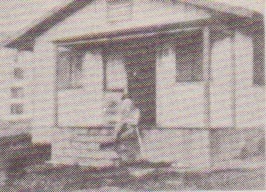
At La Jolla, California, The Scripps Biological Research Station,
on steps of cottage where Korzybski spent winter of 1921-1922

But to begin with he was not in the best of moods. For one thing, he had arrived at La Jolla with a bad cold.(21) The parties, the packing, the rush, the newspaper interviews, etc., over the last few weeks had left him feeling tired and bothered. For all the attention he received, he didn’t like being trotted out like a zoo specimen for exhibition. He disliked the exaggerations by journalists in their headlines and articles (“world’s greatest philosopher”, “war hero”, etc.).

He also felt pressed by worries. Mira had spent most of her adult life with no fixed home. One of her friends in Los Angeles once referred to her as a “beloved vagabond”. But Alfred—who had lived as a vagabond since the start of the war seven years earlier—yearned to be settled at home in Poland. Money concerned him. The question of how he and Mira were going to make ends meet once they left for Poland formed a constant nagging concern, especially since they were even having trouble making ends meet in the United States.(22) 

And his efforts to write his next book—about how time-binding worked—had opened up new problems. He felt pressed to make sense of his endless reading. He struggled with his writing. How did the foundations of mathematics, relativity theory, and now Ritter’s biology, among other things, all connect to each other in terms of the mechanism of time-binding? What was their practical import for living life? He could see the outline of something important ahead but it was still shrouded in a great deal of fog. As he wrote to his friend Robert Wolf, “There is a lot of troubles with ideas if we want them to be correct.”(23) He was glad to finally have some time to be alone and think. He hoped his meetings with Ritter and others at Scripps would give him the opportunity to gain some added clarity.

Alfred set up his work table so he could look out to the Pacific from a window. He loved the “music of the ocean”, and watching the “endless waves” helped him forget his troubles. He looked forward to a good storm.(24) He had brought with him a number of books on mathematical logic and relativity to study.

For recreation, he swam in the ocean. As he had first learned to swim in the cold water of the drainage pond of his family’s farm in Poland, the chilly Pacific waters did not dissuade him. As he later recalled:
I enjoyed in the meantime the Pacific and I bathed there and I don’t know, monkeyed with the octopuses,…and I don’t know what not...(25)  
We had a colony of seals and we were good friends and so I liked to swim with them. They didn’t approve my company, but I didn’t care. I did my swimming. I had to deal with all those squids, rays,… I had to be very careful not to put my foot in an abalone because they would bite my foot off...So, I swam a lot there alone, means without supervision, and I went quite far in the Pacific, but I returned somehow successfully. (26) 

He would also see more than one good storm. At the end of December, when he had been at La Jolla for more than a month, he wrote good-humoredly to Keyser that:
We had what they call here “golden rain.” I was impressed as a “diamond” rain at least. We had ghastly storms for several days, and terrible muds, of course bridges have gone mails have stopped etcetc. A large piece of the shore where my cabin stands has gone several more of such storms and my cabin will go. Than I will write to you from “somewhere in the Pacific” buy buy [bye bye] in the meantime, still in America (27) 

Getting carried away in a storm could not be entirely dismissed. The cabin was certainly small enough. Once, when Mira was staying with him there, it stormed while they were sleeping. The window near the bed kept blowing open. Alfred didn’t want to get out of bed any more than he already had to; he held the window closed with one foot, sticking out from under the covers.(28)

Notes 
You may download a pdf of all of the book's reference notes (including a note on primary source material and abbreviations used) from the link labeled Notes on the Contents page. The pdf of the Bibliography, linked on the Contents page contains full information on referenced books and articles. 
19. “Darwin Downed! Count In LA Denies Man Is Animal[.] World Famed Polish Nobleman and Philosopher Tells of Discoveries”. L.A. Examiner, Friday, November 4, 1921. AKDA 3.46. 

20. Telegram, W. E. Ritter to AK, 11/9/1921. AKDA 11.747. 

21. AK to Luella Twining, 11/12/1921. AKDA 11.702. 

22. AK to Amy Edgerly Rush and Minnie Edgerly Russell, 12/22/1921. AKDA 11.581. 

23. AK to Robert Wolf, 11/12/1921. AKDA 11.710.

24. AK to Cora Williams, 11/12/1921. AKDA 11.711. 

25. Korzybski 1947, p. 224. 

26. Ibid., p. 423. 

27. AK to C. J. Keyser, 12/22/1921. AKDA 11.595. 

28. Korzybski 1947, p. 224.


< Part 4 

Wednesday, October 1, 2014

Chapter 22 - "Just Work, Work, Work": Part 4 - Sweet, Sweet Delights of Human Relations

Korzybski: A Biography (Free Online Edition)
Copyright © 2014 (2011) by Bruce I. Kodish 
All rights reserved. Copyright material may be quoted verbatim without need for permission from or payment to the copyright holder, provided that attribution is clearly given and that the material quoted is reasonably brief in extent.

As the summer progressed, Mira was finishing up whatever work she had found in Santa Barbara.They planned for her to rejoin Alfred at the start of September. Then they would head to southern California where they might find better painting opportunities for her. From there they planned to make their way back across the country, visiting Mira’s sister in Kansas City, and earning what money they could with a few painting commissions for her and lectures for Alfred before going on to New York City, and then to Europe. In the meantime Alfred was working on publicity for Manhood, working on his new book project, and making friends—and a few enemies.

Soon after they came to San Francisco in May, Alfred had met biologist Calvin B. Bridges, a brilliant young colleague of geneticist Thomas Hunt Morgan in their pioneering experimental work exploring the mechanism of heredity in the fruit fly Drosophila melanogaster. Bridges had studied and worked with Morgan for a number of years in Columbia University’s famed “fly room” where he had already made a number of major discoveries of his own, and co-authored several books and papers with Morgan. He was known as one of the brightest and most productive men in Morgan’s lab. Indeed Morgan recognized this, later sharing the prize money of his 1933 Nobel Prize in Medicine with Bridges and Bridges’ lab colleague, A. H. Sturtevant. Bridges—considered a major figure in the history of genetics—might have gone on himself to win the Nobel Prize but unfortunately died suddenly from a heart infection in 1938 before the age of 50.

Both Bridges and Morgan were finishing extended working visits in the Bay Area when Alfred arrived there. Bridges, in Berkeley with his family, was planning to soon return to New York. Alfred bowled him over. After only a short time, Bridges had read a draft of Manhood (about a month prior to the publication of the book), and became an immediate fan of Korzybski’s work. The two men would remain good friends until Bridges’ death.
Calvin Blackman Bridges (1927)

Korzybski met Morgan around the time he met Bridges. Unlike Bridges, Morgan seems to have taken an immediate dislike to Alfred. After Manhood was published, Alfred learned from Bridges that Morgan often saw the book on Bridges’ desk and seemed compelled to have a “daily kick at it, moral as well as Physical, he had to take it in his hands, curse it and throw it on the table”.(9) Wishing to avoid a confrontation with Morgan, Alfred avoided him when visiting Bridges at the biology lab where they were working. But one day, he found himself face-to-face with Morgan, who made some snide remarks about the people who had provided supportive comments for the cover of the book. With what he described as cold politeness, Korzybski told Morgan, “[S]ome of those people THINK occasionally…if the study even of flies involves SOME thinking, therefore even a fly master should be interested in CORRECT thinking.”(10) It’s unlikely Alfred could have said anything to improve Morgan’s estimation of him or his work. This statement certainly didn’t.

Bridges was preparing to return to New York with his family. Before he left, Alfred consulted with him on a pressing concern. Alfred and Mira badly wanted to make a baby and hadn’t succeeded. Although both were in their 40s (with Mira almost 50) Alfred’s sperm had ‘passed’ whatever fertility test was done at the time. Mira was apparently fertile, as she was still having a period. Doctors examining her had said her cervix was narrowed and that this anatomical variation might make it more difficult for her to conceive. Bridges, a professional biologist and a ‘progressive’ in politics, had more than a passing interest in the birth control movement, eugenics, woman’s rights, etc. and had apparently already done some practical consulting work on this kind of problem. When he got back to New York, he promised to make up a kit for Alfred and Mira involving a suction tube they could use for inserting Alfred’s semen deeper into her womb after intercourse, thus increasing the probability of conception.

Before he left, Bridges also introduced Alfred to Cora Lenore Williams, an educator in Berkeley who would become a friend to both Alfred and Mira and a booster of his work. Miss Williams operated the Williams Institute of Creative Education, a private school located at the landmark Spring Mansion in the Berkeley hills.(11) Miss Williams’ school, influenced by the progressive education movement of John Dewey and others, has been described as “a tony elementary and secondary school known for its focus on languages, poetry, music, and literature.”(12) Miss Williams, who had studied and taught mathematics at the University of California, Berkeley, wanted her students to be exposed to mathematics and the sciences as well. She soon became a fan of Korzybski’s work. (He gave her a copy of Manhood after he met her.) Miss Williams invited Alfred to speak at her school soon after they met in August. He did so and then returned several times by himself and with Mira. Inspired by Manhood, Miss Williams thought time-binding could be made to form the basis for a new educational philosophy and over the next year wrote several reviews and articles on the subject. Alfred felt grateful for her “push”. He kept contact with her for many years. (The Williams Institute later became a junior college, and Alfred gave a number of presentations there, including seminars, after Science and Sanity was published.)
From Alfred Korzybski Scrapbook,
AKDA 2.705

At the beginning of September 1921, Mira returned. Alfred had already moved out of his room at Luella Twining’s and rented another apartment in San Francisco. Delighted to be together again, Alfred and Mira probably took as many opportunities as they could to use the kit Bridges had sent them. Mira had gotten a lucrative portrait commission painting members of the Spreckel family, San Francisco-area multi-millionaires known as the “sugar kings”. Her work would keep them in the city for another month or so. As soon as she was done they would leave for Southern California.

In August, Alfred had met the zoologist William Emerson Ritter, who had founded the Scripps Institute for Biological Research (later to become the Scripps Institution for Oceanography) in La Jolla, just north of San Diego. Korzybski had given Ritter, who was visiting Berkeley, a copy of Manhood. Ritter, much interested in the theoretical framework and philosophy of biology, became fascinated with the implications of time-binding and invited Alfred to come down to La Jolla for some personal discussions and conferences at the Scripps Institute.

This seemed fine to Alfred. For the time being, he had decided to stop writing. As he had written to Luella Twining previously, he still felt “[t]he world needs a complete scientific REVOLUTION, to bring science to sanity again.”(13) But the issues involved with connecting relativity, mathematical logic, etc., with the foundations of human engineering had begun to appear more complex than he had previously imagined. In relation to what he wanted to do, his understanding was not ripe. He decided for the present to do more reading, note-taking, and cogitating. Ritter, who had written a two-volume work on “The Unity of the Organism” and was writing a book on the natural history of human intelligence, seemed to have some parallel interests. Alfred was sure he could learn some things from Ritter relevant to his own research. The two men began a serious correspondence of multi-paged, theoretically-laced letters. (For Korzybski, who liked to work out his ideas in letters, this was not unusual.) Alfred was eager to get down to La Jolla for face-to-face time with the zoologist. He and Mira hoped she would be able to find some good commissions once they got to Southern California. And some speaking engagements, and other opportunities involving some income, might also arise for him.

In the meantime, in September the first public controversy concerning Korzybski’s work occurred. He described the gist of it in his 1947 memoir:
There was a curious thing which happened in Berkeley. It was an ex-engineer, Mr. Smyth. Oh, he wrote whole pages in a Berkeley paper attacking my work from the point of view that everything I had to say in my Manhood, was taken, stolen directly from his work. As a matter of fact I never saw [his work.] …I never knew his work, and I believe he actually produced nothing. His name is unknown. Just a crank. But the curious part of it is that that fellow Smyth, …He somehow was friendly with some most important mathematical logician, B. A. Bernstein who is still [in 1947] in the field an important man. He’s a real important man. And he backed Smyth against Manhood of Humanity. And they were some sort of friends and since I never met Bernstein, and since he was my enemy, and he’s really an important man, personally I don’t know him, but you can imagine...an important mathematician, real important, a mathematical logician in the University of California which means an important institution, and if he can be connected with a crank and because of the opinion of the crank, get against me, those are sweet, sweet delights of human relations. (14)

In response to Smyth and Bernstein’s attacks, Walter Polakov wrote a letter to the editor of the Berkeley paper and Keyser wrote to Bernstein, attempting to explain Korzybski’s theory. After writing a letter to the Berkeley paper as well, Alfred decided the best thing he could do would be to ignore the attacks, although he was glad Walter and Keyser had risen to his defense. In October, as he and Mira were preparing to leave the San Francisco area for southern California, Alfred’s confidence was also bolstered by some distinguished visitors: Professor Mellen Woodman Haskell, Dean of the Mathematics Department at the University of California, Berkeley, and his wife; along with Florian Cajori, who held the history of mathematics chair at Berkeley, and Cajori’s wife. Both mathematicians thought highly of Manhood. Haskell, whom Alfred had already met by means of Keyser, described how he had defended Korzybski’s work against Bernstein, a former graduate student of his, at a faculty presentation. Korzybski and Cajori exchanged autographed copies of their books.(15) 

Around this time in New York, Keyser and Bridges both wrote to Alfred about more ‘sweet delights’ from T. H. Morgan, who by that time had also returned to New York City. Keyser reported that Morgan was bad-mouthing Korzybski at Columbia faculty gatherings.(16) Morgan seemed to be pursuing some kind of personal campaign against Korzybski. Bridges wrote that Morgan had come up to psychiatrist Stuart Paton at an International Eugenics Congress in New York and upbraided Paton for having written a favorable review of Manhood. Bridges told Alfred he approached Paton afterwards and told him to ignore Morgan’s remarks.(17) 

This kind of behavior must have had at least a damping effect on Korzybski’s dreams of universal agreement. He had already expressed to Polakov the hope that the Time-Binding Club might serve as a unifying core for an eventual worldwide organization of interested laypeople and, in particular, scientists. But how could the scientists of the world unite with the close-minded, petty actions of influential men like Bernstein and Morgan standing in the way? What they were doing in relation to him seemed anything but scientific in attitude. Throughout his career he would encounter others, like these two men, who seemed to take offense at some aspect of him and his work. But he was learning to become immune to petty criticisms.

The enthusiasm of friends like Keyser, Polakov, Bridges, and Williams, and of people he met like Ritter, Haskell, and Cajori, seemed sufficient to keep him from getting discouraged. He also took heart that others whom he hadn’t met, including influential people in the sciences, were reading his book and finding it valuable. For example, in the fall of 1921 George Hale, the founder of the Mount Wilson Observatory in Pasadena, wrote to Mira (whom he had met through a mutual friend) about his positive impressions of Manhood of Humanity after a first reading.(18) In the next few years, Alfred and Mira would also meet other people who would express enthusiasm about the book, displayed proudly and prominently on their sitting-room tables, with its pages uncut and unread. He was not going to let being a ‘famous author’ go to his head. 

Notes 
You may download a pdf of all of the book's reference notes (including a note on primary source material and abbreviations used) from the link labeled Notes on the Contents page. The pdf of the Bibliography, linked on the Contents page contains full information on referenced books and articles. 
9. AK to C. J. Keyser, 10/7/1921. AKDA 12.92. 

10. AK to Keyser, 10/7/1921. AKDA 12.92. 

11. “Berkeley Private School Attracts Wide Attention”. Berkeley Daily Gazette, 8/16/1921. AKDA 1.129. 

12. http://www.berkeleyheritage.com/berkeley_landmarks/spring_mansion.html (accessed Oct. 16, 2006). [See Also: 
http://www.berkeleyside.com/2010/06/30/berkeleys-biggest-estate-mansion-up-for-sale/]

13. AK to Luella Twining, 7/18/1921. AKDA 11.172. 

14. Korzybski 1947, pp. 226–227. 

15. AK to C. J. Keyser, 10/24/1921. AKDA 11.756. 

16. C. J. Keyser to AK, 10/11/21. AKDA 6.425. 

17. C. B. Bridges to AK, 10/4/1921. AKDA 6.445. 

18. “[Korzybski] has certainly done a great service by defining so clearly and emphatically the chief characteristic of man—his time-binding capacity. I can appreciate this in some measure, though I cannot claim competence to follow all his reasoning or to estimate the probable practical bearing of his conclusions. If applied literally, they would apparently involve revolutionary changes, but whether these are feasible or even in all respects desirable is another matter.” George Hale to MEK, 10/21/1921. AKDA 6.471.


< Part 3      Part 5 >

Tuesday, September 30, 2014

Chapter 22 - "Just Work, Work, Work": Part 3 - Down and Out

Korzybski: A Biography (Free Online Edition)
Copyright © 2014 (2011) by Bruce I. Kodish 
All rights reserved. Copyright material may be quoted verbatim without need for permission from or payment to the copyright holder, provided that attribution is clearly given and that the material quoted is reasonably brief in extent.

Alfred and Mira’s situation in California seemed a little better [than Polakov's]. At least they were able to pay their bills and they had some money coming in from royalties, although the income from these was offset by their book purchases from Dutton charged to their royalty account. More or less stranded in California, they were living from hand to mouth. Their plan to return East and sail for Europe sometime in November began to seem unfeasible.

Soon after her San Francisco gallery exhibit in May, Mira went down to Santa Barbara to visit friends and hunt for portrait commissions. But while money continued to pour out for her hotel and living expenses, she was not having much luck finding lucrative commissions. Alfred referred to her as “living among the sharks”.

Meanwhile in San Francisco, Alfred contemplated their prospects with some dismay. Despite book sales going reasonably well, it was becoming clear his initial hopes of selling large numbers of books (enough to accrue a significant income) wouldn’t happen anytime soon. By January of 1922, Dutton would sell 2,275 books. More than 1000 copies were sold in the following year. Then sales tailed off to a few hundred per year until the last few years of the decade when sales dropped again to less than 100 per year.(5) 

In 1921, paid speaking engagements were not forthcoming. Alfred had contacted a number of lecture agencies and universities with no interest in him. Although he had had a few invitations to speak around San Francisco, his first paying engagement only came in September. A San Francisco bookstore, the Paul Elder Gallery, invited him to give two lectures that, though successful, provided very little money. In a letter to a friend in New York, Alfred described their gloomy outlook, “We are always working more than we should. I am writing my next book and my wife painting. We did not have any chance to enjoy California, just work, work, work.”(6)
                
Flier for Korzybski Lectures,
Paul Elder Gallery - San Francisco, Sept. 1921


In July, Alfred had moved to Berkeley. For one thing, he didn’t need all the space of the San Francisco apartment he and Mira had rented; and besides, the move made it easier for him to use the University of California library for his research. Luella Twining (who may have been an old friend of Mira’s) had a house near the campus and offered him a room for rent. Twining, a socialist and former labor organizer (7), had gotten a copy of Manhood as soon as it came out and become a devotee of time-binding. Alfred got permission to keep some trunks and suitcases in the old apartment and moved into Luella’s house. Alfred, who needed only a bed, and a desk upon which to spread his papers and books, felt as happy as he could be, which was in fact slightly depressed. Money was still tight. And he was missing Mira. But they were both plugging away, following what Alfred referred to as their ‘religion’—to keep on working.
Political Flyer featuring Luella Twining  (circa 1907),
from Alfred Korzybski's Personal Files

The thought of Alfred rooming in the home of a female friend while Mira was away may bring up the question to some readers: Did Alfred (or Mira) ever ‘get involved’ with anyone else? Mainly as a function of Mira’s need to travel for her work, this was not the first nor the last time the two of them would be living apart. But I have found no reliable indication in Korzybski’s well-documented life, or in interviews and discussions with those who knew either one of them, that either of them were unfaithful in their marriage. As in any marriage, they had conflicts. Indeed, years later, their differences led them to live apart. But sexual peccadillos do not appear to have been the basis of the split. After 1938, Alfred lived at the Institute of General Semantics building in Chicago and Mira in a nearby apartment. After 1946, when the Institute and Alfred moved to Connecticut, they had, as Robert Pula put it, a “Tallulah Bankhead style marriage”:
Tallulah Bankhead, daughter of an American Congressman and Speaker of the House, actress, and owner of one of the world’s best female whiskey-and-cigarette baritone voices, replied when asked in an interview if she and her then husband had separate bedrooms: ‘Dahling, separate bedrooms?! Separate cities!!” (8) 

If Alfred ever did succumb to temptations—if—he did so discreetly. His relationships with female students and with close female associates, like Kendig and Charlotte Schuchardt, though generally warm and friendly, appear to have remained completely professional.

Notes 
You may download a pdf of all of the book's reference notes (including a note on primary source material and abbreviations used) from the link labeled Notes on the Contents page. The pdf of the Bibliography, linked on the Contents page contains full information on referenced books and articles. 
5. The 5000th copy of Manhood of Humanity was finally sold sometime between May 1934 and April 1935. But Alfred and Mira got very little benefit from the subsequent 15% royalty increase. After the publication of Alfred’s second book, Science and Sanity in 1933, interest in Manhood—which had virtually no sales in 1932 and 1933—began to increase. But with only 10 to 30 orders per year, Dutton had little incentive to continue with another printing. With several hundred sheeted copies of the book still sitting in a warehouse, Dutton only bound the books when an occasional order came in. By 1944, these were gone. Manhood of Humanity was out of print. Meanwhile, the Institute of General Semantics had been promoting and selling the book. Korzybski bought the printer’s plates and obtained the copyright from Dutton but the IGS was unable to get it back into print until the fall of 1950. “Copyright Folder and Business Correspondence with Dutton about Manhood of Humanity”. AKDA 31. 

6. AK to Beatrice Irwin, 7/18/1921. AKDA 11.164. 

7. “Strike Leaders Facing Defeat”. New York Times, 3/8/1910.

8. Pula 2003c, p. 64. Alfred’s and Mira’s separation after 1946 had to do with exigencies of finance and health, beyond the control of either of them. By this time, they had resolved their marital conflicts. Up until Alfred’s death, they remained in frequent contact, and hoped to find some way to live closer and see each other more often. 


< Part 2      Part 4 >

Sunday, September 28, 2014

Chapter 22 - "Just Work, Work, Work": Part 2 - Marketing Manhood

Korzybski: A Biography (Free Online Edition)
Copyright © 2014 (2011) by Bruce I. Kodish 
All rights reserved. Copyright material may be quoted verbatim without need for permission from or payment to the copyright holder, provided that attribution is clearly given and that the material quoted is reasonably brief in extent.

Manhood of Humanity never seemed in danger of becoming a huge bestseller. Macrae had anticipated an interested but limited scientifically-inclined audience. He expressed pleasant surprise as nationwide interest in the book grew through the summer of 1921 and into the fall. Published at the end of June, the first printing of 1500 copies was exhausted by the end of August. Dutton quickly had another 1500 printed with half of them bound at once. Half of these were sold almost immediately. 

Publicity consisted of Dutton’s marketing efforts (fliers and review copies, book store placements, and some advertisments) and whatever interest Alfred, in California, and his friends, mainly in New York City, could muster. How would they spread the word? In 1921 radio barely existed as a form of mass media. (The first commercial radio station, KDKA in Pittsburgh, had only begun limited broadcasting at the end of 1920.) Movies were still silent (though some kind of newsreel coverage could not be ruled out). Television was an inventor’s novelty, and the internet, email, etc., yet undreamed. It seemed crucial to get news about time-binding and the book into print. Newspapers were the main form of daily mass media news and entertainment. Even small cities normally had more than one daily paper with editors always on the lookout for content.
First page of an E. P. Dutton Advertising Flier for Manhood of Humanity
(Click here 
to download pdf of entire six page flier)

Alfred, savvy about publicity, energetically made contacts and did what he could to bring his work into public awareness. Especially throughout this and the next year, he and his friends used personal contacts, letters, speaking engagements, reviews, and articles in newspapers, magazines, and journals in order to get Manhood of Humanity in the public eye. And as the notion of time-binding became more well-known, word-of-mouth began to take effect to some degree.

Macrae felt impressed by the ardor of Alfred and his friends. Keyser, for example, made significant efforts. Almost sixty and not in the most robust of health, he still had teaching responsibilities and was trying to finish Mathematical Philosophy, his magnum opus which he had been working on for years. He wouldn’t let anything he didn’t consider essential distract him. Although he had already edited Manhood, he gave the full measure of whatever spare time he had to promoting Alfred’s book.

With Keyser’s permission, Alfred had a local printer make reprints of Keyser’s May Phi Beta Kappa address on the subject of time-binding, entitled “The Nature of Man”. Alfred then privately distributed it to select individuals he met or was corresponding with. (As was typical of Korzybski, he made friends with the printer who then joined his network of “time-binders”, began corresponding with Alfred and his other friends, and ended up offering Alfred a special deal for the printing costs.)

Meanwhile Keyser had an article published in the June issue of the academic journal The Pacific Review on “The Mathematical Obligations of Philosophy” which mentioned Alfred’s new book (much of this became “Lecture I – Introduction” of Mathematical Philosophy). Keyser also reviewed Manhood for The Bookman (published in September) and The New Republic (never published) and The New York Evening Post. The September 9 edition of Science, published by the American Association for the Advancement of Science (AAAS), carried Keyser’s May address on its front page. This gave Korzybski’s work an obvious boost of prestige and brought it to the attention of the large number of professional scientists and engineers who saw the journal. The Science article was reprinted in the January 1922 The Hibbert Journal: A Quarterly Review of Religion, Theology and Philosophy. Keyser’s elaboration on the theme, “Korzybski’s Conception of Man and Some of Its Implications”, appeared in the December 1921 volume of The Pacific Review.

Keyser’s enthusiasm for Korzybski and his work was heartfelt. And he was making his promotional efforts for Korzybski do double-duty for his own work—combining the Science address with the December Pacific Review article, he formed the penultimate chapter of Mathematical Philosophy. (Korzybski later called this, Chapter XX, “an exceptionally deep and beautifully written contemplation”(2) and the best short discussion of time-binding he knew. Years later, he made sure to have it placed after the Appendices in the Second Edition of Manhood, eventually published some months after his death.) Besides his articles and review, Keyser was also making an effort to mention Korzybski’s work in academic gatherings and personal conversations and meetings, whenever it seemed appropriate.

Polakov was also doing his part to push the book. Though he couldn’t find consulting jobs, his severe financial woes and concomitant psychological depression didn’t stop an outpouring of reviews, articles and speeches. The American Federation of Engineering Societies, under Herbert Hoover, had come out with a report on industrial waste, i.e., inefficiency—Walter’s area of specialty. The report gave him an opportunity to write some articles which expanded upon his “Principles of Industrial Philosophy”. The New Republic published one such article, “Waste”, in its July 6, 1921 issue. Since the editors expunged all his references to Korzybski, Walter (and Alfred) wondered if they didn’t have some kind of ill will toward Korzybski’s work. They later got some confirmation of this when they discovered the editors had pitted Walter against Keyser for reviews of Manhood and then subsequently published a hostile review from someone else.

The July 1921 issue of The World Tomorrow, a progressive Christian monthly, published a piece “Ecce Homo” [“Behold Man”] by Polakov which functioned as an extended review of Manhood. And though Walter also seemed like the perfect person to write a review for The Nation, William Fielding, Alfred and Walter’s friend from the “Time-Binding Club”, ended up writing one for the August issue. Walter, meanwhile had a review in the August Management Engineering and The New York Times gave him a page and a half in its Sunday, September 4, issue for an article with the headline “New Theory of Man – Count Korzybski Offers “Time-Binding” as the Key”. By this time newspaper, magazine and journal editors around the country were taking note and Manhood of Humanity was getting reviews and notices from coast-to-coast.

With Alfred and Mira planning to go to Europe, Alfred had designated Walter in the “Preface” of Manhood “…to act, with my authority, as my representative to whom any further queries should be addressed in my absence from America.”(3) Although the Korzybskis had not yet left the country, Walter was already getting inquiries. One, from Ford Hall Forum, which had a large auditorium in Boston, asked him to speak there on time-binding on October 23. Alfred was delighted Walter had been offered this opportunity and even more delighted afterwards when he learned how it came off. Walter spoke on “Korzybski’s New Law of Life” to a standing-room-only audience of over 1000 people. He spoke for over an hour, answered questions for another hour, and after his lecture got mobbed on the street outside the hall by eager listeners. Ironically, the speaker’s fee barely covered his train fare, lodging, and meals and he returned home from all this adulation to his new living quarters in New York City—a maid’s closet in the building where he had had his office. He had recently been evicted from his apartment for failure to pay rent. (His daughter Catherine, who had lived with him, had already moved in with a friend.) (4)


1921 Newspaper Advertisement for Walter Polakov's presentation
on "Korzybski's New Law of Life" at Boston's Ford Hall Forum


Notes 
You may download a pdf of all of the book's reference notes (including a note on primary source material and abbreviations used) from the link labeled Notes on the Contents page. The pdf of the Bibliography, linked on the Contents page contains full information on referenced books and articles. 
2. Korzybski qtd. in Schuchardt [Read] 1950b, “Editor’s Note”, p. x. 

3. Korzybski 1921, p. xiii. 

4. Polakov to AK, 10/6/1921. AKDA 12.66. 


< Part 1      Part 3 >

Saturday, September 27, 2014

Chapter 22 - "Just Work, Work, Work": Part 1 - Introduction

Korzybski: A Biography (Free Online Edition)
Copyright © 2014 (2011) by Bruce I. Kodish 
All rights reserved. Copyright material may be quoted verbatim without need for permission from or payment to the copyright holder, provided that attribution is clearly given and that the material quoted is reasonably brief in extent.

The “Great War” had scarred Korzybski both physically and psychologically. Great troubles loomed, perhaps even another more disastrous war. But despite his memories and forebodings, he seemed incapable of cynicism. He had retained his enthusiasm, warmth, earthiness—and bluntness. He had married a large-hearted woman who carried an actual golden rule with her wherever she went. Together, they deeply felt people could do better, the world could do better. After all, Alfred had clearly demonstrated (so they thought): humans, as the time-binding class of life, have at least the potential to progress.

However, Alfred also knew a good-hearted intention to help could be worse than useless if unconstrained by an accurate view of actualities. His own earlier attraction to the sort of view expressed in the Protocols of the Elders of Zion had come out of his deeply held concern for people’s well-being (particularly in Poland) combined with an uninformed, simplistic understanding of Jewish life. His deep investment in the principle of rooting out false knowledge had required him to challenge himself once his antisemitic beliefs had come to the surface so starkly. This provided another lesson about the necessity of not taking anything for granted (least of all his own opinions), of being open to facts, and of being willing to modify his opinions in accordance with them. Doing good required a clear head.

Korzybski’s commitment to clarity, which he had cultivated over the years, provided the ‘secret’ behind his knack for solving problems of all kinds. He wanted to extract its essence and convey it to others. Now (1921) he was putting it in terms of mathematical logic. But it seemed based on an even more general orientation—a system of principles (however unclear at present) behind the physico-mathematical revolution going on around him.

These principles connected with what his father had first taught him as a child, i.e., the feel of the calculus—looking at the world, even daily life, in terms of dynamic functions, differential equations. Leibniz again—the first to use the term “function” as the name for mathematically expressed relationships between variables. Things, people, ideas were not fixed and final however they might appear. Rather, everything in the world took part in a process of growth and change. Concurrently, if things seemed confusing, an order still existed behind the confusion, an underlying network of invariant relationships that might reveal itself for someone daring enough to inquire. Function. Differentiation. Integration. This way of looking at things, part of his engineer’s mentality and worldview—how could he convey it? 
Parabolas

He felt and knew more than he could clearly say about it. He remembered the teacher who had scolded him—“If you think you know it but you can’t say it, you probably don’t.” He now saw his first book as only an introduction to something much larger and more significant. What he was now studying, the new work in the foundations of mathematics and the recent revolution in physics, seemed to him to have come from this source of clear-headedness and rigorous thinking, the physico-mathematical and engineering ‘spirit’ that had fed him from childhood onwards. He was struggling now to remove the dross and confusion (his own primarily) and to more lucidly express his vision of this source—the source of the time-binding power. Somehow, he thought, there was a way of making the highly abstract and esoteric work he was now studying meaningful and applicable to everyday life.

Alfred had been corresponding with his friend Gilchrest, the Canadian who had tutored him in English at Petawawa. He wanted to know Gilchrest’s opinion of Manhood. Later in 1921, Gilchrest wrote that he considered the book “most excellently written”, but added:
…I do not think you have yet made the practical value of your discovery apparent to ordinary people. That may come later, in your next book. For example, I have no idea what would be your first step towards solving the problems of life or making things better. And that is the sort of advice that is most needed in the opinion of such prosaic and such dull individuals as I. (1)
Alfred could certainly agree. If he could clarify the broad system of principles behind the physico-mathematical revolution, he could provide such advice. In the meantime, he had been trying to sell some books.

Notes 
You may download a pdf of all of the book's reference notes (including a note on primary source material and abbreviations used) from the link labeled Notes on the Contents page. The pdf of the Bibliography, linked on the Contents page contains full information on referenced books and articles. 
1. Gilchrest to AK, 10/24/1921. AKDA 11.727.