Thursday, January 22, 2015

Chapter 43 - 'Scientists Don't Read': Part 3 - Coghill

Korzybski: A Biography (Free Online Edition)
Copyright © 2014 (2011) by Bruce I. Kodish 
All rights reserved. Copyright material may be quoted verbatim without need for permission from or payment to the copyright holder, provided that attribution is clearly given and that the material quoted is reasonably brief in extent.

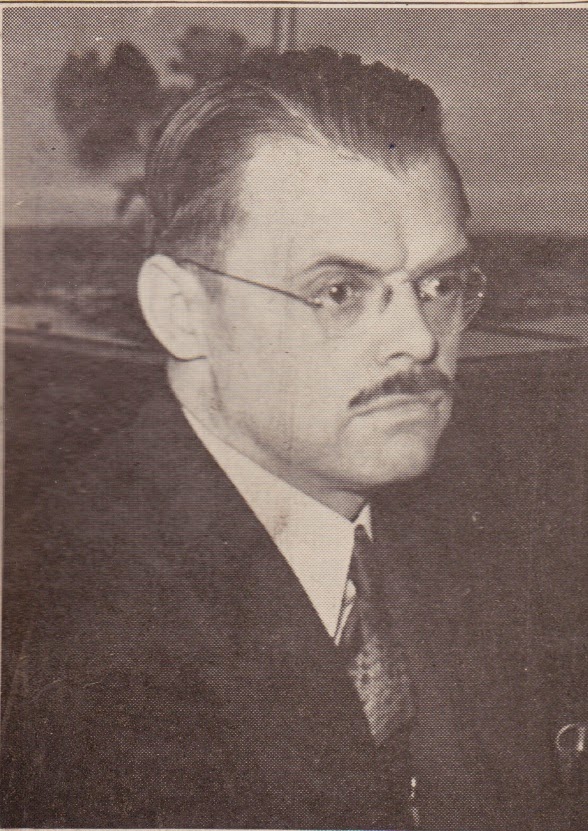
Korzybski’s relationship with biologist George Ellett Coghill (1872–1941) helped him put into perspective his efforts to connect with other scientists. For people like neuroscientist  C. Judson Herrick, who wrote a biography of Coghill, and evolutionary biologist Julian Huxley, Coghill qualified as a major—though rather unacknowledged—scientific figure. Shortly after Coghill’s death, Huxley said, “His death is a devastating loss to science. In my opinion Coghill stood among the twenty outstanding biological scientists of our time, although so few people were cognizant of his work that perhaps not many others would agree with me.”(13)
George Ellett Coghill 
Korzybski had started to correspond with Coghill in 1933, after reading his book, Anatomy and the Problem of Behavior. To Korzybski, Coghill’s approach to biology ably embodied the dynamic, structural approach he had sought to lay bare in his non-aristotelian system. Coghill, then a primary researcher at the Wistar Institute of Anatomy and Biology in Philadelphia, also served as President of the American Association of Anatomists and had spent a lifetime of teaching and research in zoology, embryology, histology, and anatomy. His pioneering studies on the relation of so-called ‘function’ and ‘structure’—which Coghill considered inseparable in living organisms—had focused on the embryology of behavior and associated bodily apparatus. Coghill had used the simplest research tools— a human hair at the end of a wood splinter—to tickle embryos of the amblystoma, a type of salamander, at different stages of development. Then he observed and described what they did and made generalizations about their development in relation to their behavior. Coghill tickled Korzybski too, who used a number of quotes from Coghill’s book in Science and Sanity.

Coghill had read most of 
Science and Sanity by January 1934 and wrote to Korzybski:
...At least I have read Science and Sanity as far as the mathematical part, which I am taking in small doses... 
It was a pleasure to follow your analysis and interpretation of the nature and problem of sanity. The presentation is clear and forceful. It should do a great deal of good—an inestimable amount if the book is sufficiently studied. It should be studied by all teachers of children, and all parents particularly.  
My own interpretation of the scientific method seems to me to be directly in line with your ideas of abstraction and identification; and my concept of the relational nature of scientific data seems to be an expression of Einsteinian relativity. In the reading of the book I could see why you liked the methodological part of my address before the Anatomists in Anatomy and the Problem of Behavior]. (14)  
Coghill clearly got what Korzybski had wanted to get across. Indeed, he already had a broadly, non-elementalistic viewpoint before he read Science and Sanity. Perhaps it had some connection with the fact that in his student days, he had enjoyed studying the calculus for fun. As a solitary researcher, Coghill had little day-to-day contact with other scientists, but he would do what he could to help promote Korzybski’s work including arranging a lecture for him at the Wistar Institute (which he managed to do in 1935). Korzybski, in turn, felt able to confide in the scientist. He wrote back to Coghill the next day:
I am struggling with enormous odds, scientific, commercial, religious (‘aristotelian’), etc., I knew that my path will be a thorny one, but I did not realize to what extent the scientific world having established for themselves a monopoly of ‘wisdom’ do not feel like their duty to be scientific in all concerns. As I see it we generally still depend on ‘philosophers’ to do the methodological work for us. I suggest that we abandon these hopes and do it ourselves. This is of extreme importance for education, as this is more transmittable than mere technicalities, as necessary as they are: besides it is more workable. (15) 
In the following month, Korzybski would further reveal to Coghill what he had begun to formulate as his problem with the ‘scientific community’ at large and, given that, where he wanted to help direct it if he could. He was asking Coghill for assistance:
...Methodology deals with general human orientations and so directly with life problems...Your great work differs so fundamentally from other similar works that I believe that the work as such would advance much further if all research men would be educated to its importance, and this can be done only in methodological papers. Assuming that you are interested in your work as work not as a personal issue (I am convinced of that), I am certain your work as work would benefit if you could or would educate methodologically large numbers of students...Under the present practice of science we are inefficient, we do not realize that some laboratory facts, no matter how important, are less important than new and reliable methodological papers which explain non-commercial and non-patented semantic [evaluational] processes by which you have achieved such important results. (16)
While Coghill wanted to help Korzybski, he had begun to suffer from serious heart troubles and furthermore was coming into a period of conflict with the administration of the Wistar Institute which forced him to retire at the end of 1935. Coghill couldn’t follow through with the kind of writing or teaching that Korzybski suggested for him to do. But as a particularly sympathetic reader, he did give valuable advice for promoting GS to scientists, which Korzybski ended up following.

Coghill wrote back to Korzybski on March 3: “...Your presentation of the problems you are facing have run back and forth through my mind in many ways. Whether the result will prove to be constructive remains to be seen.” He mentioned the possibility of writing a review for Science, although he didn’t think his present state of health, combined with his natural slowness in writing, would lead to his getting this done quickly. (It turned out he didn’t write the review.) Based on his observations of some fellow workers who were trying to read Science and Sanity, he told Korzybski:
...My impression is that the chief obstacle before the reader, particularly the experimental scientist, is the size of the book. I believe that relatively few experimentalists are great readers. Philosophers are; and they will probably read the book–for books are their bread of life. But when an experimentalist faces a book of nearly 800 pages he is likely to say to himself: “well, I would like to read that book: I must some time”, and he puts it back on the shelf with all good intentions but no results–probably ever.

I am of the opinion that your field of action now is to re-state parts of the book–not so much parts of the book as the ideas you have developed there–piece by piece, so to speak–and publish a series of articles in various magazines. In all these articles you would of course refer to the full treatment of the subject in S&S. By this means you could get your ideas instilled in the minds of readers and at the same time stimulate a desire to read more in the book itself.

In the same respect, other books of the non-A series should be relatively short...A series of short books along the lines which you have advertised, if written for particular classes of readers, –teachers in public schools– physicians– psychiatrists– etc. would I believe be read. S&S would stand as the opus magnum of the series, or the main source, and the smaller books would lead out into various fields of thought and practice with specific applications in each case.

To come back to my own situation– your book has been much help to me, and your evaluation of my work has been most stimulating. But my health is such now that I must watch my step...

I mention this personal side of my life so that you will not judge my slowness too harshly. (17)  
By June, 1934 Korzybski had concluded he was going to have to follow Coghill’s advice. He had just attended, as an invited guest, the Ninetieth Annual Meeting of the American Psychiatric Association in New York City. Reginald St. Elmo Murray, M.D., a psychiatrist at the Veterans Hospital in Lyons, New Jersey, had gotten interested in his work and written a paper on it called “The Semantic Differential in Mental Hygiene”. As the title might suggest, Murray’s grasp of the book seemed rather limited. Despite at least one prior face-to-face meeting, back and forth correspondence, and some editing on Korzybski’s part, Murray presented ‘semantic’ reactions as responses to words only, a significant mistake that many others would make as well. From Korzybski’s point of view, Murray’s style of expression seemed rather florid and the paper came across more like a church sermon than a scientific talk.(18)  

Still, with considerable resistance from the psychiatry meeting organizers (who, given his status as a non-psychiatrist, seemed loath to give him any time on the program), Korzybski got 10 minutes to serve as a discussant for Murray’s paper. Before the meeting, Alfred wrote to many of his psychiatrist friends inviting them to come to the talk. The paper delivered on June 1, the last day of the meeting, drew a lot of interest, not only from the attending psychiatrists but also from the press. An Associated Press reporter wrote a piece about the presentation that included interview comments from Korzybski and had national distribution.

Korzybski appreciated the interest and the publicity but, as he told A. Ranger Tyler, he found the meeting depressing:
It seems that a fairly large number of psychiatrists are interested in my work, some of the really important very much so, but they are very slow. There were some really fine papers of an “inspiring” character for the profession, but these do not give workable means, and so they are quite useless for any immediate activities. My wife attended the meetings with me, she was quite happy because “every important paper went my way.” I was frankly very depressed, because out of a 20 year sentence (the average for all pioneers in human problems) I have served only six months, and so I will die before anything will happen if it goes this way. (19)  
Since the theory of sanity and mental hygiene had become so central to his work, he needed the cooperation of psychiatrists, who as a group seemed as reluctant to read the book as the experimentalists Coghill told him about. He decided to produce a brief outline of the initial remarks he had written for Murray’s paper. In the “Outline” he would distill the main points of Science and Sanity that most readers seemed to be missing, and with this perhaps entice others to open the book and read. He would either get it published as an article or print it himself as a pamphlet.(20) In any case, such a piece could help “to eliminate my wasting a life time of personal education of people by letters.”(21) He wrote to Coghill shortly after the psychiatric association conference, “My difficulties become clearer everyday and it seems that only lectures (which I cannot get) and articles (which nobody wants to print or read) would do.”(22)  

In this initial stage of figuring out how to promote his work, George Ellett Coghill’s support and advice seemed priceless. But Coghill was not going to be able to help with much else. He had a major physical collapse at the end of June 1934. He couldn’t even respond to letters from Korzybski until January 1935. In May of that year, he got Korzybski to lecture at the Wistar Institute. After Coghill was forced to retire from Wistar at the end of 1935, the two men stayed in touch. In 1939, Coghill agreed to serve as an Honorary Trustee of the Institute of General Semantics, a role he continued until his death in July 1941.

Notes 
You may download a pdf of all of the book's reference notes (including a note on primary source material and abbreviations used) from the link labeled Notes on the Contents page. The pdf of the Bibliography, linked on the Contents page contains full information on referenced books and articles. 
13. Julian Huxley, qtd. in Herrick 1949, p. 6.

14. G. E. Coghill to AK, 1/17/1934. AKDA 32.882. 

15. AK to G. E. Coghill, 1/18/1934. AKDA 32.878.

16. AK to G. E. Coghill, 2/21/1934. AKDA 32.889. 

17. G. E. Coghill to AK, 3/26/1934. AKDA 32.899. 

18. AK to David Fairchild, 8/16/1934. AKDA 25.126. 

19. AK to A. Ranger Tyler, 6/4/1934. AKDA 27.464. 

20. Korzybski presented “An Outline of General Semantics: The Application of Some Methods of Exact Sciences to the Solution of Human Problems and Educational Training for General Sanity” in 1935 at the First American Congress for General Semantics. He had it published in 1938 in General Semantics: Papers from the First American Congress for General Semantics, edited by Hansell Baugh. He later had it reprinted as a pamphlet sold by the Institute of General Semantics. It was later reprinted in Alfred Korzybski Collected Writings, pp. 189–224. 

21. AK to A. Ranger Tyler, 7/10/1934. AKDA 27.473. 

22. AK to G. E. Coghill, 6/10/1934. AKDA 32.871. 


< Part 2     Part 4 >

Wednesday, January 21, 2015

Chapter 43 - 'Scientists Don't Read': Part 2 - "Dear Professor Einstein"

Korzybski: A Biography (Free Online Edition)
Copyright © 2014 (2011) by Bruce I. Kodish 
All rights reserved. Copyright material may be quoted verbatim without need for permission from or payment to the copyright holder, provided that attribution is clearly given and that the material quoted is reasonably brief in extent.

By the end of 1933, the mathematical physicist—a world-famous, living symbol of science—was residing in the United States, a Jewish refugee from Nazi Germany. His public endorsement could give Korzybski a powerful entering wedge into the awareness of other scientists, foundations, various state and federal agencies, the general public, and others who could further support his work. But although Einstein had become the object of great public interest, he had also become beset—as Korzybski knew—with the attempts of many people to get his attention for their causes or projects. Jewish scholars trying to escape Europe wanted Einstein’s support to get into the United States. Various Jewish groups and individuals saw Einstein as a leader—in spite of his lifelong detachment from Jewish culture and religion. Einstein may have mainly wanted to be left alone to pursue his research. Still, Korzybski would see if he could get Einstein’s attention and interest.

At the end of November 1933, he sent the physicist a copy of Science and Sanity with a one-page letter, which summarized his work:
Dear Professor Einstein:
I am taking the liberty of sending to you my new book Science and Sanity as an evidence of my deeply felt homage and gratitude for your great work. 
 
Methodological investigations have disclosed quite unexpected results; namely that elementary physico-mathematical methods as particularly embodied in your’s and Minkowski’s work, are essential for sanity. ... 

When he hadn’t gotten any acknowledgement by mid-January of the following year, he sent another letter asking if Einstein had received the book. If not, Alfred offered to send another copy. At the end of the month, Einstein wrote back in German thanking Korzybski for the book, which he had indeed gotten. At least Einstein (unlike Max Born) seemed to be reserving his judgment:
I received your book already some time ago and thank you cordially. My workload with duties and correspondence is so immense, that I could only dedicate little (time) to your work, in any case much too little to allow myself a judgment concerning it. I hope to perhaps be able to still catch up with it. (9)

Over the next year or two, Korzybski made efforts at further contact with Einstein through mutual acquaintances. In the late summer of 1934, Alfred’s good friend and supporter, botanist David Fairchild, was staying at the resort town of Watch Hill, Rhode Island where Einstein had also gotten a cottage for a summer of relaxation and sailing. Alfred did not shy away from suggesting to his friend David that developing a friendship with his “backdoor neighbor” Einstein might also benefit Alfred. Fairchild had met Einstein on the beach and chatted with him, but it seemed clear to Fairchild that Einstein mainly wanted to be left alone. Fairchild did not want to impose on the physicist. So that was that. Korzybski also knew a number of other people who knew Einstein, including a mathematician who seemed close to Einstein and who also seemed enthusiastic about Korzybski’s work. But her relationship, however close, never seemed to work out for Korzybski’s benefit.

Over the next decade, Korzybski would occasionally contact Einstein with a reprint or a note. In late 1939, more than a year after the founding of the Institute of General Semantics, Korzybski wrote to Einstein asking him if he would accept a position as an Honorary Trustee. It took Einstein some time, and a second letter from Korzybski, to respond, which he finally did on January 17, 1940 in an ornately polite letter written in German:
Dear Sir,
With great regret I don’t see myself in the position to accept your kind offer because I see myself unable to accept a moral responsibility of any kind for publications that currently appear under the topic of ‘Semantic’. (10) 

Even after getting turned down like this, Korzybski continued on occasion to write quite cordially and collegially to Einstein with, apparently—from comments in Korzybski’s letters—no response. By 1947, a few years before his death, Korzybski had ruefully come to conclude that Einstein was not able or willing to see the human import that Korzybski had derived from his work. He recalled an interview with Einstein he had seen a number of years before. Einstein was asked “What will your theory mean to the world?”
Einstein had no answer. He smiled only and said, “Let them discover.” “Let them discover.” And curiously enough, this is rather funny, curiously enough when it was discovered, then Einstein does not agree. Oh, the tricks of human nature. (11) 
Evidently, Einstein did eventually at least peruse Science and Sanity. In the early 1950s, some time after Korzybski’s death, Harry Weinberg, one of Alfred’s favorite students—was vacationing with his wife Blanche in upstate New York. They had taken out a boat on Lake Saranac and noticed a small sailboat in the distance with two white-haired figures, one of whom looked familiar—like Albert Einstein. The Weinbergs got themselves over to the other boat. They had indeed found Einstein who was sitting with a woman (his sister?) who looked startlingly like the scientist. Weinberg introduced himself as a student of Korzybski and asked permission to take a photograph (NOT the one below), which he was allowed to do. He understood that Korzybski had once sent Doctor Einstein a copy of Science and Sanity. Had Einstein read it and what did he think of it? Einstein replied in his heavily German-accented English, “Dot’s ah krrrazy boook!”(12)

'Science and Sanity? Dot's ah krrrazy boook!'
Notes 
You may download a pdf of all of the book's reference notes (including a note on primary source material and abbreviations used) from the link labeled Notes on the Contents page. The pdf of the Bibliography, linked on the Contents page contains full information on referenced books and articles. 
9. AK to Albert Einstein, 11/29/1933. AKDA 32.968; Albert Einstein to AK, 1/29/1934. AKDA 32.966. Translated by Max Sandor. 

10. Albert Einstein to AK, 1/17/1940. IGS Archives. Translated by Max Sandor. 

11. Korzybski 1947, pp. 48–49.

12. Pula 2001b. pp. 48–49. After her husband’s death, Blanche Weinberg told this story to my friend and colleague Robert P. Pula who related it to me a number of years before he wrote it down.


< Part 1      Part 3 >

Tuesday, January 20, 2015

Chapter 43 - 'Scientists Don't Read': Part 1 - Introduction

Korzybski: A Biography (Free Online Edition)
Copyright © 2014 (2011) by Bruce I. Kodish 
All rights reserved. Copyright material may be quoted verbatim without need for permission from or payment to the copyright holder, provided that attribution is clearly given and that the material quoted is reasonably brief in extent.

Korzybski saw himself as a scientific worker and, despite the radical nature of his work as a gadfly in scientific borderland, he experienced remarkable acceptance by the scientific community at large throughout his career. Even before publication of Science and Sanity, he had gotten a good sense of this. A significant number of respectable scientists and mathematicians had helped him with the research and editing. It gratified him that these (mainly) men—with whatever corrections they’d suggested—found acceptable his treatment of their particular specialties. And just before the book came out, he got another significant confirmation of his status in the scientific community.

At the end of August 1933, he received an envelope from the Washington, D.C.–based AAAS. Very busy with the final production of the book, he had allowed the unopened envelope, which he assumed might be a bill about overdue membership fees, to get buried on his desktop among other papers and mail. When he finally got around to opening the letter he was surprised to see an official notification: “I have the honor to inform you that you have been elected Fellow of the American Association for the Advancement of Science. Respectfully yours, Henry B. Ward, Permanent Secretary.” The 'back of the membership card, included the definition of “Fellowship” from the “(Bylaws of the AAAS, Art. II)”: “Section 4. All members who are professionally engaged in scientific work, or who have advanced science by research, may be elected by the Council to be fellows on nomination or on their own application.” Replying to Henry Ward, Korzybski expressed his “deep appreciation for this honour.” The life-long honor might serve a useful purpose as well, if it helped him in his quest to find more scientists willing to cooperate with him.(1) 

Notification of Korzybski's Election as a AAAS Fellow,
AKDA 2.679
If enough scientists got inspired to jump into the non-aristotelian trenches, a great deal could be accomplished. For one thing the social sciences might move considerably forward. But even in the so-called physico-mathematical sciences, progress often seemed inhibited because of inadequately addressed linguistic, epistemological issues. Perhaps, as he suggested in the book, applying his methods could even help resolve such impasses as the esoteric controversy about the status of transfinite numbers in mathematics, to pick only one example. He believed that a consciously non-elementalistic, non-aristotelian revision—a methodological unification—of the sciences could result in unexpected breakthroughs through cross-fertilization of disciplines formerly seen as disconnected.

For such a non-aristotelian revision of the sciences and life to happen, polite interest or even general agreement would not suffice. A large enough number of individual scientists would need to get interested enough to study and apply what he was advocating and, as he realized even in 1933/34, they would first of all have to adopt and integrate it, to some degree, into their personal lives.* That requirement would always remain a snag—perhaps the snag—for many scientists, as well as others, trying to make sense of Korzybski’s work. 
* If you have trouble distinguishing between orders of abstractions (in other words, lack consciousness of abstracting) in your personal life, how can you possibly become optimally conscious of abstracting in your profession? 

Some scientists would respond as Max Born did, after Korzybski had sent him a letter early in 1933 asking for permission to quote from his writings. Alfred briefly explained the subject of his book and offered to send Born a copy when it came out.(2) Born—friendly, though interestingly ‘closed’, considering his role as one of the founders of quantum physics—wrote back in German:
I thank you for your nice letter and am glad that you have drawn inspirations from my book about Einstein’s Theory of Relativity. Indeed I really am interested in epistemology but absolutely cannot understand what this has to do with sanity (mental health). I’m afraid that we will not be able to communicate with each other over this point. Because I am very concerned with not drawing more conclusions from insights into physics than it is absolutely certain. The application for medical problems seems to me too bold. (3)

Nonetheless, other scientists found Korzybski’s work initially appealing. Visiting Baltimore and Washington in the first part of November, some weeks after the book was published, Alfred had a chance to gauge the response of many of his scientist friends, some of whom had at least read his manuscript or parts of it and consequently had received complimentary copies. While he found a great deal of interest, he ruefully noted that despite the fact many hadn’t read the completed book, they seemed to think they ‘knew all about it’.

There were also a few men like the Harvard zoologist William Morton Wheeler who had already written to Alfred in late October to say he was reading the book and had realized he missed a great deal of value while correcting the proofs—having lost the trend of the reasoning while editing Korzybski’s English. As he was getting “a better understanding of the [non-] A system”, it was now making a “profound impression” on him. Wheeler also reported that two of his colleagues at the Harvard Biological Institute and the Comparative Zoology Museum, G.H. Parker and T. Barbour had bought Science and Sanity and were taking their copies to bed with them.(4) 

Later in November, Alfred (with Mira) went to Boston to see Wheeler and Bridgman and to meet with a number of other Harvard scientists. After he returned, he wrote about his trip to Keyser:
Dear Dear Old Man,  
Please excuse the delay in answering your dear old letter of Nov. 16 but I was lecturing at Harvard and came home only yesterday home [sic]. It seems the lectures were a success. I [had] a large and very mixed audience at a biological seminary [probably arranged by Wheeler at the Biological Institute] in which many specialists attended. I had a two hour lecture at the home of [E.V.] Huntington [where Alfred and Mira stayed as guests] with Birkhoff and also E.B. [Edwin Bidwell] Wilson, [Harlow] Shapley, [L.J.] Henderson, etc., two two-hours lectures at the psychopathic hospital to doctors, one to the astronomical group at the home of Shapley, and one to neurologists at the home of a prof. of physiology and anatomy. One never knows but it seems that all these specialists have been genuinely electrified. I gave hell to Birkhoff and Veblen (at the Nat. Academy dinner), and I think I got under their skin a little. We had a very nice and long dinner with Sheffer. I saw Whitehead twice and he was kind enough to invite us to his seminar. [Korzybski had already sent an extra copy of Science and Sanity to Huntington, who had delivered it to Whitehead’s home.] I attended also one lecture of Sheffer. I was amazed that both lectures were aiming the same direction. 
The widespread interest among these scientific workers encouraged him:
As a rule I am not optimistic about my lectures, but this time I believe that I really made good. I had other important conferences with [Henry] Murray (Clinic of abnormal Psychology) and anthropologists and physiologists, and we fell on each others’ necks, it looks really that perhaps my work may have after all some value. It is so peculiar that discussing the problems from so many angles with specialists all of them should find an advance in their fields.
But he also experienced some shocks or at least frustrations at Harvard. Whitehead, for example, seemed deeply concerned with the kinds of problems Korzybski had dealt with in his book. In his seminar, as Alfred wrote to Keyser, “Whitehead said “Identity is a horrible idea, no one seems to know what it means”.” Had Whitehead even glanced at the preface of Science and Sanity? Alfred commented:
The trouble with Whitehead is that he has no use for anthropology and psychiatry, otherwise he would know that ‘identity’ represents a misevaluation which makes the optimum adjustment impossible. 
...With Whitehead of course there is no discussion, he listens very attentively and sympathetically but he will not read. Personally to me this is a drama, but this cannot be helped. He told me that Wheeler ‘knows more about philosophy and logic than the whole department’. I utilized this and Wheeler promised to convey to Whitehead many points of my work. (5)

Another jolt for Alfred involved his friend Percy Bridgman, who hadn’t done more than glance at the book and seemed unlikely to read the whole thing. Since he had read parts of the manuscript, he seemed to assume he already understood Korzybski’s work and it was becoming more and more apparent to Alfred that he didn’t. Alfred’s meeting with the physiologists and neurologists also left him surprised and dismayed at what he perceived as their generally antiquated outlook.(6) 

After he got home Alfred also wrote to mathematician E. B. Wilson, who had attended the talk Alfred gave at Huntington’s home. The letter explained his work a bit more and asked for Wilson’s help in trying to get Alfred’s message across to scientists. Could Wilson write an endorsement statement for him for the foundations or perhaps even write a review for a scientific journal? Wilson replied several weeks later saying that despite his interest in the talk, he could make neither heads nor tails of Korzybski’s aim or message. He had also spent a few hours with Science and Sanity but, as he wrote to Korzybski, “I do not find your book intelligible any more than I found your talk intelligible.”(7) Wilson admitted that he thought the fault was probably in him but until he had more time to adequately study Korzybski’s work he could not say anything about it. Korzybski found Wilson’s response worrisome but expressed his gratitude to Wilson for his honesty and hoped he would continue to reserve judgment until he had further time to study and apply the material in the book.

Around this time, Korzybski got some other more annoying reactions. He had written to some book clubs to explore the possibility of them carrying his book. Not surprisingly, Science and Sanity seemed too specialized a volume for Book of the Month Club. But it just seemed wrong for the Scientific Book Club editor to reject it as over the heads of the majority of his members without having a look at the book itself.(8)

The wildly varying reactions to his work would continue to bother Korzybski. On the one hand, he had received enough positive responses from people like Keyser, Wheeler, and Dr. Wilmer, the famous Johns Hopkins ophthalmologist, to reassure him of the value of pursuing his plan to get scientists behind him. On the other hand, he felt bewildered by either the lack of interest, the lack of comprehension, or the closed-minded dismissal by a number of others. If he could only get Einstein, one of his great inspirations, on his side.

Notes 
You may download a pdf of all of the book's reference notes (including a note on primary source material and abbreviations used) from the link labeled Notes on the Contents page. The pdf of the Bibliography, linked on the Contents page contains full information on referenced books and articles. 
1. AK to Henry Ward, 9/24/1933. AKDA 24.160. 

2. AK to Max Born, 2/24/1933. AKDA 35.121. 

3. Max Born to AK, 3/7/1933. AKDA 25.383. Translated by Max Sandor. 

4. William Morton Wheeler to AK, 10/30/1933. AKDA 34.197. 

5. AK to C. J. Keyser. 11/26/1933. AKDA 26.278. 

6. AK to C. J. Keyser, 12/16/1933. 26.306. 

7. E. B. Wilson to AK, 12/16/1933. AKDA 34.355. 

8. Kirtley F. Mather to AK, 9/19/1933. AKDA 34.248.


Monday, January 19, 2015

Chapter 42 - Reviewing Reviews: Part 3 - Some 'Philosophers' Respond

Korzybski: A Biography (Free Online Edition)
Copyright © 2014 (2011) by Bruce I. Kodish 
All rights reserved. Copyright material may be quoted verbatim without need for permission from or payment to the copyright holder, provided that attribution is clearly given and that the material quoted is reasonably brief in extent.

Throughout 1934, Science and Sanity continued to generate much interest. Alfred and Mira were filling the pages of their scrapbook with clippings of new reviews (as well as other articles and materials related to Alfred and his work). Only a few reviews seemed downright dismal. Two of the worst came from one man, Ernest Nagel—a student of John Dewey and a respected Columbia University philosopher of science. In the February issue of The Journal of Philosophy, Nagel panned the book. In a shorter review note for the August 1 New Republic, Nagel wrote “Writing as much as Mr. Korzybski does, he is bound to say good things occasionally. But most of the book consists of irrelevant material taken from mathematics, physics, chemistry, biology and psychiatry.” It bothered Korzybski that what Nagel seemed to disagree with were Nagel’s own misrepresentations. How could Nagel have possibly come to the conclusion, as he wrote in the February review, that Korzybski believed “..hypotheses contrary to the fact are meaningless (e.g., p. 168)”? Huh? Such a misleading account of his work could do real harm. How many people would accept Nagel’s judgment and as a result not bother to take Korzybski seriously? Alfred wrote a protest letter to the New Republic, but in the October 24 issue the editor chose instead to print rejoinders to Nagel by Polakov and Robert H. Allen, a journalist whom Alfred knew. In his reply to these, written from Warsaw and published at the end of the year, Nagel wrote: 

...While I respect very highly the men who endorse “Science and Sanity,” I must differ with them in their evaluation of it; moreover, I am not convinced that they have all undergone the same labor with the book that I have...it is my considered opinion that “Science and Sanity” has no merit whatsoever,...16
Perhaps the only serious review rivaling Nagel’s in nastiness was published in the July 21, 1934 Journal of the American Medical Association. Like Nagel, the anonymous reviewer—possibly Morris Fishbein, the Journal’s editor—considered the book worthless. The review began disparagingly, “In spite of its title, this book is neither scientific nor sane; it is merely ponderous.” It continued with various misstatements about the book such as “It is the first volume of a series of books dealing with non-Aristotelian logic” [a fairly common error about Korzybski’s work] and “Since he points out that mental adjustment is a purely linguistic matter [he most definitely had not pointed that out!], the author would seem to be well adjusted, but to the psychiatrist there seems to be little of value in the book.” Korzybski wrote to Fishbein protesting the misrepresentation and prejudicial remarks. Many psychiatrists were finding a great deal of value in his work. The April Psychiatric Quarterly had called Science and Sanity “a source book of ideas and inspiration.” Dr. William A. White, although too busy as usual, had already written a friendly, if superficial, review published in the July issue of Mental Hygiene. (The book would later receive positive reviews in a number of psychiatric journals.) A paper on Korzybski’s work had just been respectfully presented more than a month before at the 90th Annual Meeting of the American Psychiatric Association in New York City. Other psychiatrists, besides Graven, were becoming students of his work. Fishbein wrote back refusing to make any correction and the two men carried on an unpleasant correspondence until October when Korzybski seems to have given up.

However much he felt irritated about the Nagel and JAMA reviews, Sidney Hook’s more positive treatment of Science and Sanity in the March 10, 1934 Saturday Review of Literature may have bothered him more. He had started to correspond with Hook in the middle of 1933 and had initially seemed willing to consider Hook, a student of Dewey who taught at New York University, as one of those ‘philosophers’ doing valuable work in epistemology. But Hook, though more friendly, treated Korzybski’s work much as Nagel and the JAMA had—as a work of ‘philosophy’ or ‘logic’—and missed its applied, experimental nature. Restating Korzybski’s views in elementalistic, ‘philosophical’ language, Hook distorted them. Like Nagel, he had read the book and continued to ‘hum his own humming’ as Korzybski sometimes characterized poor readers or listeners who jumped to and stuck to their own incorrect conclusions about what a writer or speaker said. Korzybski had repeatedly referred to semantic [evaluational] reactions as non-verbal in nature—psycho-logical, organismal responses to words, symbols, and other events. Korzybski apparently hadn’t repeated this often enough for Hook to get it—for in his review Hook identified semantic reactions with language. Nonetheless, this didn’t stop him from criticizing Korzybski for his “repetitiousness”. Not understanding what Korzybski meant by identification as an organismal response, Hook had no trouble declaring that John Dewey— in his work on ‘logic’—had actually already “worked out” Korzybski’s “fundamental position”. According to Hook, still a Marxist in 1933, “Social and economic problems have no more to do with the interpretation of the law of identity than “the flowers that bloom in the spring, tra-la.” ”(17) Decently enough, Hook had sent a copy of the review to Korzybski about a month before it was printed. Korzybski quickly wrote back and cordially attempted to correct the misinterpretations. But subsequently, the final published piece gives no indication that Hook re-evaluated what he wrote in response to Korzybski’s suggestions. Writing to Tyler on March 16, Korzybski located part of the problem in Hook’s approach to reading, an approach common to many readers, not only ‘philosophers’:
...Physiological mechanisms require relaxation before they may work, and reading at first critically inhibits responses. I had a real body-blow. Sidney Hook a very gifted, learned, honest, etc., ‘philosopher’ wrote a review of my book for the Saturday Review of Literature, the review is very friendly etc., but...he has missed the whole thing because as a philosopher he starts to read critically, and this inhibits the working. And so it goes. (18) 

Despite Korzybski’s general feelings about academic ‘philosophy’ he was not badly treated by all ‘philosophical’ reviewers. For example, the October 1934 edition of The Personalist had a brief, intelligent overview of the book by H. B. Alexander, a wide-ranging humanist professor who had made forays into lexicography and anthropology and helped found Scripps College, an innovative school for women in Southern California. Alexander commended Korzybski’s “critical language consciousness and conscience” which came “from a ‘semantics’ deeper-set than any verbal contrivance of experience.” Korzybski wrote to him to thank him for the kind review.

Though he didn’t write a review, another ‘philosopher’, Oliver Leslie Reiser became a supporter of Korzybski’s work and helped publicize it at the end of 1934. Reiser had studied and taught both psychology and philosophy at Ohio State University before becoming a professor of philosophy at the University of Pittsburgh. He seemed ready for Korzybski when they first became acquainted—probably sometime in 1930 after Korzybski read an article by Reiser and sent him a complimentary note. The two men corresponded for several years before the publication of Science and Sanity. In a May 1933 letter to Alfred, whom he addressed as “Count Korzybski” he said “There was a time when I depended [on] the tradition[al] (aristotelian) “laws of thought” (e.g. in my ‘Humanistic Logic’) but in recent years I have moved away from this position.”(18b) Clearly, general semantics had ‘grabbed’ him and he came to see Korzybski as a possible herald of a new era of human ‘thought’.
Oliver L. Reiser 
Korzybski Scrapbook, AKDA 2.735
During those first years of their relationship, Reiser seemed to be emerging consciously as a non-aristotelian epistemologist. While Science and Sanity was being prepared for publication, Reiser agreed to have his name announced as the prospective author of From Primitive Religious To Modern Scientific Structural Assumptions, one of the ‘Volumes In Preparation’ mentioned in Science and Sanity. Over the next year, Reiser studied Science and Sanity, sent Alfred copies of his published papers, and the two men corresponded with more frequency. Korzybski could still see some ‘shades’ of elementalism and identification in Reiser’s formulating. But he respected the 39-year old ‘philosopher’, whom he saw as good non-aristotelian material and bluntly asked Reiser in a June 29, 1934 letter:
Why do you insist in printing all the stuff you have ever written instead of tackling a fundamental analysis of so called ‘fundamentals’ and do some constructive real work? I have read everything you have written and frankly consider that you are a most gifted and informed man for a ‘philosopher’, but why in the Dickens do you bicker with ‘philosophers’ for ‘philosophers’ instead of applying your great gifts and knowledge to human orientations and methods and disregard professional ‘philosophers’ as everybody else does. (19) 

Reiser told Korzybski that he was finding it somewhat difficult to leave behind these trappings of the culture of academic ‘philosophy’. Nonetheless he was working at it and presented one result of his efforts at the 94th Annual American Association for the Advancement of Science (AAAS) meeting, held in Pittsburgh at the end of December 1934. His paper, entitled “Modern Logic and Non-Aristotelian Logics”, discussed general semantics in the context of various developments in logic, although he did explicitly note, “Korzybski’s system should not be described as a non-Aristotelian logic. All existent logics, Korzybski argues, are elementalistic...The science of the adjustment of man to his environment is a psycho-logic, and this should be a non-Aristotelian system rather than a logic.”(20) 

Reiser’s paper, one among some 1,500 talks given, drew remarkable attention from the press. It was not only mentioned but written about at length in articles around the U.S. Watson Davis, the Director of the Science Service and editor of the nationally-distributed Science News Letter (which also had a press service) had written an article devoted to Reiser’s presentation and on the “new mode of thinking” of Korzybski and others. Davis’s article, dated December 28, was picked up by papers like the Buffalo, New York News and Buffalo Evening News, the Houston,Texas Press, and The Washington Daily News. The Pittsburgh Post-Gazette and The Bulletin Index (“Pittsburgh’s weekly newsmagazine”) had separate stories on Reiser’s talk. The notion of non-identity especially seemed to grab reporters. This headline for the Davis article appeared in one paper:“Einstein Theory” of Logic Offered: That a Thing Is Not Always Itself.(21) As a follow-up, in its January 12, 1935 edition, Watson’s weekly Science News Letter printed another article on Reiser’s talk, “New Mode of Thought Urged To Replace Aristotle”. Reiser had definitely made a big publicity splash for Korzybski and himself. Afterwards, Alfred asked Reiser to submit a paper for the upcoming First American Congress for General Semantics which Reiser did, entitled “A Non-Aristotelian System and General Semantics”.

The two men remained in contact for many years. Reiser, now neglected as a ‘philosopher’, taught at the University of Pittsburgh and published many articles and books until his death in 1974. He would write some excellent things related to general semantics in the course of his career, including the 1940 book, The Promise of Scientific Humanism and the 1958 The Integration of Human Knowledge. In his 1989 book Logic and General Semantics: Writings of Oliver L. Reiser and Others, Sanford Berman commented that Reiser, in the 1940 book, “presented the most complete analysis of Aristotelian and non-Aristotelian logic and thought ever written by a student of general semantics.”(22) Robert Pula recommended Reiser’s writings with some qualification, noting “...a residual mystical inclination, some unconscious identifying, hankering after ‘absolutes’, etc.”(23) in Reiser’s 1958 book.

Korzybski certainly noted this tendency over the years. In early 1935, soon after Reiser’s success at the AAAS meeting, Korzybski wrote to him, “You see for many reasons I do not deal with ‘philosophers’, and you are the only one in the ‘sem. family’. There is endless work to be done by a man like you, but this work to be effective must be RADICAL with no compromise.”(24) 

Reiser never seemed to become radical enough for Korzybski. He continued writing about Korzybski’s work in terms of ‘logic’, ‘semantics’, and ‘philosophy’, as those terms were commonly and elementalistically employed. In subsequent years, Korzybski spoke bluntly to his friend the ‘philosopher’ whom he didn’t want to see “flounder in a rarified atmosphere of verbalism which has nothing to do with so-called realities.”(25)


Notes 
You may download a pdf of all of the book's reference notes (including a note on primary source material and abbreviations used) from the link labeled Notes on the Contents page. The pdf of the Bibliography, linked on the Contents page contains full information on referenced books and articles. 
16. See Ernest Nagel. “Review of Science and Sanity”, Journal of Philosophy, February 11, 1933. AKDA 2.692; “Review of Science and Sanity”, The New Republic, August 1, 1934, AKDA 2.719; and “Mr. Nagel Answers”, The New Republic, December 26, 1934, AKDA 2.719. 

17. Hook, “The Nature of Discourse”, Saturday Review of Literature, 3/10/1934. AKDA 2.695. 

18. AK to A. Ranger Tyler, 3/16/1934. AKDA 27.392.

18b. O.L. Reiser to AK, 5/29/1933. AKDA 33.362. 19. AK to O.L. Reiser, 6/29/1934. AKDA 33.378.

20. O.L. Reiser. “Modern Logic and Non-Aristotelian Logics”, AKDA 33.399. 

21. “Einstein Theory” of Logic Offered: That a Thing Is Not Always Itself’. Houston, Tex. Press, 12/28/1934. AKDA 2.735. 

22. Berman, p. ix. 

23. Pula 1996 “General Semantics Seminar-Workshop Bibliography. Revised, Updated and Annotated”. http://www.generalsemantics.org/the-general-semantics-learning-center/online-library/bibliographies/bob-pulas-bibliography/

24. AK to O.L. Reiser.1/10/1935. AKDA 33.385. 

25. AK to O. L. Reiser, n.d. [1948 or 1949]. Ralph Hamilton Papers.


Sunday, January 18, 2015

Chapter 42 - Reviewing Reviews: Part 2 - First Reviews

Korzybski: A Biography (Free Online Edition)
Copyright © 2014 (2011) by Bruce I. Kodish 
All rights reserved. Copyright material may be quoted verbatim without need for permission from or payment to the copyright holder, provided that attribution is clearly given and that the material quoted is reasonably brief in extent.


Just Published Announcement from Science Press
AKDA 2.685
In fact, the first review had already been published in September 1933 in The Collecting Net, a subscription newsletter “devoted to the scientific work” at the biological research stations at Woods Hole on Cape Cod and Cold Spring Harbor on Long Island. Ralph Lillie, a University of Chicago physiologist who had helped edit Science and Sanity and had great regard for Korzybski and his work, wrote an informative and complimentary notice based on his reading of the manuscript. Lillie began, “This interesting and original book deserves careful study by all who are concerned with science and its applications.” Alfred didn’t know about it until mid-December when Lillie wrote to him sending along a copy.

By this time, other reviews began to trickle in. Alfred and Mira had been working for months to try to get the proper attention for the book. Responses from the circular mailing in May had included a number of requests for review copies, which they began to send out as soon as the book had been published. Given their tight budget, Alfred felt constrained about the number of copies they could distribute. But despite his insistence that they must focus on more scientific journals (psychiatric and educational included), they had sent a number of copies to more literary-focused magazines and to philosophical journals as well. Given that he had no budget for advertising, he was eager for publicity wherever he could get it.

However, he had limits. He refused—politely—to send a review copy, as requested, to The Catholic School Digest, whose review may or may not have been bad. He also refused another request, from a biologist who wanted to review the book for The Christian Century, a popular, non-denominational, liberal Christian magazine. The man sent another review he’d already written along with some other pages from the magazine. Korzybski wrote back to him and politely refused to send a copy noting, “I must strictly depend on scientific journals for reviews.” However, when he got a request for a review copy from Rabbi Felix Levy, who wanted to put something about it in the Year Book of the Central Conference of American Rabbis (representing the Reform movement of Judaism), Korzybski wrote back saying he would gladly send a copy. Alfred’s biases against religion, especially Christianity, may have unduly cut off his work from exposure to potentially interested readers. His personal opinions aside, nothing in the system he had developed made it inherently odious to religious people not inflexibly committed to fundamentalist views.

Surprisingly, one of the first and—in Korzybski’s opinion—one of the best reviews of Science and Sanity appeared in a daily newspaper, The Knickerbocker Press, in Albany, New York. The paper ran a two-page feature article by A. Ranger Tyler, its new literary editor, in its Sunday, December 10 edition. Tyler had already written to Alfred in early November after ‘inheriting’ the book from the paper’s previous literary editor who had received the review copy. The book immediately ‘grabbed’ him, as he frankly told Korzybski in his letter,
I can not adequately express my joy at finding someone attempting the fundamentals of sanity. My work as a newspaperman—when I am not reviewing books—gives ample evidence of the stranglehold of what you term Aristotelian semantic reactions have on a woefully large majority of otherwise personable human beings. Walter Pitkin [an acquaintance of Korzybski] gropingly felt the situation in his amusing “A Short Introduction to the History of Human Stupidity,” but he was simply being a reporter. (4) 

Even after only about a month of reading, Tyler was already analyzing news issues (for himself) in terms of orders of abstractions.(5)  He even admitted to Korzybski to have become a bit manic in relation to the book, “My wife thinks I dream orders of abstraction, etc.”(6) He started writing the article at the beginning of December as he finished his first reading.

Korzybski appreciated the headline, “Can Human Nature Be Changed? Yes, Author Reveals” and the sub-heading, ”Basic Shift in Methods of Thought on Scientific Lines, Suggested in Epoch-Making Book”. In the article itself, Tyler had written, “I stake my reputation on the belief this is the most significant book of the century, so far.”
Let us be frank. While the book is written for the comprehension of the “average educated layman,” most readers of any degree of education will find it difficult, especially at first to understand. The divergence from our customary channels of thought is responsible for this...Anybody with the willingness to understand can gain great value from the book. It is naturally of particular significance in the work of educators, teachers, and psychiatrists, because it offers the first suggestion of how to teach children to think as they were “constructed” to think and how to eradicate the confusions that usually are found at the bottom of mental ills. (7) 

After the review was published and he felt more at ease to express himself, Korzybski told Tyler about his amazement at the fact that Tyler had managed to write about aristotelian and non-aristotelian systems, non-identity, semantic reactions, and abstracting, among other formulations in more or less everyday language without introducing fallacies about his work.(8) 

In the young newspaperman (who admittedly had a biology degree and had taught math at a boy’s prep school), Korzybski appears to have found his ideal ‘average intelligent layman’—actually an all-too-rare, more or less extensionally-oriented and generally sane individual. As he later wrote to Tyler: “...you ‘knew it’ all by yourself, and I only happened to formulate what you felt instinctively yourself. The depth of understanding [in the review and subsequent letters] shows that. You could not absorb organically that much from one reading, unless you had it.”(9) To Korzybski, Tyler seemed to belong to that small group of ‘naturally’ extensional non-aristotelians who found in general semantics a clearer language and method for doing better what they were already inclined to do. The much larger group of ‘aristotelians’ would need a great deal more training and drilling, whatever their verbal assent, to orient themselves differently. Over the next year, Korzybski and Tyler met in person and maintained a steady correspondence. Alfred would confide to him quite a lot in this early period of getting his work established. (The two men stayed in contact for a number of years afterwards and Tyler was one of the few people to have papers presented at both the First (1935) and Second (1941) American Congresses on General Semantics. (10) 

In the first six months after publication, other newspaper reviews, articles, and editorial pieces appeared in the Mansfield [Ohio] News-Journal, the Binghamton N.Y. Press, the Cincinnati Enquirer, the Wilmington [Delaware] Evening Journal, The New York Post and The Brooklyn Daily Eagle. In early February 1934 an Associated Press reporter interviewed Korzybski, which led to a whole new round of articles in newspapers around the country, which made use of the syndicated piece. Finally The New York Times, whose editors had initially seemed resistant to covering the book, on February 11 carried a sizable and friendly review by Korzybski’s old acquaintance George Moreby Acklom. Although containing some errors (Acklom referred to Alfred as ‘Dr. Korzybski...‘a psychiatrist’) and mildly critical, Korzybski probably couldn’t have expected anything better.(11) In general, the newspaper coverage of the book (mainly positive, if not laudatory) indicated a rather remarkable public interest for such a seemingly ‘heavy’ book.

Perhaps the most important initial review for Korzybski was the personal one he awaited from Cassius Keyser, who—occupied with his own writing and various health issues—had had limited time and energy over the past few years to help with the evolving manuscript of Korzybski’s opus. And although Korzybski had occasionally seen the “dear dear old man” and had tried his best to keep Keyser up to date via letters, he had shied away from imposing too much on his friend. After the book’s publication, Keyser surely must have gotten one of the first of the complementary copies Alfred sent to various friends and helpers. What would Keyser make of it?

Toward the end of 1933, Alfred had begun collecting statements about the book for possible use in his campaign to interest foundations in his work. Mira saw Keyser in the beginning of December by which time Keyser had finished his first reading. Would he write a recommendation? Keyser agreed. In a few days he sent Alfred a letter with his statement enclosed:
I have read Korzybski’s Science and Sanity attentively and critically from lid to lid. Though I do not find myself in full agreement with the author at every point, I am bound in candor to say that as a whole this work is a tremendous and timely drive in the right direction. It is undoubtedly and beyond all comparison the most momentous contribution that has ever been made to our knowledge and understanding of what is essential and distinctive in the nature of Man...bearing...upon...the whole of our human methodology for gaining, communicating, and utilizing knowledge at any stage and upon any level. (12) 

At the beginning of his trials to get publicity and establish his work, seeing Keyser’s response—combined with the Lillie and Tyler reviews, which he had just received—buoyed up Korzybski tremendously. He wrote to Lillie a few days later:
...I rush this letter not only as an acknowledgement and expression of my gratitude, but also to send you a statement of Prof. Keyser...The letter of Professor Keyser made me very happy not only because it is really splendid but particularly because Prof. Keyser has done so much for putting my first book before the public, as he devoted his most important Phi Beta Kappa address to a review of the book, and in some cases was criticized for it and his health did not allow him to see the Ms or the proofs of the new S+S so he read an entirely new book to him. Personally for about 12 years I labored under a definite and permanent longing that the dear Old Man should not be ashamed of this new work, to have such an appreciation is of course a great deal of happiness to me.(13) 

Soon afterwards, Keyser extended what he wrote for a review later published in the April 1934 edition of The New Humanist. The review, entitled “The Foundations of the Science of Man”, discussed Science and Sanity in terms of its aim, means, principles, terms, and major theses. The review showed the mathematician’s remarkable capacity as a careful, analytical reader. By January, Keyser had almost completed another still more extensive review article for Scripta Mathematica, when he was hospitalized for some problems related to his old surgeries. He wasn’t able to finish it until April. As he explained to Korzybski, he felt the lack of criticism in the New Humanist review might lead readers to dismiss it. Keyser had not only tightened up and elaborated what he had previously written but added a critical section of “Queries, Doubts, and Reservations”. This piece, entitled “Mathematics And The Science Of Semantics” published in the May Scripta qualifies as one of the best reviews of Science and Sanity ever written—and one of the clearest short introductions. As the late Keyser/Korzybski scholar Elton S. Carter, pointed out, “Cassius J. Keyser [was] rare indeed among the critics of general semantics, not because he praised Science and Sanity, but because he exhibited ample evidence of knowing what he was talking about.”(14) Korzybski wrote to Keyser in June after he had read the Scripta review and addressed some of Keyser’s queries, doubts, and reservations. He felt grateful to Keyser and considered the criticisms mild. (15)


Notes 
You may download a pdf of all of the book's reference notes (including a note on primary source material and abbreviations used) from the link labeled Notes on the Contents page. The pdf of the Bibliography, linked on the Contents page contains full information on referenced books and articles. 
4. A. Ranger Tyler to AK, 11/ 2/1933. AKDA 27.178. 

5. A. Ranger Tyler to AK, 12/1/1933. AKDA 27.197. 

6. A. Ranger Tyler to AK, 12/7/1933. AKDA 27.215.

7. A. Ranger Tyler. “Can Human Nature Be Changed? Yes, Author Reveals”. AKDA 2.688. 

8. AK to A. Ranger Tyler, 12/12/1933. AKDA 27.223. 

9. AK to A. Ranger Tyler, 1/3/34. AKDA 27.254. 

10. See Tyler’s “The Place of General Semantics in Journalism” (1935) and “Newspapers, Education and General Semantics” (1941) in the volumes of the First and Second American Congresses on General Semantics. 

11. Acklom, “The Cleavage Between Science and Human Activities”. New York Times, Feb. 11, 1933. 

12. C. J. Keyser to AK, 12/9/1933. AKDA 34.329. 

13. AK to Ralph S. Lillie, 12/14/1933. AKDA 27.225. 

14. Carter 1955, p. 66.

15. See E. L. Gates, “Keyser And Korzybski: Letters About Keyser’s Reviews of Science and Sanity And Comments, April-June 1934” in Alfred Korzybski Collected Writings, p. 183–188. Also see Elton S. Carter 1955.


< Part 1      Part 3 >