Showing posts with label Chapter 55 - Poland Fights. Show all posts

Thursday, April 9, 2015

Chapter 55 - Poland Fights: Part 3 - A Serious Curmudgeon

Korzybski: A Biography (Free Online Edition)
Copyright © 2014 (2011) by Bruce I. Kodish 
All rights reserved. Copyright material may be quoted verbatim without need for permission from or payment to the copyright holder, provided that attribution is clearly given and that the material quoted is reasonably brief in extent.

Reading Korzybski’s personal correspondence with Mira throughout 1943 makes it hard not to put him in the category of ‘serious curmudgeon’. He wrote to her, talked to her by phone, went out with her occasionally, and saw her at the seminars she was continuing to attend. She mainly spent her time reading, reading, reading; taking time from her studies to send him clippings, letters with suggestions for his work and the Institute, outlines from books she read and lectures she attended, and love notes. He made use of many of her suggestions—eventually—and appreciated a great deal of what she sent him, including book and lecture notes, when he had time to read them thoroughly. But 1943 was still characterized by phone blowups by him, as well as letters scolding her for what he considered irresponsible verbalizing or for her ‘Sarah Bernhardt ways’ in public or for interfering with his students and staff at the Institute. How much actual justification he had for his complaints seems hard to say. I have the distinct impression that much of it actually had little to do with her behavior and more to do with his unhappiness with the state of the world, and the pressures he felt from his unending work and financial worries. 

As the person who, for all their troubles, remained the closest to him, Mira served as the target of choice for Alfred blowing off steam. It still bothered her but she seemed to have a better ability now to not let it bother her too much. She seemed to realize that he had no one else to complain to. Then too, at times he seemed to be softening. He sometimes would write to her without vituperation—simply confessing his tiredness with the endless work, the constant interruptions from former students dropping in or writing letters for advice, the seemingly endless exhausting personal interviews which accompanied the seminars and which he also provided—for a fee—for former students on request, problems with trustees and with staff, and his vicarious suffering from the war and the conditions in Poland, etc., etc., etc. She loved him. She felt grateful for the fact that he was supporting her in a way that finally was allowing her to get some of the education she had missed most of her life. And she seemed more cognizant than before that his almost complete dedication to work and consequent lack of ‘everydayishness’ with her did not reflect any lack of love or concern for her. He reiterated that he was doing it all for her. And she believed him. Even considering this, at times it was not easy to be married to Alfred.

In spite of this, it would be a mistake to think that Korzybski was perpetually boiling over in a bad mood. He may have had, as he frankly admitted at times, a rather pessimistic outlook on life, but he did not seem much inclined to let himself succumb to depression. He had always had the ability to bury himself in whatever task he had taken for his work. And he seemed to find it congenial to take a stoic attitude towards the whips and scorns of life. Indeed, he scorned the scorns. He could somehow often laugh at himself or at least make a wry joke out of his pains and troubles. And there was always one damned thing after another to provide such ‘comic’ material. Here, in a February 1944 letter to Douglas and Marian Campbell, he described his general condition and gave an account of one of those ‘damned things’ that happened toward the end of 1943:
I know that Kendig is keeping you informed of our official doings because I read the copies of her letters. Here I may tell you a few of my private news. I am overworked and imposed upon by a great many students. In connection with endless administrative duties, editorial work, writing, lecturing, and personal interviews. Sometimes I doubt if a Missouri army mule, even in sunny Calif...I am sorry, I mean Italy, would stand all of that. But somehow I stand it. My old war injuries, and particularly hernia, bother me quite a lot. Dear old McNealy looked me over physically thoroughly and found me in good shape, but he believes that an operation on my hernia would be too late for me now. You know my sweet disposition about monkeying around with doctors. Well, I can tell you a funny story of what I would call a ‘modern medical treatment’. As you may know, I have rubber soles on my shoes and my stick has also a rubber end, the three of them being slippery like hell on wet surfaces. Well, just the day before the intensive seminar, which means more than 6 hours a day for 2 or 3 weeks, last August I slipped in my office, fell down and cracked a rib. Pearl telephoned to McNealy describing how I feel, being an Adam when something interferes with my rib. The telephone diagnosis was ‘cracked rib’, and McNealy suggested we call a doctor who supposedly was pretty good, to come and bandage me. We called him, he came, and did really a lousy job (5 bucks please). I did not feel that I could lecture all day under those conditions of pain I had. The Old Faithfuls, Charlotte and Pearl, decided to take care of me. I had to sit on the bed without a shirt, but the rest of me intact; they got a mile of adhesive tape, sat on each side of me and put their feet in the remaining ribs, and started to make a mummy out of me, bandaging me as far as they could. They certainly made a good job, and I went through the seminar and interviews with flying colors. Being a vital fellow, I am a ‘hairy ape’. You can imagine what fun I had when the damn tape was taken off. When it was taken off Dr. [Samuel] Rosen of New York was here with his wife and I had an interview with them the same night. Dear old Mrs. Rosen laid on the sofa and went to sleep; dear old Rosen (M..D. and an old student) felt it his professional duty to take the bandages off the hairy ape. But after hours of pulling hair by hair I had enough of professional help, and under the alibi that his wife needs to go to bed for good, I begged the professional to leave me alone, which ultimately they did. Then Charlotte and Pearl began to soak me in benzine and instead of pulling hair by hair, they pulled them out in bunches, which was much easier for them and me. Ultimately it was a happy performance. You probably know my biblical inclinations, and so you realize my appreciation of the monkey-business the almighty did to poor Adam. By this time, in spite of the work on the seminars and interviews, I was recovered.

The old staff, Kendig, Charlotte, Pearl, Anne and Mrs. Williams [Kendig’s secretary], stick with us at the Institute. It is really a joy and help to deal only with old students. There is so much in it, no matter with how many of their god damn ‘mamas’ I have to struggle, so far successfully. (11)

Notes 
You may download a pdf of all of the book's reference notes (including a note on primary source material and abbreviations used) from the link labeled Notes on the Contents page. The pdf of the Bibliography, linked on the Contents page contains full information on referenced books and articles. 
11.AK to Douglas and Marian Campbell, 2/1/1944. IGS Archives.


< Part 2 

Tuesday, April 7, 2015

Chapter 55 - Poland Fights: Part 2 - The Need for Funds

Korzybski: A Biography (Free Online Edition)
Copyright © 2014 (2011) by Bruce I. Kodish 
All rights reserved. Copyright material may be quoted verbatim without need for permission from or payment to the copyright holder, provided that attribution is clearly given and that the material quoted is reasonably brief in extent.

As midyear approached, Korzybski could do very little to help the Jews or anyone else in his besieged homeland. He had little time or money to donate to any efforts like Peter Bergson’s. The Institute was barely scraping by financially. It was getting harder to get students. He would give only four seminars that year, with smaller class sizes. In addition, the Institute had just expended a great deal of time and money to publish the Papers from The Second American Congress on General Semantics, finally coming out at the end of July. After much delay, Kendig had completed the final major job of writing the contributors’ biographies earlier in the year. They had gotten page proofs from the printer in April of 1943. 

The struggle to produce the Congress volume definitely seemed worthwhile. In an “Acknowledgment” dated May, 1943, Alfred had written:
...My words of appreciation can not convey the depth of my feelings of gratitude for the Congress and to the Congress contributors and those responsible for this volume. In many ways, this Second Congress with all the empirical data and the whole atmosphere was an unique experience for me. After the struggle to formulate a non-aristotelian system, to see that it does actually work in practice was a sort of fruition of a lifetime’s work. So once more I want to express my deep-felt thanks to those who contributed to that memorable occasion. (6) 
Nonetheless, despite the back orders for the volume, it would take some time to recover the Institute’s investment.

Another significant burden on the Institute was the Society for General Semantics and its new publication, now called ETC.: A Review of General Semantics. S. I. Hayakawa, who had been appointed editor, was working furiously on getting out Volume I, Number 1 of the journal. (Scheduled for June publication, it finally came out in August.) Although the Society existed as a separate organization, helping it and Hayakawa had definitely taxed Korzybski’s already reduced and over-worked secretarial staff. (Korzybski, who took seriously his role as a “Consulting Editor”, also contributed to the journal’s first issue. He wrote a letter to the editor on the significance of the new journal’s title, and a foreward to an article on “Science and Values” by Edward L. Thorndike, that he had gotten Hayakawa to reprint. Hayakawa had also reprinted Korzybski’s early post-Manhood article, “The Brotherhood of Doctrines”.)

Besides the Congress Papers, the Institute was adding to its record of solid work and accomplishment with an expanding offering of general-semantics related articles and books. These included a new Institute publication for seminar students on The Technique of Semantic Relaxation by Charlotte Schuchardt, who by then had taken on a significant part of the teaching of that activity at Korzybski’s seminars. With even greater impact, as Kendig pointed out in her letter, over two hundred thousand copies of Hayakawa’s Language in Action, several thousand of Lee’s Language Habits in Human Affairs, and many copies of Johnson’s Language and Speech Hygiene, had gone into circulation. ETC.was widening public interest in general semantics as well. Hayakawa, Lee, and Johnson, among other students of Korzybski, were writing articles and becoming well-known in their respective fields. Hayakawa, in particular because of his book, had become a national figure and was locally known as well because of a regular column he’d begun writing for the Chicago Defender, Chicago’s weekly newspaper for the Black community.

Interest in general semantics or ‘semantics’, not all of it enthusiastic, was becoming widespread in the broader intellectual community. In the Fall 1942 issue of the marxist Journal, Science and Society, Margaret Schlauch had written an extremely critical piece, “Semantics as Social Evasion”, based on her misinterpretations of Korzybski’s work. English professor and literary theorist Herbert J. Muller also misconstrued Korzybski’s work, but came out more favorably towards it in his book Science and Criticism: The Humanistic Tradition in Contemporary Thought (published in March of 1943):
... Science and Sanity can equip [the critic] with a sounder grammar and vocabulary. Unlike the positivists and the totalitarian reformers, Korzybski points to a principle of flexibility, not a fixation, as a solution to our problems. He leaves room for the necessary criticism and supplement of his thought...” (7) 

In more popular American culture, ‘semantics’ had become pervasive. A newspaper review described the late 1943 movie Lost Angel starring six-year-old child actress Margaret O’Brien. The movie concerned “a group of scientists who take over a foundling child and attempt to educate her in lore and knowledge, forgetting altogether the human equation. She is taught semantics, music, Napoleonic history, Chinese economics and the higher sciences and arts.”(8)
clip from Lost Angel

 As Allen Walker Read would write in his 1948 article “An Account of the Word ‘Semantics’”: “The great popular vogue of the word semantics can be traced to the ferment caused by the works of Alfred Korzybski.”(9) But already by 1943, the term had slipped away from any korzybskian moorings it might have had and was likely to be used to refer to a mishmash of Korzybski’s work with that of others, or to indicate detached verbalism, verbal quibbling, or the intentional use of words to mislead and deceive. It had become clear to Korzybski that it confused people for students of his work to refer to it as ‘semantics’. As a result, he was emphasizing even more strongly the importance of explicitly distinguishing between ‘semantics’ and ‘general semantics’.

Despite the significant public interest, with wartime asperities prevailing the Institute was going to have difficulty surviving for very much longer. The income from seminars (Korzybski taught 37 of them from July 1938 to the end of 1943), and from books (even with greatly increased sales of Science and Sanity), could not cover expenses. The Institute continued to get financial help from various individuals. In April, it received $1,000 from the Society for General Semantics, which had pledged $5 from every individual’s membership dues. None of this sufficed. The Institute was going to be drawing on cash reserves soon. Without a significant infusion of more money, it would not be able to continue past 1944—let alone carry on the kind of program Korzybski and Kendig had envisioned but had not yet been able to carry out. In October Kendig wrote to Charles Congdon, who had been elected President of the Society and was still on the Institute Board of Trustees:
Some days ago I sent you the Financial Report which was submitted at the Annual Meeting. I call your attention particularly to the Forecast for 1943-44. You will notice that we had an operating deficit of over $6,000 for 1942-43 and forecasted operating deficit of $13,500 for 1943-44. If we don’t make up this $20,000 early in 1944, we shall have exhausted all our reserve funds by the end of the fiscal year. That would be goodbye to the Institute. The immediate objective must be to raise some $20,000, in order for us to plan to go on. (10)

They would require even more money to carry out the long-term plans, first elaborated in 1939, to make the Institute a center for training leaders in different professions as well as competent teachers of GS. With sufficient funds, Korzybski could be freed from the incessant burden of having to give one basic seminar after another, as others could give them too. This would give Korzybski the time to do more creative work and writing and to do in-depth training of leaders. In the meantime, Korzybski and everyone else at the Institute were going to have to carry on as they had been doing and muddle through. Kendig worked on her appeal, “Letter to the Students and Friends of The Institute of General Semantics”, throughout the fall. She had a final version in December, which got sent out to the Institute mailing list in January 1944.


Notes 
You may download a pdf of all of the book's reference notes (including a note on primary source material and abbreviations used) from the link labeled Notes on the Contents page. The pdf of the Bibliography, linked on the Contents page contains full information on referenced books and articles. 
6. “Acknowledgment by Alfred Korzybski”, in M. Kendig, ed. Papers from the Second American Congress on General Semantics, p. vi. 

7. Muller, p. 104. 

8. “ ‘Lost Angel’ at Capitol Exhilarating”. Washington, D.C. News, 12/31/1943. AKDA Scrapbook 41.374. 

9. Allen Walker Read, ‘An Account Of The Word “Semantics”,’ in Word 4 (2), August 1948, p. 88. Reprinted for private distribution by the Institute of General Semantics.

10. M. Kendig to C. B. Congden, 10/12 /1943. IGS Archives.


< Part 1      Part 3 >


Monday, April 6, 2015

Chapter 55 - Poland Fights: Part 1 - Introduction

Korzybski: A Biography (Free Online Edition)
Copyright © 2014 (2011) by Bruce I. Kodish 
All rights reserved. Copyright material may be quoted verbatim without need for permission from or payment to the copyright holder, provided that attribution is clearly given and that the material quoted is reasonably brief in extent. 

Since the start of the war, Korzybski had followed with great personal interest the news from every front; he had students just about everywhere that American soldiers were stationed. But he had a special concern for what was happening on the Eastern Front in Europe, especially in Poland. By January 1943, the news had become rather grim. He had gone to the Chicago Arts Club for a luncheon meeting of the Chicago Chapter of the American Friends of Poland. Michael Kwapiszewski, the minister plenipotentiary of Poland to the United States, talked to the group on the situation in Poland. The January 31 issue of The Chicago Sun gave a brief account of his presentation:

A phrase which brought sighs was his mention of the systematic extermination of Polish culture which the Nazis have undertaken for the three years past. “Men of science and learning have been exterminated,” he said. “All schools except primary have been closed. For the first time in 600 years Cracow University, founded in 1364, has been closed and looted.” (1)

There seemed little Korzybski could directly do. In letters to various influential individuals, he continued to ask for governmental support to bring together experts in human behavior (including those trained in his methods) to deal with war-related issues of morale, propaganda, etc. He remained adamant about the need for the allied powers to support investigating the sanity of Germany’s rulers and publicly advertising the results. But no one seemed to take this seriously. He was willing to offer his services if someone did.

Since the beginning of the war he had kept in touch with a number of Polish organizations connected to the Polish government-in-exile in London and to the Polish Underground. These groups included the Polish Labor Group, which two times per month published a newsletter Poland Fights, with news and reviews. This group also published a series of pamphlets, which Alfred obtained, on various activities of the Polish Underground. He also received publications from the Polish Information Center, the American Friends of Polish Democracy, Tygodnik Polski: The Polish Weekly published in New York City, and another weekly The Polish Review, among others. These, along with his daily consumption of other newspapers and magazines, radio reports, and material Mira and others found, kept him more informed than most people about the Germans’ “criminal destruction of Poland”. As indicated by letters to Mira at this time, this news distressed him terribly.

As with other Poles of the ‘progressive’ stripe, the fate of Jews at the hands of the Nazi Germans seemed to him linked with the fate of Poland, where the Nazis were committing the major portion of their attempted genocide of the Jewish people. Reports of the Nazi mass exterminations tended to get buried in the back pages of America’s leading newspapers, but those looking for this news could find it. Korzybski sought it out and, unlike many, did not consider it beyond belief. He filled file folders labeled “Jewish”, “Jewish Problem”, and several labeled “Poland”, with newspaper and magazine clippings, pamphlets, and other materials about the outrages in his homeland. Mira, who also felt an affinity with Jews and Judaism, gathered such material for him too. She received regular bulletins from a number of Chicago synagogues and occasionally went to their programs, if not their religious services. I don’t know if Alfred ever attended any of these functions, but at least he got the synagogue bulletins from her, which he marked and filed.

Regarding the fate of the Jews, since the mid-1930s he had contemplated writing a fundamental article on ‘the Jewish Question’. From a civilizational point of view, a non-aristotelian analysis of this had long seemed essential to him. Antisemitism seemed to him basic to the Nazi German ideology, which he had railed against for a decade. (Nazi/Fascist promotion of The Protocols of the Elders of Zion, with which he had profound familiarity, qualified as the perfect paranoid projection of Germany’s own program of world conquest.)

He had also spoken publicly and positively about the Jewish role in the development of a higher, non-aristotelian civilization (although he habitually misconstrued the notion of ‘the chosen people’ as understood in traditional, normative Judaism). In the summer of 1938, at the first Institute of General Semantics seminar, he had told his students:
...A gifted race called the Jews had extremely good organization among themselves; high culture. They established a doctrine that they were ‘chosen people’, by which they meant really that they were a superior race, according to what they saw around. Others did not like them. Then in about 300 years what did they establish? A rabbinical institution, which was strictly a brain institution. The rabbis were taken care of, and all they did was think for the race. The institution, as such, is sound. The rest in the world keep the thalamus throbbing, but not thinking. We are undoing the historical tragedy. The Jews applied thousands of years ago the scientific method of today. Applied scientific method to verbiage; tremendous spread of words. Later turned out to be the Talmudistic movement. They had the guts and the institution to do it thousands of years ago. (2) 

Alfred had had many Jewish students whose difficulties seemed bound up with the painful history of antisemitism—a history that now pressed in upon both them and him with un-speakable enormity. Some of them had urged him to write about these issues, but lack of time and money had prevented him from doing it—so far. As 1943 progressed, he felt he had to do something.

In April, news had already begun leaking out of Poland about what was happening in the Warsaw Ghetto. The last remaining Jews there—who had not yet been sent to Treblinka, a German-run death camp in Eastern Poland—were engaging in pitched battle with their Nazi tormentors with help from the Polish underground. Korzybski undoubtedly read the sparse newspaper accounts of the uprising, only about a half-hour walk north from where he had once lived on Wilcza Street. By mid-May, the Warsaw Ghetto had been destroyed along with most of the Jewish fighters there. Only a few ghetto residents escaped. Those who remained were captured and sent to their almost certain deaths. The July 5 issue of Poland Fights had more details about “The Battle of the Warsaw Ghetto”. The report began, “The 35,000 Jews [more like 40,000-50,000] remaining in the Warsaw ghetto took up arms in an heroic struggle against annihilation by the Germans.” Alfred underlined the rest of the opening paragraph in red pencil: “They did not fight for their lives, for their fate was known in advance. They fought to let the world know that they died as soldiers of the fighting Polish Underground.”(3) 

Some of Alfred’s clippings reflected an interest in how Jews in America were responding to the news from Europe. One could see in these accounts a mixture of despair, resignation, and resolve to do something—along with a profound confusion of goals and means. The American Jewish community, however small, had many groups and interests. These groups had difficulty working cooperatively to influence the U.S. government to do anything to aid the Jews of Europe. Many of the leaders of the major Jewish organizations, like the Reform Rabbi Steven S. Wise, who had connections with the Roosevelt administration, seemed profoundly hesitant to speak out for fear of encouraging more antisemitism, already rampant in the U.S.

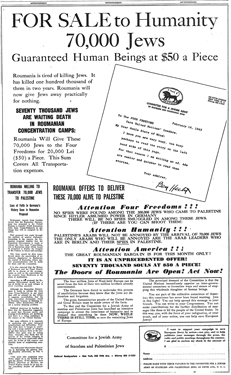
Other groups and individuals appeared less willing to go along with F.D.R.’s policy of “rescue through victory”—the idea that nothing could be done for the Jews being slaughtered in Europe except for the allies to win the war against Germany. For example, Peter Bergson (Hillel Kook) and a small group of other Palestinian Jews, who had come to the U.S. as colleagues of Vladimir (Ze’ev) Jabotinsky in the Revisionist Zionist movement, were working along with people like screen-writer Ben Hecht, and Congressman Will Rogers, Jr. to publicize to Americans the terrible news from Europe. They sought to mobilize public opinion to push the Roosevelt administration into some substantive action. Alfred’s February 25, 1943 copy of The Sentinel, a Chicago “weekly newspaper devoted to Jewish Interests”, carried a dramatic full-page advertisement by the Bergson group with the headline “For Sale to Humanity 70,000 Jews Guaranteed Human Beings at $50 a Piece...” The Romanian government, at this time in the Nazi camp, had actually expressed its willingness to save these Jews—then in concentration camps—and deliver them to Palestine for that price. 


With “Action—Not Pity” as their motto, the Bergson group, at this time calling itself the “Committee For A Jewish Army Of Stateless and Palestinian Jews”, was lobbying American Jews and the American People-as-a-whole to prod their government to do something. Korzybski had a clipping about the Bergson group’s dramatic pageant, “We Will Never Die,” which came to Chicago in May for one performance at the Chicago Stadium. As evidenced by later clippings in his personal files, over the next few years Korzybski followed the efforts of various groups associated with Bergson like the New Zionist Organization of America. Korzybski had clipped a full page ad from that organization out of the Chicago Daily News of 4-17-44. Its headline pleaded “OPEN THE DOORS OF PALESTINE”. I have not found any specific statements by him about Bergson or the Revisionist Zionists. However, it seems to me that given his sympathy for Zionism, his preference for blunt honesty, and the way that he followed reports about Bergson, et al, in the papers, he probably looked favorably upon their efforts.

If he could do little else, Korzybski as a Polish nobleman could show his solidarity with the Jewish people. In May, while the Germans were finishing their ‘liquidation’ of the Warsaw Ghetto, Korzybski decided to have the Institute issue a mimeographed edition of “The Essence of Judaism”, the 1934 article from The American Scholar he had long recommended. This version included a foreword of some four pages by Korzybski where he stated, “We reprint here the article of Professor Hans Kohn, who deals with the ‘space’ versus ‘time’ orientations, because this article is unusually valuable for getting a glimpse of modern scientific trends.”(4) To Korzybski it made sense that Nazi Germany would demonize the Jews, whose tradition, to him, represented an unusual, early, non-aristotelian outcropping of Western culture. The ‘beastly’ Nazis, on the one hand, had raised ‘lebensraum’—the space-binding, power-based conquest of territory for German dominance over lesser ‘races’—as their supreme ideal. On the other hand, Jewish culture—more consciously ‘time-binding’ in its basic orientation—elevated progress not through ‘space’ but through ‘time’, knowledge, and ‘history’; and was an exemplar for “creative individuals all over the world, who have a ‘feel’ for life, [and] have also a ‘time’ process orientation in some degree, as there is no sanity in science or life without it.”(5) Mimeographing provided the least expensive way of making Kohn’s “unusually valuable” article, with Korzybski’s commentary, available for distribution. (Never published elsewhere in Korzybski’s lifetime, Kendig nonetheless gave the article, with Korzybski’s “Foreword”, the place of significance it deserved in Korzybski’s Collected Writings.)


Notes 
You may download a pdf of all of the book's reference notes (including a note on primary source material and abbreviations used) from the link labeled Notes on the Contents page. The pdf of the Bibliography, linked on the Contents page contains full information on referenced books and articles. 
1. “Events of Week”. The Chicago Sun, 1/31/1943. AKDA Scrapbook 41.214. 

2. Transcript of IGS 1938 Summer Seminar, p. 69. IGS Archives. 

3. “The Battle of the Warsaw Ghetto” in Poland Fights, 7/5/1943. IGS Archives.

4. Korzybski, “Foreword to ‘The Essence of Judaism’ by Hans Kohn”, in Alfred Korzybski Collected Writings, p. 403. 5. Ibid.