Korzybski: A Biography (Free Online Edition)
Copyright © 2014 (2011) by Bruce I. Kodish
All rights reserved. Copyright material may be quoted verbatim without need for permission from or payment to the copyright holder, provided that attribution is clearly given and that the material quoted is reasonably brief in extent.
Unlike what one might gather from some histories of the time, Russian military intelligence was not completely primitive nor utterly incompetent. Indeed, Korzybski often scored successes in his work for Colonel Terechoff’s unit which, among other things, involved the training and running of Russian spies and the catching of German ones.
In one of these jobs, he taught a class of thieves. Terechoff, wanting to rob the safes of the German General Staff, got a half-dozen or so safe-crackers released from Warsaw jails. Korzybski gave a series of lectures to the thieves. Not on how to crack safes—which they knew quite well how to do—but rather on details about German military organization, what documents to look for, the best ways to escape from German areas, etc. Korzybski measured his success by the fact that most of his men returned safely from their missions. (5)
Some of the agents with whom Korzybski dealt, worked for the Russians strictly for money. Korzybski considered these people the lowest of the low and didn’t even like to shake their hands after briefing them. For a time, Korzybski was put in charge of dealing with double agents. The double agents were people spying for the Russians who also spied for the Germans but represented themselves to the Russians as ‘really’ working for them, not the Germans. It could get confusing. Korzybski often didn't know with any confidence where the loyalty of such people lay. In such cases he would often provide a double agent with true but useless information, such as the location of a Second Army Division about to be moved somewhere else. In this way, he might at least mislead German battle planners. (6)
With other double agents, Korzybski could more definitely 'smell a rat'. One such case involved a German officer who had come over to the Russian side. He was placed in Korzybski’s charge, to be put up in Korzybski’s Warsaw apartment. The man claimed to have information on German positions, etc., and managed to convince Terechoff of his sincerity. But Korzybski didn’t trust him. Terechoff brought the officer to the Grand Duke's headquarters, along with Korzybski. The man sat with Korzybski at one end of the room telling him in German about German positions southwest of Warsaw (so this incident must have occurred sometime early in 1915 after the Germans had already captured Lodz and the surrounding area). The man didn’t realize he was telling Korzybski details about Korzybski’s property at Rudnik and its adjacent territory. Since Korzybski was familiar with almost every stone for twenty miles around the estate, discrepancies in the man’s story indicated the man was fibbing. Korzybski kept a poker face and took notes, then excused himself as he got up to talk to Terechoff and the Grand Duke at the other side of the room. Saluting both men he reported, “That man is not an honest spy. Every word he said is just nothing but a damn lie.”(7) The German officer may have heard this or may have guessed in some other way that his ruse had failed. He jumped up and ran to the window. Alfred pulled out his gun and yelled for the sentries, who grabbed the man and took him away.
Unlike what one might gather from some histories of the time, Russian military intelligence was not completely primitive nor utterly incompetent. Indeed, Korzybski often scored successes in his work for Colonel Terechoff’s unit which, among other things, involved the training and running of Russian spies and the catching of German ones.
In one of these jobs, he taught a class of thieves. Terechoff, wanting to rob the safes of the German General Staff, got a half-dozen or so safe-crackers released from Warsaw jails. Korzybski gave a series of lectures to the thieves. Not on how to crack safes—which they knew quite well how to do—but rather on details about German military organization, what documents to look for, the best ways to escape from German areas, etc. Korzybski measured his success by the fact that most of his men returned safely from their missions. (5)
Some of the agents with whom Korzybski dealt, worked for the Russians strictly for money. Korzybski considered these people the lowest of the low and didn’t even like to shake their hands after briefing them. For a time, Korzybski was put in charge of dealing with double agents. The double agents were people spying for the Russians who also spied for the Germans but represented themselves to the Russians as ‘really’ working for them, not the Germans. It could get confusing. Korzybski often didn't know with any confidence where the loyalty of such people lay. In such cases he would often provide a double agent with true but useless information, such as the location of a Second Army Division about to be moved somewhere else. In this way, he might at least mislead German battle planners. (6)
With other double agents, Korzybski could more definitely 'smell a rat'. One such case involved a German officer who had come over to the Russian side. He was placed in Korzybski’s charge, to be put up in Korzybski’s Warsaw apartment. The man claimed to have information on German positions, etc., and managed to convince Terechoff of his sincerity. But Korzybski didn’t trust him. Terechoff brought the officer to the Grand Duke's headquarters, along with Korzybski. The man sat with Korzybski at one end of the room telling him in German about German positions southwest of Warsaw (so this incident must have occurred sometime early in 1915 after the Germans had already captured Lodz and the surrounding area). The man didn’t realize he was telling Korzybski details about Korzybski’s property at Rudnik and its adjacent territory. Since Korzybski was familiar with almost every stone for twenty miles around the estate, discrepancies in the man’s story indicated the man was fibbing. Korzybski kept a poker face and took notes, then excused himself as he got up to talk to Terechoff and the Grand Duke at the other side of the room. Saluting both men he reported, “That man is not an honest spy. Every word he said is just nothing but a damn lie.”(7) The German officer may have heard this or may have guessed in some other way that his ruse had failed. He jumped up and ran to the window. Alfred pulled out his gun and yelled for the sentries, who grabbed the man and took him away.
Korzybski avoided involving himself in the disposal of rogue Russian agents. The Russian side would somehow let the Germans know that such-and-such a person worked for the Russians. This provided a way for the Russians to get rid of those they considered unreliable—the Germans could shoot or hang them. Korzybski considered this a dirty business and wanted nothing to do with it.
He himself soon became a target for German spying efforts. He often carried documents with him that could include information of great value to the enemy, e.g., lists of agents, where they had been sent, etc. Coming home to Warsaw from the front for several days, he met a beautiful young woman who immediately fell in love with him. This made him suspicious. He wondered if she was a spy sent—as others had been—to sleep with him and steal his papers. Colonel Terechoff had an opposite on the German side named Colonel Mueller. Korzybski guessed Mueller would have been the one most likely to send such a spy. So Korzybski wrote a letter to him with the address of the town where German Army Intelligence Headquarters was located:
Dear Colonel Mueller, I am deeply grateful to you for sending to me such beautiful young girl spies. In the meantime in the future when you do so, I would appreciate it but I would just advise you to brief the girls better not to be so obvious. Yours very truly,...(8)Several days later, Korzybski was preparing to leave home and the young lady came to his apartment to say goodbye. He had gotten several soldiers to wait outside his apartment building and instructed them to arrest the woman leaving his apartment if he waved his handkerchief outside the window. Korzybski handed her the open letter and told her to read it since it was written to her friend the Colonel. At this point he hadn’t yet determined if she was a spy or not. He watched her turn pale when she saw the address and become faint when she read the letter. Her reaction confirmed his suspicions, he asked her to go, and she left. Alfred signaled with his handkerchief and the soldiers arrested her. He never learned what happened to her. His attitude here may seem harsh, but he did not take his duties lightly. He knew a good spy could cost the lives of many men.
As Terechoff’s unit captured German spies and people suspected of being spies, new problems arose. Even in Tsarist Russia and under severe wartime conditions, those suspected of spying could not just be shot. Rather, such prisoners, were sent for confinement to an old fortress about 30 miles from Warsaw manned by the Russian state-security police, known as the “gendarmes”, who later inspired the Nazi German Gestapo. As a Pole, Alfred especially loathed the gendarmes, since over the years many of his acquaintances, friends, and relatives had been harassed, imprisoned, or murdered by them. Indeed he himself had only just escaped getting sent by them to Siberia. It was already bad enough that many people in the regular army confused Korzybski’s army intelligence unit with them. To have to work with them seemed especially galling. Even worse, the gendarmes had begun to release the prisoners that Terechoff’s unit had already sent to them. This was not really surprising given that most of the gendarmes, Baltics of German descent, had strong pro-German sympathies. Neither Terechoff (nor Korzybski) would stand for the possibility that active spies might go free to continue their activities against Russia. Terechoff sent Korzybski to deal with the problem.
Korzybski arrived at the gendarmes’ fortress in a broken-down, chauffeur-driven, German-made automobile. Even with credentials from Terechoff, he had difficulty getting through the front gate. What business could this Private Korzybski have with the Colonel of the secret police? Finally, accompanied by a guard, he was allowed through and escorted into the commandant's office. Carrying his cavalry sword under his arm, Korzybski entered, clicked his spurs and saluted. After being invited to do so, he removed his hat, sat down, and handed his credentials to the Colonel, who asked, “What is the problem?”
Korzybski very politely and diplomatically explained: "The officers, your men, you harm the General Staff by releasing suspect spies which, if spies, go on being spies…I was sent by Colonel Terechoff of the Intelligence Department simply to report to you.” The Colonel seemed very sympathetic, promised that no more prisoners would be released without consulting Terechoff's office, and asked Korzybski to give his report to the fortress's staff of captains.
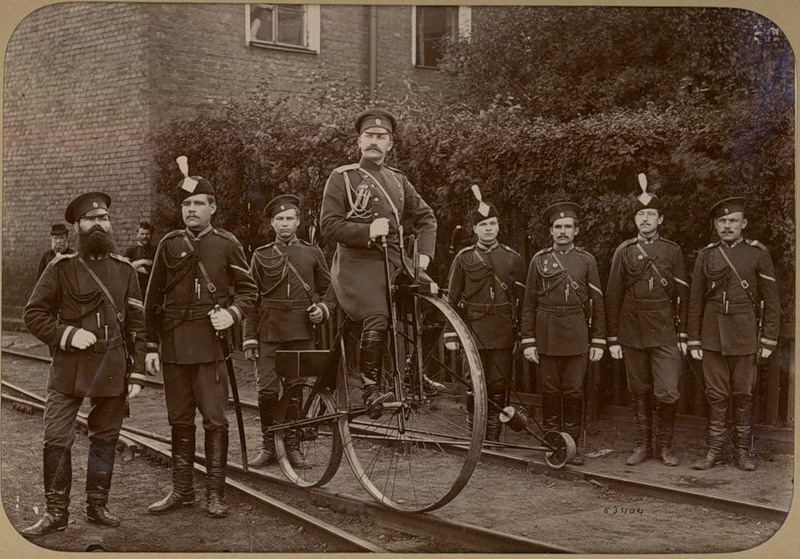 |
| A Unit of Russian Gendarmes - 1890 |
Korzybski addressed the shocked and silent assembly. “Gentlemen, we are at war. For whom are you working? For the German or for the Russian?” The atmosphere immediately changed. The captains, suddenly solicitous, agreed to do everything they could to cooperate with Colonel Terechoff’s intelligence unit. As they left the assembly room all smiles, Korzybski refused to shake hands with any of them. He did shake hands with the Colonel, who gave him a letter promising the gendarmes’ full cooperation. (9)
Notes
You may download a pdf of all of the book's reference notes (including a note on primary source material and abbreviations used) from the link labeled Notes on the Contents page. The pdf of the Bibliography, linked on the Contents page contains full information on referenced books and articles.
5. Korzybski 1947, pp. 88–89.
6. Ibid., p. 86.
7. Ibid., p. 104.
8. Ibid., p. 98.
9. Ibid., 91–96.
5. Korzybski 1947, pp. 88–89.
6. Ibid., p. 86.
7. Ibid., p. 104.
8. Ibid., p. 98.
9. Ibid., 91–96.
< Part 2


