Showing posts with label Chapter 9 - At The Disposal of The Minister Of War. Show all posts

Monday, July 21, 2014

Chapter 9 - At The Disposal Of The Minister Of War: Part 3 - How Many Horse-Miles to New York City?

Korzybski: A Biography (Free Online Edition)
Copyright © 2014 (2011) by Bruce I. Kodish 
All rights reserved. Copyright material may be quoted verbatim without need for permission from or payment to the copyright holder, provided that attribution is clearly given and that the material quoted is reasonably brief in extent.

Probably sometime late in October or in early November, Alfred happened to bump into Captain Sobanski, another friend from the front and a fellow Pole. Alfred told him about his frustrations with the war, with the ineptness of the Russian army, with the inability of Russian industry to provide adequate ammunition and supplies, and with the Tsar and his regime. He felt utterly disgusted.

Sobanski, an engineer, told him about a Russian Military Commission forming. About 200 technical experts were being sent to America to supervise the manufacture and testing of ammunition for the Russian Army. Sobanski was going as a “Senior Inspector”. He suggested Korzybski visit Colonel Moisiev who was organizing the project. Korzybski went to see the Colonel as soon as he could, presented his credentials, and asked for a job. Moisiev immediately accepted Korzybski, though he apologized that the best paying jobs had already been taken. Alfred didn’t care. He was appointed “Junior Inspector”. Their ship was scheduled to leave shortly. (According to Korzybski’s 1915 pocket calendar they sailed from Petrograd on November 17.)

Korzybski needed to get his affairs arranged, i.e., officially resign from his military appointment, obtain a passport, and get his travel stipend:

I immediately got something like $3000 or more—dollars, not rubles—in cash. Cash in hand for the travel to the United States and back. Can you imagine traveling from Petrograd to New York $3000, and say $200 for round trip. Is that a crazy price? You know how they calculated? I was entitled to four horses and the mileage between Petrograd and New York was calculated on the price of horses. Mileage by horses and I was supposed to have four horses. Do you follow the idiocy of it? So the trip was calculated on the basis of four horses and the legal cost of four Russian horses by the mile amounted to $3200 or so. So I got the money—can you imagine what was the relief of being free of the [Tsar], hav[ing] a huge amount of money in cash, as it was in rubles…7000 rubles or so. Unheard of money. Of course, idiotic all through, granted. So finally I got the money in dollars and passport and everything. And sailing in three days, five. And what I did, I wanted to pay the 100 [rubles] back to that kind general...who lent me the 100 [rubles]. And I paid 100 [rubles] for some beautiful ivory snuff-box with diamonds and I don’t know what-not. All antique or some such. And I put the 100 rubles in it, and I saw the general and thanked him so much for his trying to help me and I paid the money that way. It means a 100 [ruble] box of some sort with 100 [rubles] inside. (8)
Then, as he put it, “I resigned from my former appointments and sailed in a few days, deciding to have an educational trip, which I did.”(9)
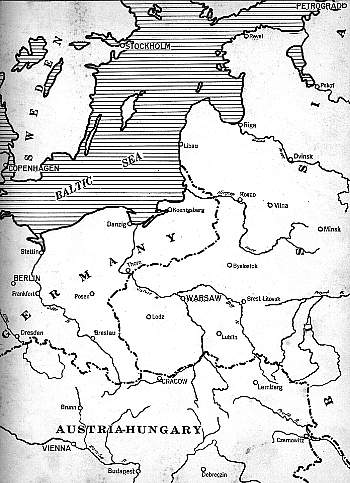
Eastern Front-North with pre-war borders shown,
(Petrograd shown in far upper right corner)

Notes 
You may download a pdf of all of the book's reference notes (including a note on primary source material and abbreviations used) from the link labeled Notes on the Contents page. The pdf of the Bibliography, linked on the Contents page contains full information on referenced books and articles. 
8. Korzybski 1947, p. 152–153. 

9. AK to V. Molodoy, Unsent letter, 12/16/1924. AKDA 15.733.

Chapter 9 - At The Disposal Of The Minister Of War: Part 2 - At The Disposal of the Minister of War

Korzybski: A Biography (Free Online Edition)
Copyright © 2014 (2011) by Bruce I. Kodish 
All rights reserved. Copyright material may be quoted verbatim without need for permission from or payment to the copyright holder, provided that attribution is clearly given and that the material quoted is reasonably brief in extent.

Korzybski’s career as a bomb-maker lasted only a short time—until July 4. He had impressed the Grand Duke and other members of the General Staff, not only for his invention (despite their inability to use it) but also because of his work with Terechoff. Korzybski was still looking to help. So by the orders of Grand Duke Nicholas, the Commander-in-Chief of the Russian Army, Korzybski was sent to Petrograd (the name of the Russian capital which had recently been changed from “St. Petersburg”) to be “at the disposal of the Minister of War.” Alfred arrived in Petrograd at the end of July. (4) Soon afterwards, he went to the Ministry of War office and was ushered in to see General A. A. Polivinov, recently promoted from Deputy Minister to Minister of War after a scandal involving his predecessor, Sukhomlinov, who was getting blamed for the accumulating war failures.

Polivinov was one of the few people in the Tsarist regime, along with the Grand Duke, whom Korzybski felt any respect for. Men like them, whatever their personal merits, were severely hemmed in by the ineptness and corruption of so many of their subordinates, colleagues, and superiors—along with the extreme inertia of the Tsarist administration, in general, and the dullness of the Tsar on top, more specifically. The resultant Russian inefficiency seemed inevitable and responsible for the debacle on the battlefield. Russian industry, although technically quite capable of providing adequate stocks of shells and other military supplies, had been stopped from doing so by dishonest businessmen, corrupt officials, and inadequate planning. With better leadership, the Russians could at least have held back the Germans from capturing so much of Russian Poland. Korzybski expected that the Grand Duke, unable to adequately replace equipment or men, would soon resign out of tiredness and desperation. The situation indeed looked desperate. The Germans were about to overrun Warsaw. And the Russian Army was retreating.

Having already heard about Korzybski, Polivinov embraced him and asked, “What can I do for you?”(5) Alfred could have chosen any situation he wanted. He wanted to serve at the front. He could no longer run around in a cavalry or infantry unit. But he had a friend serving as an officer in the Bodyguard Heavy Artillery Regiment. So he requested to be put there. He felt he could make a quite adequate artillery officer and asked permission to take the officer's exam at the Artillery Academy: 

Polivinov knew, and he knew that I knew that a complete collapse of the Russian front was in view, this request in a way was suicide, we both knew it. The so very nice old man got very excited, he jumped to his feet and exclaimed “Are you crazy?” I said, “No Excellence but I am cut away by the enemy from my home and property, so I better enlist.” With reluctance he agreed. (6) 

So with an order from the Minister of War, Korzybski went to the Commandant of  the City of Petrograd who took care of such enlistments. Just to forgo potential trouble, Korzybski had paid 50 of his last 100 rubles to a military doctor to get a medical clearance certifying his fitness for service. The Commandant looked through Korzybski's papers and then at Korzybski and refused to take him. Korzybski returned to Polivinov who went to the Tsar himself to obtain an imperial decree for Alfred to join the Regiment. 

With the imperial decree in hand, Alfred spent a good deal of time fruitlessly searching for the Bodyguard Heavy Artillery Regiment supposedly located somewhere in or around Petrograd. He couldn't find it. Meanwhile, the news from the front had not been good. On August 5, within 2 weeks of Alfred’s arrival in Petrograd, the Germans had captured Warsaw  and the Russians were steadily retreating east of the Vistula. The Grand Duke resigned at the end of August. Tsar Nicholas—whom Alfred considered a “half wit”(7)—took over the position of Commander-in-Chief in early September. Hopeless.

Korzybski also felt personally desperate. He had less than 50 rubles left in his pocket, no income, and was wondering how he was going to live. Luckily, one day on a street in Petrograd, he ran into a general whom he had known at the front. The general lent Alfred 100 rubles to tide him over and Alfred, not one to ever beg, gratefully took it. The general also suggested that Alfred, with his engineering background, might be able to get a job in the Russian armaments industry. Alfred began to consider this, and the general said he would keep a lookout for any job possibilities.


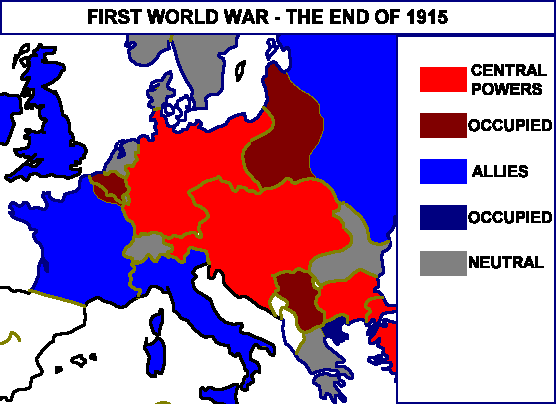
All through September and October, Korzybski remained in purgatory in Petrograd while the Russian retreat continued. By the end of September, the Germans had reached Riga, Pinsk, and Baranovichi, the former headquarters of the Russian General Staff. But the Germans had major problems too. They had reached the end of their supply lines. Along with the general destruction of battle, both the Germans and the retreating Russian forces had stripped much of the Polish infrastructure. As Korzybski had unhappily predicted, the German juggernaut could not depend on an undevastated Poland. By October, the Germans and Austrians—stuck in the White Russian and Ukrainian mud—dug into trenches facing the Russian side. Their advance had stopped.

http://www.historyofwar.org/Maps/maps_ww1_f.html

Notes 
You may download a pdf of all of the book's reference notes (including a note on primary source material and abbreviations used) from the link labeled Notes on the Contents page. The pdf of the Bibliography, linked on the Contents page contains full information on referenced books and articles. 
4. The microfilmed copy of Korzybski's 1915 pocket calendar makes it possible to specify the times for his presence there.“Kalendarz”. AKDA 2.27-2.37.

5. Korzybski 1947, pp. 148, 216. 

6. AK to V. Molodoy, Unsent letter, 12/16/1924. AKDA 15.733. 

7. Korzybski 1947, p. 148.

< Part 1      Part 3 >


Saturday, July 19, 2014

Chapter 9 - At The Disposal Of The Minister Of War: Part 1 - Introduction

Korzybski: A Biography (Free Online Edition)
Copyright © 2014 (2011) by Bruce I. Kodish 
All rights reserved. Copyright material may be quoted verbatim without need for permission from or payment to the copyright holder, provided that attribution is clearly given and that the material quoted is reasonably brief in extent.

In the winter of 1914–1915, Russian forces had some apparent success. They seemed about to capture Kracow and had reached the mountain passes of the Carpathians, which led down into the Austrian heartland. But the Austrians, with help from the Germans, pushed them back. By April, Warsaw was under threat. In addition to their losses, the shortages of shells, ammunition, rifles, clothing, and food further demoralized Russian troops.

From April to September of 1915, the Germans and Austrians relentlessly pushed forward. In the initial stages of the German-Austrian advance, Korzybski seemed to accelerate his efforts, traveling from one front to another gathering intelligence, not just for Stavka and the Second Army, but for the other Russian armies as well. But by the end of June it become clear that Russian forces would have to retreat from most, if not all, of Poland in order to just survive. The war was changing from one of mobility to one of positions and entrenchment. There would be no more need for Terechoff’s highly mobile cavalry intelligence group. It was disbanded on June 20. Korzybski helped organize the breakup of the office in Warsaw, including the disposal of equipment and the dispersal of men to other units. Where would he go?
Eastern Battle Front - 1915 
He had been thinking about an invention—a bomb. To work on it, he was sent to the Artillery Department Laboratory of the Headquarters of the Second Army. Korzybski’s invention, an incendiary device, seemed extremely simple but nasty. He manufactured some samples for a demonstration at General Staff Headquarters. His bomb consisted of a 12 by 4 inch wooden box that could easily break apart when dropped from a plane. The box was stuffed with tar and kerosene-soaked rags wrapped around a center portion containing smokeless powder. The powder in turn surrounded a thin metal capsule holding some phosphorous in a liquid solution. Since phosphorous burns when exposed to air, the bomb was set off by first breaking the capsule with an icepick. The surrounding fluid would evaporate, the phosphorous would start to burn, ignite the powder and then, in 5 to 10 minutes, the rags and then the box would begin to burn as well. At this point, the box could be dropped to do its work on a field or a roof of straw or wood.

After one successful demonstration in front of the General Staff, Korzybski was asked to do another one before Grand Duke Nicholas, who had missed it. The Grand Duke wanted to see an actual aerial demonstration, with Korzybski dropping his incendiary-box bombs from a plane onto a target field. Alfred did not relish going up in an airplane. He had not enjoyed his last plane ride—to say the least.


"Nieuport 10" (colorized) - French 2-Seater Airplane Used By Russian Imperial Forces

On the front, he had become friendly with a French flyer glad to have someone to speak with in his native language. One day the flying ace invited him to come along for a flight over the German trenches. Alfred described the ride:
I was not tied up. I had no safety belt. Not tied up and he wanted to give me the thrill which he assumed would be the thrill of my life, he began to make the loop over the German trenches and of course, the Germans did not appreciate the joke and they riddled us with machine guns. Well, I had very little to say about that because that son of a gun was doing the driving. We were in the meantime riddled with bullets on one side and on the other side, retaliating to the Germans, out of the window I was vomiting like hell on them. It was one of my first rides. How much I got to them I don't know. Their bullets got to us all right. The rest of my reaction was probably lost in the winds. But anyway I did it. Naturally when we came back home, [so to] speak home, naturally I gave him  ‘a piece of my mind’, so to say in quotation marks, no more airplanes for me. Well I did not calculate properly. Grand Duke Nicholas wanted to see....(1) 
The Grand Duke insisted and Alfred considered it his duty not to refuse:
I took my incendiary bombs with me and then we began to fly....What was I doing putting the ice pick into the phosphorus—oh, I don’t want to make a monkey out of myself...and I don’t know I dropped a half dozen of them, or a dozen, it doesn’t matter because they were small things and the question was just to make fire for five, ten minutes. They were timed deliberately for a short exposure, so to say, for air. They all collapse and they start burning, and in the meantime, I nearly, somehow, I nearly burned down the airplane by mistake and the pilot got nervous and so when we were landing he nearly smashed  the airplane. So, of course, we have an interchange of opinions about his capacity as a  pilot and my capacity as a bombadier. Just an exchange of opinions, that’s all...In the  meantime in front of Grand Duke Nicholas both of us had to keep our opinions in rather polite language. And there were two of my airplane rides. And since then [Alfred was telling this story in 1947], no more airplane rides, thank you. (2) 

Although in later life he realized commercial airline travel had become “not so unpleasant”(3), it seems he never did fly again. As for his incendiary bomb, although the demonstrations impressed the Russian and French officers watching them, his bomb was not used, since, with the diminishing front and the relatively short range of their planes, the Russians were worried about burning up parts of their own territory. The French later used their own version of an incendiary bomb using glass bottles which, in Korzybski’s opinion, didn’t work nearly as well.


Notes 
You may download a pdf of all of the book's reference notes (including a note on primary source material and abbreviations used) from the link labeled Notes on the Contents page. The pdf of the Bibliography, linked on the Contents page contains full information on referenced books and articles. 
1. Korzybski 1947, p. 304. 

2. Ibid., pp. 304-305. 

3. Korzybski 1947, p. 304. 

Part 2 >