Tuesday, April 14, 2015

Chapter 56 - Time To Try New Things: Part 4 - The Process of Abstracting

Korzybski: A Biography (Free Online Edition)
Copyright © 2014 (2011) by Bruce I. Kodish 
All rights reserved. Copyright material may be quoted verbatim without need for permission from or payment to the copyright holder, provided that attribution is clearly given and that the material quoted is reasonably brief in extent.

The July seminar-workshop was notable for more than its new structure. Korzybski also produced a mimeographed handout for an important new visualization, to use with the structural differential, for conveying the process of abstracting. As a partly iconic, visual (and kinesthetic) representation of Korzybski’s system, nothing had seemed to match the differential as a training device—once students understood the distinctions and relationships represented. There was the rub. Some basic and persistent misunderstandings of the differential by students had vexed him for several years. The origin of Korzybski’s new diagrammatic formulation of abstracting came from his attempt to deal with some of these issues, particularly brought to the fore by Hayakawa’s work.

He described part of the problem in a May 24 letter to Robert Lee Durham, President of the Southern Seminary and Junior College in Buena Vista, Virginia, who had sent a letter asking about some fundamental issues related to identity and identification:
You know from Science and Sanity the structural differential. On top there is the event, then comes the ‘object’, and then follow higher and higher order abstractions. On a printed page the ‘higher’ go ‘down’. A great many students are somehow confused because higher and higher abstractions in a diagram go physically lower and lower on a printed page. In the lithographed edition [1939] of Hayakawa’s Language in Action the differential was given the way it was in Science and Sanity, from the top of the page down, which was correct. He was pestered by his students on this subject. Somehow he did not know the answer, so in the printed text edition of his book on page 96 he turned around the differential and put in print: ‘Start reading from bottom UP’. Why in the dickens then do it, when normally you read from up down? The answer is the unconscious assumption trained in us in a pre-scientific orientation; namely, the earth is flat and so ‘up’ and ‘down’ have absolute value, while on a spherical earth they have only relative value. (9) 

In the later editions of his book, Hayakawa had further compounded the problem of reversing the Structural Differential by renaming it “The Abstraction Ladder”, a metaphor that reified the unconscious assumption of absolute ‘up’ and ‘down’ and obscured the process aspect of abstracting. Hayakawa’s ladder metaphor effectively eliminated the circularity of human knowledge, the important connection between the highest and lowest levels in the process. In subsequent editions of the book, Hayakawa even used a picture of a ladder with a little man seemingly stranded at the top.

The structure of a representation could radically change what got expressed. Korzybski had long warned his students about the dangers of translating the non-aristotelian system into the old elementalistic distinctions and terminology. To a significant extent, Hayakawa had so far—and would continue—to do exactly that. Korzybski had advised speaking in terms of “evaluation”. But in Language in Action, Hayakawa continued to talk about ‘meaning’ without quotes (easier to forget about a ‘meaning-maker’). Korzybski had built his terminology distinguishing different orientations (extensional versus intensional), from the prior distinction between extensional and intensional definitions. He had rejected the distinction of ‘denotation’ and ‘connotation’ as elementalistic and confusing, since it depended on what he considered a faulty distinction between ‘objective’ and ‘subjective’ factors. But Hayakawa built his discussion in terms of ‘extensional meaning’ or ‘denotation’ and ‘intensional meaning’ or ‘connotation’. Hayakawa wrote:
The extensional meaning of a word or expression is that which it points to (denotes) in the extensional [physical] world...[it] cannot be expressed in words, because it is that which the words stand for...The intensional meaning of a word or expression, on the other hand, is that which is suggested (connoted) in the mind. (10) 

If one accepted Korzybski’s contention that any definition (extensional or intensional) evaluated—by someone—had a neurological context, one could not continue to distinguish ‘denotation’ from ‘connotation’ in the way Hayakawa had done. Using Hayakawa’s elementalistic terms in quotes, any ‘meanings’ had to exist ‘in the mind’, i.e., ‘inside someone’s head’. Talking about ‘denotation’ and ‘connotation’ in the way Hayakawa did, implied a sharp distinction between ‘objective’ and ‘subjective’ factors that didn’t exist, even if most people felt familiar and comfortable with those terms.

Hayakawa’s presentation of ‘general semantics’ had other related problems, including: his under-emphasis of non-verbal levels of abstracting; his emphasis on individual words rather than statements to illustrate different levels of verbal abstraction (potentially very misleading since determining the level of abstraction of one word compared to another required a larger context); his under-emphasis on the constructive as well as the ‘leaving out’ aspects of abstracting; his failure to connect mapping to the process of abstracting; his relative neglect of self-reflexiveness and complete neglect of multiordinality; his neglect of the elementalism/non-elementalism distinction and his persistent use of elementalistic formulations (e.g., talking about ‘affective’, ‘informational’, ‘directive’ and ‘pre-symbolic’ dimensions of language as if these could exist as entirely separate forms); his persistence in formulating elementalistically in terms of ‘meaning’ (he could have remedied this somewhat by using quotes but in the book he had neither discussed nor used single quotes or hyphens as safety devices); his interchangeable use of ‘semantics’ with ‘general semantics’ long after Korzybski had warned him and others about the confusion it caused; et cetera.

According to Kendig, as early as 1943 “as he said at the time, [Korzybski] was ‘struggling how to put his finger on’—how to convey to a writer—the hidden confusions in a manuscript about poetry and science.”(11) She nigh surely was referring to Hayakawa as the writer and to his article “Poetry and Science” published in 1942 in the English Institute Annual, which he reprinted in the Summer 1944 volume of ETC. After grappling with these issues for about a year, Korzybski presented his new diagram to the first summer seminar-workshop class. With a revision of it in 1946 (to bring in feedback interactions and interplay among the levels) and further explanatory text then and in 1950, the diagram became a centerpiece of his teaching in seminars and in his writing until the end of his life. Using it as an adjunct to the Structural Differential, he wanted to make as clear as possible the notion of abstracting as a neurological process.


The Process of Abstracting, 
by Alfred Korzybski (1946,1950)


Notes 
You may download a pdf of all of the book's reference notes (including a note on primary source material and abbreviations used) from the link labeled Notes on the Contents page. The pdf of the Bibliography, linked on the Contents page contains full information on referenced books and articles. 
9. AK to Robert Lee Durham, 5/24/1944. IGS Archives. 

10. Language in Action (1940), p. 27 

11. Kendig, Foreword to Korzybski’s “An Extensional Analysis..., in Alfred Korzybski Collected Writings, p. 565.


< Part 3      Part 5 >


Monday, April 13, 2015

Chapter 56 - Time To Try New Things: Part 3 - Some Students

Korzybski: A Biography (Free Online Edition)
Copyright © 2014 (2011) by Bruce I. Kodish 
All rights reserved. Copyright material may be quoted verbatim without need for permission from or payment to the copyright holder, provided that attribution is clearly given and that the material quoted is reasonably brief in extent.

Three first-time students at the seminar-workshop illustrate a variety of responses to Korzybski’s work. David Harold Fink, a psychiatrist then living in Detroit, had published a book, Release From Nervous Tension in 1943. One chapter, “Words Are Triggers To Action” made generous use of general semantics although he made no mention of it or Korzybski. In writing his book, Fink seems to have been mainly influenced by Chase and Hayakawa, whose books he did mention. (He would also mention Wendell Johnson in later editions.) What he got out of the seminar-workshop seems hard to say since little changed in subsequent editions of his book and I’ve found no correspondence between him and Korzybski. (Mira did read Fink’s book and made notes about the chapter for Alfred.) Pooh-poohed by some academic psychiatric reviewers, Fink’s book would become a self-help bestseller, going through numerous editions over the next several decades and selling hundreds of thousands of copies. Fink wrote about the importance of becoming aware of words as directive maps, which entailed emotional reactions of all kinds. Human progress, social and individual, involved the process of making better, more scientific word maps. Undoubtedly, works like Fink’s, derived in part from Korzybski’s work (without directly referring to it), did much to bring a few of Korzybski’s basic notions into more common usage.

A second student, Alabama native Annie Goulding Dix, taught English and Journalism at the Richmond Professional Institute of the College of William and Mary. A fellow teacher had given her a copy of ETC., something about it grabbed her, and she immediately signed up for the 1944 summer seminar-workshop. A kindly intelligent woman with little pretense, she was willing to do the simple-sounding stuff Korzybski suggested and found it more than eye-opening. As she recounted years later in a memoir, she “found [general semantics] of more value to her students than any other subject she had taught.” It became a central part of her teaching repertoire for the remainder of her career—although she would have to learn how to deal with the reactions of some of her colleagues:
“What is new in all of this?” say some of my learned friends. “It’s all old stuff; everybody knows it. It’s too obvious.” So they will not waste their time with it. I am reminded of the story in the Bible of Naaman, the Syrian captain, who came to the prophet Elisha to be cured of his leprosy. Elisha said, “Go and bathe seven times in the River Jordan.” Naaman was insulted by such trivial treatment, and went away in a rage. His servants said to him, “If he had told you to do some big thing, you would have done it. Why not try what he says?” So he put his pride in his pocket and went back to do the thing that was so trivial that it was insulting. And, lo and behold, he was cured!
Ann felt willing to experiment with what she was learning at the seminar-workshop:
I remember the first time I consciously tested the efficacy of language usage as suggested by General Semantics. It was during my summer with Korzybski in Chicago in 1944. I was in the Loop in Chicago. It was dinner time and I was hungry. I looked at menus in the windows of restaurants. One was appealing, except that it had carrots, food that I had hated since I was a child. Korzybski had recently discussed the obvious fact that all things change. The ancient Greek philosopher, Heraclitus, put it this way: “No one can step into the same river twice.” You come nearer to communicating what you mean if you mentally date your comments. For example: myself 1944 is not myself 1914. So I consciously brought my distaste for carrots out into the open. “As a child, I didn’t like carrots. I still don’t like them.” Now to test the General Semantics suggestion, I said to myself: “Annie Goulding (as my mother called me in 1914) didn’t like carrots. Now, I am Ann (as my friends call me in 1944.) Those two persons are not the same.” So putting my distaste in my pocket (as Naaman had put his pride), I went into the restaurant and ordered the dinner with the carrots.

And, lo and behold, they were delicious.

Thus I discovered that, to speak truth in any judgment or evaluation, the tense of the verb is very important. In this case, only the past tense: “I hated” carrots or “used to hate carrots,” was true. By testing for current facts, I saw that my use of the present tense: I “hate carrots” was false. Many changes had occurred in those past thirty years. I had no current opinion. I had only been quoting the opinion of that little girl of long ago. (4)

In 1947, she would become a professor at the New Jersey State Teachers College (now Montclair State University), where she worked until her retirement in 1962. Afterwards, she continued teaching adult classes in GS. She wrote only a few articles for ETC. and the General Semantics Bulletin. But one of them, “Avoiding The Dangers Of Semantic Adolescence”, presented in 1951 as a paper at the First Conference on General Semantics at the University of Chicago, provides one of the clearest accounts of some of the dangers and challenges involved in internalizing a non-aristotelian orientation.
Beware of merely talking about general semantics without applying its principles in practice. The highly verbal individual who finds in general semantics a new and exciting philosophy is in danger of keeping it forever on the verbal level, thus increasing the very futility that its discipline hopes to correct. ...general semantics has not served its purpose until it enters into the language and evaluative habits of the individual. It is this that concerns me as a teacher,...Our beginners—be they young or old—need to be constantly reminded of what Korzybski said: that extensional orientation is a lifetime process. The exhilaration that comes with the beginning of awareness is not the end but only the beginning, and the growing or adolescent stage will not always be easy. But the maturity we seek is worth the effort. (5) 

A few years after her seminar with Korzybski, Ann would move to New York City and marry another student of Korzybski, Adlerian psychiatrist Joseph Immanuel Meiers—a Jewish refugee from Latvia. Both Ann and Joseph Meiers exemplified the quiet maturity and good humor of Korzybski’s best students. They didn’t become famous, but as relatively uncelebrated leaders they positively affected many people’s lives. (The couple became life-long friends of Charlotte Schuchardt Read and Allen Walker Read, living a few blocks from them on the upper Westside of Manhattan near Columbia University.)

A third notable student at this first IGS seminar-workshop was a twenty-three year old ‘firecracker’ from Miami, Florida named Ken Keyes, Jr. He had joined the Navy in the summer of 1941. As he had hoped by enlisting early, he was able to live at home while ‘sailing a desk’ in a Naval Intelligence censorship unit in Miami. By 1944, he was serving as chief petty officer in a Naval Intelligence photo lab on the ‘U.S.S. DuPont’, his name for the building in downtown Miami where he had his office. Ken and his wife, Roberta Rymer Keyes, already the parents of two, had become very enthusiastic about general semantics and its possibilities for reforming childhood education.

They (mainly Ken) began corresponding with the Institute in 1943 on the stationary of an organization they had just founded, “The Society for Educational Research—a non-profit group devoted to the formulation and dissemination of objectives and methods for 20th Century education”. With considerable financial resources (both Ken and Roberta had wealthy parents) they had already in 1944 bought 45 acres of property south of Miami for a non-aristotelian educational experiment they planned. Using general semantics as the core they were “hoping to set up and run a demonstration project in which five orphans from each race of humankind could grow up in loving harmony together.”(6) Life eventually prevented the project from happening.

Although Korzybski and Kendig provided encouragement, there seems more than a whiff of utopianism in Keyes’ letters. His ‘semantic adolescence’ seems clear from a note he wrote to Korzybski at the seminar: he had not prepared a personal history for his interview because “there are no personal problems of personality maladjustment, relations with people, etc., that I am aware of at the present time.”(7) (Years later, Keyes would write extensively about his own personality problems after he did become aware of them.) In his interview, he wanted to talk with Korzybski about the work he and his wife were planning. It seems likely that Korzybski indulged him. Without question Keyes could get things done. He had already demonstrated talents as a businessman, inventor, and photographer, among other things. He had access, probably through his work, to people with graphic design and printing skills. Although he wasn’t able to stay until the end of the workshop, he had agreed to prepare for seminar participants a professional-looking print handout of Korzybski’s blackboard diagrams—which he did. Korzybski and Kendig greatly appreciated his work.

The young man seemed very serious about changing the world with general semantics. Soon after the seminar-workshop in September 1944 he changed the name of his organization to “The Institute for Non-Aristotelian Research and Education”. Over the next year and a half, he continued to correspond with Korzybski and Kendig about the organization’s projects. He formed a study group in Miami, gave seminars; and sent professional-looking graphic mockups to Korzybski with cartoons and illustrations for a handbook he was producing, as well as for a journal for an association of GS teachers he wanted to establish.

In June 1945, Korzybski wrote to him, bluntly advising him to ‘put on the brakes’:
Your experience in teaching GS is not long enough or good enough...I am not trying to discourage you. Your ambitions are praiseworthy, but certainly for success you have to slow down and give yourself more time to digest the whole thing in your organism more. (8) 

After leaving the Navy, Keyes with Roberta and their two children, would put aside his institute and its long-term educational projects for the more immediate business of making a living. Then in 1946, their institute got permanently shelved after he contracted polio. But, despite becoming significantly disabled, he—and Roberta—would help Korzybski afterwards in a most important way.


Notes 
You may download a pdf of all of the book's reference notes (including a note on primary source material and abbreviations used) from the link labeled Notes on the Contents page. The pdf of the Bibliography, linked on the Contents page contains full information on referenced books and articles. 
4. Annie Dix Meirs 1995, pp. 61-62. 

5. Ann Dix Meiers 1952, p. 277. 

6. Keyes 1989, p. 16. 

7. Ken Keyes, Jr. to AK, nd. I.G.S Archives.

8. AK to Ken Keyes, 6/21/1945 qtd. in letter of Ken Keyes, Jr. to AK, 7/5/1945. IGS Archives.


Sunday, April 12, 2015

Chapter 56 - Time To Try New Things: Part 2 - The IGS Seminar-Workshop

Korzybski: A Biography (Free Online Edition)
Copyright © 2014 (2011) by Bruce I. Kodish 
All rights reserved. Copyright material may be quoted verbatim without need for permission from or payment to the copyright holder, provided that attribution is clearly given and that the material quoted is reasonably brief in extent.

One way to develop new leaders would be to open up Korzybski’s seminars. For one thing, Kendig had long noticed that,
...The people who came to [Korzybski’s] seminars got a great deal out of them, and they were moved, and something happened inside of them, inside of their skins. But they got some very peculiar notions that they took away in their notebooks—I used to look in their notebooks sometime. So I thought, well, I asked him if I could just have a few sessions afterwards, after the seminars, and find out what was inside their heads,...I thought it might be nice if we could straighten out at least some of their verbalisms, as well as their semantic reactions. (2) 

For a number of years, Korzybski had provided time slots during his seminars for guest lecturers such as Dr. William Peterson, a University of Chicago physician and an Institute Honorary Trustee who had authored a multi-volume work on the influence of weather on health and behavior. Johnson, Hayakawa, Lee, and others had also lectured on non-aristotelian applications in their work. Why not bring in these kinds of presentations—and what Kendig wanted to do—after Korzybski had introduced the system? These extensions to Korzybski’s seminar would emphasize participant practice and the variety of applications of the system—a workshop. After all, application remained the main thrust.

By February, the first IGS “seminar-workshop” (Kendig’s term for the new format) was being planned for that summer. As Kendig wrote in a promotional letter she sent out a few months later, “At this time it seems to us that increasing competence of ‘old students’ is of equal or greater importance than enlarging the number of IGS students. The seminar-workshop program was organized to suit this situation.”(3) After this first one in 1944, the IGS would continue the Seminar-Workshop—with ongoing transformations—as a yearly offering usually given for three weeks every summer. (Elements of the workshop were integrated into Korzybski’s shorter intensive seminars as well.)

This first one was supposed to go from July 6 to 28, but having to rearrange the schedule to accommodate the guest speakers allowed them to finish two days early. Korzybski first gave the seminar, his 36 hours of lecture-demonstrations on the basic formulations. Then while he saw individuals for interviews, the other students participated in the workshop sessions (another 50 hours), which included group discussions with Kendig on applying GS, as well as lecture sessions and other activities in areas of special interest led by various advanced students such as Congdon, Hayakawa, Johnson, and Bontrager. Raymond W. McNealy, M.D., Institute trustee, surgeon and medical school professor discussed “General Semantics and Medical Education”. Wilbur E. Moore, head of the Speech Department at Central Michigan College of Education, gave presentations on “New Patterns for Debate”, and “Non-verbal Electrical Tests of Extensionalization”. (He had been doing research on the effects of extensional training on galvanic skin resistance using ‘lie-detection’ instruments). Korzybski also had some sessions with those who had attended previous seminars to deal with theoretical and practical questions related to people’s attempts to make applications. Francis Chisholm, who gave several workshop presentations, assisted Kendig in organizing and running the entire seminar-workshop.


Notes 
You may download a pdf of all of the book's reference notes (including a note on primary source material and abbreviations used) from the link labeled Notes on the Contents page. The pdf of the Bibliography, linked on the Contents page contains full information on referenced books and articles. 
2. M. Kendig, “Talk in Los Angeles, 1/18/1961, Unpublished. IGS Archives. 

3. Kendig promotional letter, 5/19/1944. AKDA, IGS Scrapbook 4.13.

Saturday, April 11, 2015

Chapter 56 - Time To Try New Things: Part 1 - Introduction

Korzybski: A Biography (Free Online Edition)
Copyright © 2014 (2011) by Bruce I. Kodish 
All rights reserved. Copyright material may be quoted verbatim without need for permission from or payment to the copyright holder, provided that attribution is clearly given and that the material quoted is reasonably brief in extent.

If the fund-raising letter motivated people to help, the Institute’s financial problems would have better chances of resolution. Korzybski maintained that the Institute, if it survived, had a useful function to serve in “breaking the hold of aristotelianism”. He penciled in those words below the last paragraph of a later mimeographed version of an April, 1944 memorandum that he wrote to Kendig “about his future-work program.” The paragraph read,
Please remember that my age and war injuries are getting to be a handicap and I have only a few years left for constructive work. And yet I feel that I still have something to contribute for the future of mankind. These few years should be spent in the most constructive way for the future, by preserving the Institute as a center for the training of future leaders, so that there will be some capable people able to carry on. Knowing the difficulties, I do not believe that without a special center such training of leaders can be accomplished, and I believe this should be the main immediate aim of the Institute. (1) 
They would do what they could. But 1944 was going to be a tough year. With registrations for seminars at their lowest point, Korzybski would only give two Institute seminars this year—plus lectures at the end of February at the Menninger Psychiatric Clinic in Topeka, Kansas and lectures at a University of Denver Workshop in August. Given the hobbling state of Institute finances and Korzybski’s goal to develop leaders, it seemed like a time to try new things.


Notes 
You may download a pdf of all of the book's reference notes (including a note on primary source material and abbreviations used) from the link labeled Notes on the Contents page. The pdf of the Bibliography, linked on the Contents page contains full information on referenced books and articles. 
1. “Memorandum From Alfred Korzybski to M. Kendig About His Future-Work Program”, April,1944. (Mimeographed IV/1945). IGS Archives.


Thursday, April 9, 2015

Chapter 55 - Poland Fights: Part 3 - A Serious Curmudgeon

Korzybski: A Biography (Free Online Edition)
Copyright © 2014 (2011) by Bruce I. Kodish 
All rights reserved. Copyright material may be quoted verbatim without need for permission from or payment to the copyright holder, provided that attribution is clearly given and that the material quoted is reasonably brief in extent.

Reading Korzybski’s personal correspondence with Mira throughout 1943 makes it hard not to put him in the category of ‘serious curmudgeon’. He wrote to her, talked to her by phone, went out with her occasionally, and saw her at the seminars she was continuing to attend. She mainly spent her time reading, reading, reading; taking time from her studies to send him clippings, letters with suggestions for his work and the Institute, outlines from books she read and lectures she attended, and love notes. He made use of many of her suggestions—eventually—and appreciated a great deal of what she sent him, including book and lecture notes, when he had time to read them thoroughly. But 1943 was still characterized by phone blowups by him, as well as letters scolding her for what he considered irresponsible verbalizing or for her ‘Sarah Bernhardt ways’ in public or for interfering with his students and staff at the Institute. How much actual justification he had for his complaints seems hard to say. I have the distinct impression that much of it actually had little to do with her behavior and more to do with his unhappiness with the state of the world, and the pressures he felt from his unending work and financial worries. 

As the person who, for all their troubles, remained the closest to him, Mira served as the target of choice for Alfred blowing off steam. It still bothered her but she seemed to have a better ability now to not let it bother her too much. She seemed to realize that he had no one else to complain to. Then too, at times he seemed to be softening. He sometimes would write to her without vituperation—simply confessing his tiredness with the endless work, the constant interruptions from former students dropping in or writing letters for advice, the seemingly endless exhausting personal interviews which accompanied the seminars and which he also provided—for a fee—for former students on request, problems with trustees and with staff, and his vicarious suffering from the war and the conditions in Poland, etc., etc., etc. She loved him. She felt grateful for the fact that he was supporting her in a way that finally was allowing her to get some of the education she had missed most of her life. And she seemed more cognizant than before that his almost complete dedication to work and consequent lack of ‘everydayishness’ with her did not reflect any lack of love or concern for her. He reiterated that he was doing it all for her. And she believed him. Even considering this, at times it was not easy to be married to Alfred.

In spite of this, it would be a mistake to think that Korzybski was perpetually boiling over in a bad mood. He may have had, as he frankly admitted at times, a rather pessimistic outlook on life, but he did not seem much inclined to let himself succumb to depression. He had always had the ability to bury himself in whatever task he had taken for his work. And he seemed to find it congenial to take a stoic attitude towards the whips and scorns of life. Indeed, he scorned the scorns. He could somehow often laugh at himself or at least make a wry joke out of his pains and troubles. And there was always one damned thing after another to provide such ‘comic’ material. Here, in a February 1944 letter to Douglas and Marian Campbell, he described his general condition and gave an account of one of those ‘damned things’ that happened toward the end of 1943:
I know that Kendig is keeping you informed of our official doings because I read the copies of her letters. Here I may tell you a few of my private news. I am overworked and imposed upon by a great many students. In connection with endless administrative duties, editorial work, writing, lecturing, and personal interviews. Sometimes I doubt if a Missouri army mule, even in sunny Calif...I am sorry, I mean Italy, would stand all of that. But somehow I stand it. My old war injuries, and particularly hernia, bother me quite a lot. Dear old McNealy looked me over physically thoroughly and found me in good shape, but he believes that an operation on my hernia would be too late for me now. You know my sweet disposition about monkeying around with doctors. Well, I can tell you a funny story of what I would call a ‘modern medical treatment’. As you may know, I have rubber soles on my shoes and my stick has also a rubber end, the three of them being slippery like hell on wet surfaces. Well, just the day before the intensive seminar, which means more than 6 hours a day for 2 or 3 weeks, last August I slipped in my office, fell down and cracked a rib. Pearl telephoned to McNealy describing how I feel, being an Adam when something interferes with my rib. The telephone diagnosis was ‘cracked rib’, and McNealy suggested we call a doctor who supposedly was pretty good, to come and bandage me. We called him, he came, and did really a lousy job (5 bucks please). I did not feel that I could lecture all day under those conditions of pain I had. The Old Faithfuls, Charlotte and Pearl, decided to take care of me. I had to sit on the bed without a shirt, but the rest of me intact; they got a mile of adhesive tape, sat on each side of me and put their feet in the remaining ribs, and started to make a mummy out of me, bandaging me as far as they could. They certainly made a good job, and I went through the seminar and interviews with flying colors. Being a vital fellow, I am a ‘hairy ape’. You can imagine what fun I had when the damn tape was taken off. When it was taken off Dr. [Samuel] Rosen of New York was here with his wife and I had an interview with them the same night. Dear old Mrs. Rosen laid on the sofa and went to sleep; dear old Rosen (M..D. and an old student) felt it his professional duty to take the bandages off the hairy ape. But after hours of pulling hair by hair I had enough of professional help, and under the alibi that his wife needs to go to bed for good, I begged the professional to leave me alone, which ultimately they did. Then Charlotte and Pearl began to soak me in benzine and instead of pulling hair by hair, they pulled them out in bunches, which was much easier for them and me. Ultimately it was a happy performance. You probably know my biblical inclinations, and so you realize my appreciation of the monkey-business the almighty did to poor Adam. By this time, in spite of the work on the seminars and interviews, I was recovered.

The old staff, Kendig, Charlotte, Pearl, Anne and Mrs. Williams [Kendig’s secretary], stick with us at the Institute. It is really a joy and help to deal only with old students. There is so much in it, no matter with how many of their god damn ‘mamas’ I have to struggle, so far successfully. (11)

Notes 
You may download a pdf of all of the book's reference notes (including a note on primary source material and abbreviations used) from the link labeled Notes on the Contents page. The pdf of the Bibliography, linked on the Contents page contains full information on referenced books and articles. 
11.AK to Douglas and Marian Campbell, 2/1/1944. IGS Archives.


< Part 2 

Tuesday, April 7, 2015

Chapter 55 - Poland Fights: Part 2 - The Need for Funds

Korzybski: A Biography (Free Online Edition)
Copyright © 2014 (2011) by Bruce I. Kodish 
All rights reserved. Copyright material may be quoted verbatim without need for permission from or payment to the copyright holder, provided that attribution is clearly given and that the material quoted is reasonably brief in extent.

As midyear approached, Korzybski could do very little to help the Jews or anyone else in his besieged homeland. He had little time or money to donate to any efforts like Peter Bergson’s. The Institute was barely scraping by financially. It was getting harder to get students. He would give only four seminars that year, with smaller class sizes. In addition, the Institute had just expended a great deal of time and money to publish the Papers from The Second American Congress on General Semantics, finally coming out at the end of July. After much delay, Kendig had completed the final major job of writing the contributors’ biographies earlier in the year. They had gotten page proofs from the printer in April of 1943. 

The struggle to produce the Congress volume definitely seemed worthwhile. In an “Acknowledgment” dated May, 1943, Alfred had written:
...My words of appreciation can not convey the depth of my feelings of gratitude for the Congress and to the Congress contributors and those responsible for this volume. In many ways, this Second Congress with all the empirical data and the whole atmosphere was an unique experience for me. After the struggle to formulate a non-aristotelian system, to see that it does actually work in practice was a sort of fruition of a lifetime’s work. So once more I want to express my deep-felt thanks to those who contributed to that memorable occasion. (6) 
Nonetheless, despite the back orders for the volume, it would take some time to recover the Institute’s investment.

Another significant burden on the Institute was the Society for General Semantics and its new publication, now called ETC.: A Review of General Semantics. S. I. Hayakawa, who had been appointed editor, was working furiously on getting out Volume I, Number 1 of the journal. (Scheduled for June publication, it finally came out in August.) Although the Society existed as a separate organization, helping it and Hayakawa had definitely taxed Korzybski’s already reduced and over-worked secretarial staff. (Korzybski, who took seriously his role as a “Consulting Editor”, also contributed to the journal’s first issue. He wrote a letter to the editor on the significance of the new journal’s title, and a foreward to an article on “Science and Values” by Edward L. Thorndike, that he had gotten Hayakawa to reprint. Hayakawa had also reprinted Korzybski’s early post-Manhood article, “The Brotherhood of Doctrines”.)

Besides the Congress Papers, the Institute was adding to its record of solid work and accomplishment with an expanding offering of general-semantics related articles and books. These included a new Institute publication for seminar students on The Technique of Semantic Relaxation by Charlotte Schuchardt, who by then had taken on a significant part of the teaching of that activity at Korzybski’s seminars. With even greater impact, as Kendig pointed out in her letter, over two hundred thousand copies of Hayakawa’s Language in Action, several thousand of Lee’s Language Habits in Human Affairs, and many copies of Johnson’s Language and Speech Hygiene, had gone into circulation. ETC.was widening public interest in general semantics as well. Hayakawa, Lee, and Johnson, among other students of Korzybski, were writing articles and becoming well-known in their respective fields. Hayakawa, in particular because of his book, had become a national figure and was locally known as well because of a regular column he’d begun writing for the Chicago Defender, Chicago’s weekly newspaper for the Black community.

Interest in general semantics or ‘semantics’, not all of it enthusiastic, was becoming widespread in the broader intellectual community. In the Fall 1942 issue of the marxist Journal, Science and Society, Margaret Schlauch had written an extremely critical piece, “Semantics as Social Evasion”, based on her misinterpretations of Korzybski’s work. English professor and literary theorist Herbert J. Muller also misconstrued Korzybski’s work, but came out more favorably towards it in his book Science and Criticism: The Humanistic Tradition in Contemporary Thought (published in March of 1943):
... Science and Sanity can equip [the critic] with a sounder grammar and vocabulary. Unlike the positivists and the totalitarian reformers, Korzybski points to a principle of flexibility, not a fixation, as a solution to our problems. He leaves room for the necessary criticism and supplement of his thought...” (7) 

In more popular American culture, ‘semantics’ had become pervasive. A newspaper review described the late 1943 movie Lost Angel starring six-year-old child actress Margaret O’Brien. The movie concerned “a group of scientists who take over a foundling child and attempt to educate her in lore and knowledge, forgetting altogether the human equation. She is taught semantics, music, Napoleonic history, Chinese economics and the higher sciences and arts.”(8)
clip from Lost Angel

 As Allen Walker Read would write in his 1948 article “An Account of the Word ‘Semantics’”: “The great popular vogue of the word semantics can be traced to the ferment caused by the works of Alfred Korzybski.”(9) But already by 1943, the term had slipped away from any korzybskian moorings it might have had and was likely to be used to refer to a mishmash of Korzybski’s work with that of others, or to indicate detached verbalism, verbal quibbling, or the intentional use of words to mislead and deceive. It had become clear to Korzybski that it confused people for students of his work to refer to it as ‘semantics’. As a result, he was emphasizing even more strongly the importance of explicitly distinguishing between ‘semantics’ and ‘general semantics’.

Despite the significant public interest, with wartime asperities prevailing the Institute was going to have difficulty surviving for very much longer. The income from seminars (Korzybski taught 37 of them from July 1938 to the end of 1943), and from books (even with greatly increased sales of Science and Sanity), could not cover expenses. The Institute continued to get financial help from various individuals. In April, it received $1,000 from the Society for General Semantics, which had pledged $5 from every individual’s membership dues. None of this sufficed. The Institute was going to be drawing on cash reserves soon. Without a significant infusion of more money, it would not be able to continue past 1944—let alone carry on the kind of program Korzybski and Kendig had envisioned but had not yet been able to carry out. In October Kendig wrote to Charles Congdon, who had been elected President of the Society and was still on the Institute Board of Trustees:
Some days ago I sent you the Financial Report which was submitted at the Annual Meeting. I call your attention particularly to the Forecast for 1943-44. You will notice that we had an operating deficit of over $6,000 for 1942-43 and forecasted operating deficit of $13,500 for 1943-44. If we don’t make up this $20,000 early in 1944, we shall have exhausted all our reserve funds by the end of the fiscal year. That would be goodbye to the Institute. The immediate objective must be to raise some $20,000, in order for us to plan to go on. (10)

They would require even more money to carry out the long-term plans, first elaborated in 1939, to make the Institute a center for training leaders in different professions as well as competent teachers of GS. With sufficient funds, Korzybski could be freed from the incessant burden of having to give one basic seminar after another, as others could give them too. This would give Korzybski the time to do more creative work and writing and to do in-depth training of leaders. In the meantime, Korzybski and everyone else at the Institute were going to have to carry on as they had been doing and muddle through. Kendig worked on her appeal, “Letter to the Students and Friends of The Institute of General Semantics”, throughout the fall. She had a final version in December, which got sent out to the Institute mailing list in January 1944.


Notes 
You may download a pdf of all of the book's reference notes (including a note on primary source material and abbreviations used) from the link labeled Notes on the Contents page. The pdf of the Bibliography, linked on the Contents page contains full information on referenced books and articles. 
6. “Acknowledgment by Alfred Korzybski”, in M. Kendig, ed. Papers from the Second American Congress on General Semantics, p. vi. 

7. Muller, p. 104. 

8. “ ‘Lost Angel’ at Capitol Exhilarating”. Washington, D.C. News, 12/31/1943. AKDA Scrapbook 41.374. 

9. Allen Walker Read, ‘An Account Of The Word “Semantics”,’ in Word 4 (2), August 1948, p. 88. Reprinted for private distribution by the Institute of General Semantics.

10. M. Kendig to C. B. Congden, 10/12 /1943. IGS Archives.


< Part 1      Part 3 >


Monday, April 6, 2015

Chapter 55 - Poland Fights: Part 1 - Introduction

Korzybski: A Biography (Free Online Edition)
Copyright © 2014 (2011) by Bruce I. Kodish 
All rights reserved. Copyright material may be quoted verbatim without need for permission from or payment to the copyright holder, provided that attribution is clearly given and that the material quoted is reasonably brief in extent. 

Since the start of the war, Korzybski had followed with great personal interest the news from every front; he had students just about everywhere that American soldiers were stationed. But he had a special concern for what was happening on the Eastern Front in Europe, especially in Poland. By January 1943, the news had become rather grim. He had gone to the Chicago Arts Club for a luncheon meeting of the Chicago Chapter of the American Friends of Poland. Michael Kwapiszewski, the minister plenipotentiary of Poland to the United States, talked to the group on the situation in Poland. The January 31 issue of The Chicago Sun gave a brief account of his presentation:

A phrase which brought sighs was his mention of the systematic extermination of Polish culture which the Nazis have undertaken for the three years past. “Men of science and learning have been exterminated,” he said. “All schools except primary have been closed. For the first time in 600 years Cracow University, founded in 1364, has been closed and looted.” (1)

There seemed little Korzybski could directly do. In letters to various influential individuals, he continued to ask for governmental support to bring together experts in human behavior (including those trained in his methods) to deal with war-related issues of morale, propaganda, etc. He remained adamant about the need for the allied powers to support investigating the sanity of Germany’s rulers and publicly advertising the results. But no one seemed to take this seriously. He was willing to offer his services if someone did.

Since the beginning of the war he had kept in touch with a number of Polish organizations connected to the Polish government-in-exile in London and to the Polish Underground. These groups included the Polish Labor Group, which two times per month published a newsletter Poland Fights, with news and reviews. This group also published a series of pamphlets, which Alfred obtained, on various activities of the Polish Underground. He also received publications from the Polish Information Center, the American Friends of Polish Democracy, Tygodnik Polski: The Polish Weekly published in New York City, and another weekly The Polish Review, among others. These, along with his daily consumption of other newspapers and magazines, radio reports, and material Mira and others found, kept him more informed than most people about the Germans’ “criminal destruction of Poland”. As indicated by letters to Mira at this time, this news distressed him terribly.

As with other Poles of the ‘progressive’ stripe, the fate of Jews at the hands of the Nazi Germans seemed to him linked with the fate of Poland, where the Nazis were committing the major portion of their attempted genocide of the Jewish people. Reports of the Nazi mass exterminations tended to get buried in the back pages of America’s leading newspapers, but those looking for this news could find it. Korzybski sought it out and, unlike many, did not consider it beyond belief. He filled file folders labeled “Jewish”, “Jewish Problem”, and several labeled “Poland”, with newspaper and magazine clippings, pamphlets, and other materials about the outrages in his homeland. Mira, who also felt an affinity with Jews and Judaism, gathered such material for him too. She received regular bulletins from a number of Chicago synagogues and occasionally went to their programs, if not their religious services. I don’t know if Alfred ever attended any of these functions, but at least he got the synagogue bulletins from her, which he marked and filed.

Regarding the fate of the Jews, since the mid-1930s he had contemplated writing a fundamental article on ‘the Jewish Question’. From a civilizational point of view, a non-aristotelian analysis of this had long seemed essential to him. Antisemitism seemed to him basic to the Nazi German ideology, which he had railed against for a decade. (Nazi/Fascist promotion of The Protocols of the Elders of Zion, with which he had profound familiarity, qualified as the perfect paranoid projection of Germany’s own program of world conquest.)

He had also spoken publicly and positively about the Jewish role in the development of a higher, non-aristotelian civilization (although he habitually misconstrued the notion of ‘the chosen people’ as understood in traditional, normative Judaism). In the summer of 1938, at the first Institute of General Semantics seminar, he had told his students:
...A gifted race called the Jews had extremely good organization among themselves; high culture. They established a doctrine that they were ‘chosen people’, by which they meant really that they were a superior race, according to what they saw around. Others did not like them. Then in about 300 years what did they establish? A rabbinical institution, which was strictly a brain institution. The rabbis were taken care of, and all they did was think for the race. The institution, as such, is sound. The rest in the world keep the thalamus throbbing, but not thinking. We are undoing the historical tragedy. The Jews applied thousands of years ago the scientific method of today. Applied scientific method to verbiage; tremendous spread of words. Later turned out to be the Talmudistic movement. They had the guts and the institution to do it thousands of years ago. (2) 

Alfred had had many Jewish students whose difficulties seemed bound up with the painful history of antisemitism—a history that now pressed in upon both them and him with un-speakable enormity. Some of them had urged him to write about these issues, but lack of time and money had prevented him from doing it—so far. As 1943 progressed, he felt he had to do something.

In April, news had already begun leaking out of Poland about what was happening in the Warsaw Ghetto. The last remaining Jews there—who had not yet been sent to Treblinka, a German-run death camp in Eastern Poland—were engaging in pitched battle with their Nazi tormentors with help from the Polish underground. Korzybski undoubtedly read the sparse newspaper accounts of the uprising, only about a half-hour walk north from where he had once lived on Wilcza Street. By mid-May, the Warsaw Ghetto had been destroyed along with most of the Jewish fighters there. Only a few ghetto residents escaped. Those who remained were captured and sent to their almost certain deaths. The July 5 issue of Poland Fights had more details about “The Battle of the Warsaw Ghetto”. The report began, “The 35,000 Jews [more like 40,000-50,000] remaining in the Warsaw ghetto took up arms in an heroic struggle against annihilation by the Germans.” Alfred underlined the rest of the opening paragraph in red pencil: “They did not fight for their lives, for their fate was known in advance. They fought to let the world know that they died as soldiers of the fighting Polish Underground.”(3) 

Some of Alfred’s clippings reflected an interest in how Jews in America were responding to the news from Europe. One could see in these accounts a mixture of despair, resignation, and resolve to do something—along with a profound confusion of goals and means. The American Jewish community, however small, had many groups and interests. These groups had difficulty working cooperatively to influence the U.S. government to do anything to aid the Jews of Europe. Many of the leaders of the major Jewish organizations, like the Reform Rabbi Steven S. Wise, who had connections with the Roosevelt administration, seemed profoundly hesitant to speak out for fear of encouraging more antisemitism, already rampant in the U.S.

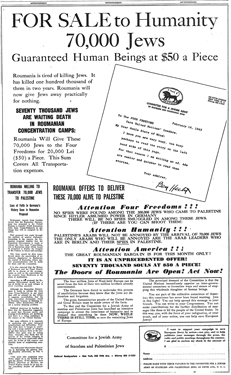
Other groups and individuals appeared less willing to go along with F.D.R.’s policy of “rescue through victory”—the idea that nothing could be done for the Jews being slaughtered in Europe except for the allies to win the war against Germany. For example, Peter Bergson (Hillel Kook) and a small group of other Palestinian Jews, who had come to the U.S. as colleagues of Vladimir (Ze’ev) Jabotinsky in the Revisionist Zionist movement, were working along with people like screen-writer Ben Hecht, and Congressman Will Rogers, Jr. to publicize to Americans the terrible news from Europe. They sought to mobilize public opinion to push the Roosevelt administration into some substantive action. Alfred’s February 25, 1943 copy of The Sentinel, a Chicago “weekly newspaper devoted to Jewish Interests”, carried a dramatic full-page advertisement by the Bergson group with the headline “For Sale to Humanity 70,000 Jews Guaranteed Human Beings at $50 a Piece...” The Romanian government, at this time in the Nazi camp, had actually expressed its willingness to save these Jews—then in concentration camps—and deliver them to Palestine for that price. 


With “Action—Not Pity” as their motto, the Bergson group, at this time calling itself the “Committee For A Jewish Army Of Stateless and Palestinian Jews”, was lobbying American Jews and the American People-as-a-whole to prod their government to do something. Korzybski had a clipping about the Bergson group’s dramatic pageant, “We Will Never Die,” which came to Chicago in May for one performance at the Chicago Stadium. As evidenced by later clippings in his personal files, over the next few years Korzybski followed the efforts of various groups associated with Bergson like the New Zionist Organization of America. Korzybski had clipped a full page ad from that organization out of the Chicago Daily News of 4-17-44. Its headline pleaded “OPEN THE DOORS OF PALESTINE”. I have not found any specific statements by him about Bergson or the Revisionist Zionists. However, it seems to me that given his sympathy for Zionism, his preference for blunt honesty, and the way that he followed reports about Bergson, et al, in the papers, he probably looked favorably upon their efforts.

If he could do little else, Korzybski as a Polish nobleman could show his solidarity with the Jewish people. In May, while the Germans were finishing their ‘liquidation’ of the Warsaw Ghetto, Korzybski decided to have the Institute issue a mimeographed edition of “The Essence of Judaism”, the 1934 article from The American Scholar he had long recommended. This version included a foreword of some four pages by Korzybski where he stated, “We reprint here the article of Professor Hans Kohn, who deals with the ‘space’ versus ‘time’ orientations, because this article is unusually valuable for getting a glimpse of modern scientific trends.”(4) To Korzybski it made sense that Nazi Germany would demonize the Jews, whose tradition, to him, represented an unusual, early, non-aristotelian outcropping of Western culture. The ‘beastly’ Nazis, on the one hand, had raised ‘lebensraum’—the space-binding, power-based conquest of territory for German dominance over lesser ‘races’—as their supreme ideal. On the other hand, Jewish culture—more consciously ‘time-binding’ in its basic orientation—elevated progress not through ‘space’ but through ‘time’, knowledge, and ‘history’; and was an exemplar for “creative individuals all over the world, who have a ‘feel’ for life, [and] have also a ‘time’ process orientation in some degree, as there is no sanity in science or life without it.”(5) Mimeographing provided the least expensive way of making Kohn’s “unusually valuable” article, with Korzybski’s commentary, available for distribution. (Never published elsewhere in Korzybski’s lifetime, Kendig nonetheless gave the article, with Korzybski’s “Foreword”, the place of significance it deserved in Korzybski’s Collected Writings.)


Notes 
You may download a pdf of all of the book's reference notes (including a note on primary source material and abbreviations used) from the link labeled Notes on the Contents page. The pdf of the Bibliography, linked on the Contents page contains full information on referenced books and articles. 
1. “Events of Week”. The Chicago Sun, 1/31/1943. AKDA Scrapbook 41.214. 

2. Transcript of IGS 1938 Summer Seminar, p. 69. IGS Archives. 

3. “The Battle of the Warsaw Ghetto” in Poland Fights, 7/5/1943. IGS Archives.

4. Korzybski, “Foreword to ‘The Essence of Judaism’ by Hans Kohn”, in Alfred Korzybski Collected Writings, p. 403. 5. Ibid.


Sunday, April 5, 2015

Chapter 54 - War Work: Part 6 - "Some Non-Aristotelian Data on Efficiency for Human Adjustment" or Overworked Like Hell—As Usual

Korzybski: A Biography (Free Online Edition)
Copyright © 2014 (2011) by Bruce I. Kodish 
All rights reserved. Copyright material may be quoted verbatim without need for permission from or payment to the copyright holder, provided that attribution is clearly given and that the material quoted is reasonably brief in extent.

Alfred worked with great efficiency. Within the limited human and financial resources of the Institute—especially now with the war going on—he had a systematic way of dealing with problems, and achieving goals, and he got things done. Key for this: he knew how to delegate work, and he had co-workers whom—though insufficient in number—he could trust. 

Nonetheless, he habitually seemed to have too much to get done. For example, he was inundated with letters. He certainly tried to have Kendig and others deal with whatever correspondence he didn’t have to touch. However, people were constantly writing to him and the Institute—some students, some not—requesting advice, referrals, or other help that no one else could deal with. He encouraged his seminar students to write to him and report on how they were getting along and he responded with care and concern to every one of them who did so. His typing skill and speed had deteriorated over the years and he dictated his letters whenever he could—to his trusted confidential secretary Pearl or to Charlotte if there were privacy issues—but sometimes he had to type them himself, which he disliked. Then there were his seminars, not so bad to prepare for and give, but followed by the ‘killing job’—especially if he had a large class— of conducting personal interviews. But given the importance he gave to students’ personal applications (the ‘meat’ of his work), he felt he had to continue to offer them. 

And then, unexpected events that created new problems—sometimes significant ones—could be expected to happen. Such an event happened on December 16, as Alfred was gearing up for the Holiday Intensive that would start in a little more than a week. Institute trustee and lawyer, Samuel G. Clawson, died suddenly of a heart attack at the age of 46—an especially heart-rending loss given that he left a wife and 28-month old twins, a son and daughter. Clawson, a student of Korzybski’s work, had ably provided the Institute with legal advice throughout the negotiations with Cornelius Crane and had helped with other matters as well. A specialist in tax law, Clawson had served as one of the prosecutors in the Federal case against Al Capone, which put the Chicago crime boss in prison. (Korzybski, fascinated by the case, had gotten the story first-hand from Clawson.) Clawson’s renown resulted in national coverage of his death. As if Clawson’s death was not bad enough, I can imagine Korzybski scowling and shaking his head as he read the obituaries in The Chicago Daily News and The New York Times which both repeated “...[Clawson] was appointed a member of the board of trustees of the General Semantics Institute, an organization devoted to the study of words.”(28) Now Korzybski and Kendig were going to have to scramble to find a replacement for him on the board. Within a couple of months they got Lee R. LaRochelle, another relatively young Chicago-area lawyer. (Unfortunately, in 1947, he too would die of a heart attack.)

It’s not surprising then that Korzybski, himself constantly skirting on the edge of too much to deal with, had long had great personal interest in the work of V. A. Graicunas, discussed earlier, who had quantified the long-noted reduction in a manager’s ability to adequately manage as the number of assistants or tasks increased; leading to increasingly poor and confused management and ultimate failure. British management writer Lyndall F. Urwick had included Graicunas’ original paper, with his own further development of it, in his 1937 book, Papers on the Science of Administration. Korzybski had been presenting this material to his seminar classes and recommending the book to all of his readers. Now at the end of 1942 and the first couple of months of 1943, he was working on what he considered an important introductory/expository essay to the original note Polakov had written to him about Graicunas’ work. His essay and Polakov’s note would go into the Congress Papers as the final article, an appendix of the volume that would take up the whole of the final “Part IV”: “Some Non-Aristotelian Considerations”.

In their “Foreword”, Korzybski and Kendig had put the following on their list of faulty aristotelian assumptions: “The belief that the principle of additivity (in mathematics called linearity) can adequately account for all the relations involved in the fields of science and life processes, which is implied in the three-letter word, and.”(29) Graicunas’ work opened up for consideration many of the practical aspects of non-additivity that Korzybski had long tried to get across to his students and that he worked to apply in his own life. In the article, entitled “Some Non-Aristotelian Data on Efficiency for Human Adjustment”, he expanded upon the importance of non-additive, non-linear relationships in everyday life—even beyond the particular management/administrative applications Graicunas had emphasized:
If in personal life we undertake or have to carry too many responsibilities, interests, involvements, etc., the complexities often grow beyond the capacity of one human brain to manage them adequately, and human tragedies, disorganizations, etc., follow, very often culminating in maladjustment and even neurosis or psychosis. 
Many times a single painful event in childhood or even later in life distorts the attitudes and colors the whole life. Thus, the ‘addition’ of a single factor results in unnecessary complexities which are certainly not additive, but spread all through life in some geometrical ratio. (30)
Korzybski demonstrating the Graicunas diagram at the August 1947 seminar. 

The Graicunas “Span of Control” diagram and this material on non-additivity would continue to have an important part in Korzybski’s seminar teaching on how to manage oneself.(31)


Notes 
You may download a pdf of all of the book's reference notes (including a note on primary source material and abbreviations used) from the link labeled Notes on the Contents page. The pdf of the Bibliography, linked on the Contents page contains full information on referenced books and articles. 
28. Samuel Clawson Obituaries. AKDA 41.210. 

29. Korzybski and Kendig, “Forword to a Theory of Meaning Analyzed”, in Alfred Korzybski Collected Writings, p. 378. 

30. Korzybski, “Some Non-Aristotelian Data On Efficiency For Human Adjustment”, in Alfred Korzybski Collected Writings, p. 392. 

31. Korzybski wrote:
In human life one of our difficulties is that we are ‘both the marble and the sculptor’, as Carrel says, and so we are both the managed and the manager of our personal lives, the supervised and the supervisor, the co-ordinated and the co-ordinator. Perhaps one of the main sources of a great many maladjustments is exactly that self-reflexiveness and circularity which we do not know how to manage simply because we don’t know that there are non-aristotelian methods to do so. [“Some Non-Aristotelian Data On Efficiency For Human Adjustment”, in Alfred Korzybski Collected Writings, p. 394.]