Monday, July 21, 2014

Chapter 9 - At The Disposal Of The Minister Of War: Part 2 - At The Disposal of the Minister of War

Korzybski: A Biography (Free Online Edition)
Copyright © 2014 (2011) by Bruce I. Kodish 
All rights reserved. Copyright material may be quoted verbatim without need for permission from or payment to the copyright holder, provided that attribution is clearly given and that the material quoted is reasonably brief in extent.

Korzybski’s career as a bomb-maker lasted only a short time—until July 4. He had impressed the Grand Duke and other members of the General Staff, not only for his invention (despite their inability to use it) but also because of his work with Terechoff. Korzybski was still looking to help. So by the orders of Grand Duke Nicholas, the Commander-in-Chief of the Russian Army, Korzybski was sent to Petrograd (the name of the Russian capital which had recently been changed from “St. Petersburg”) to be “at the disposal of the Minister of War.” Alfred arrived in Petrograd at the end of July. (4) Soon afterwards, he went to the Ministry of War office and was ushered in to see General A. A. Polivinov, recently promoted from Deputy Minister to Minister of War after a scandal involving his predecessor, Sukhomlinov, who was getting blamed for the accumulating war failures.

Polivinov was one of the few people in the Tsarist regime, along with the Grand Duke, whom Korzybski felt any respect for. Men like them, whatever their personal merits, were severely hemmed in by the ineptness and corruption of so many of their subordinates, colleagues, and superiors—along with the extreme inertia of the Tsarist administration, in general, and the dullness of the Tsar on top, more specifically. The resultant Russian inefficiency seemed inevitable and responsible for the debacle on the battlefield. Russian industry, although technically quite capable of providing adequate stocks of shells and other military supplies, had been stopped from doing so by dishonest businessmen, corrupt officials, and inadequate planning. With better leadership, the Russians could at least have held back the Germans from capturing so much of Russian Poland. Korzybski expected that the Grand Duke, unable to adequately replace equipment or men, would soon resign out of tiredness and desperation. The situation indeed looked desperate. The Germans were about to overrun Warsaw. And the Russian Army was retreating.

Having already heard about Korzybski, Polivinov embraced him and asked, “What can I do for you?”(5) Alfred could have chosen any situation he wanted. He wanted to serve at the front. He could no longer run around in a cavalry or infantry unit. But he had a friend serving as an officer in the Bodyguard Heavy Artillery Regiment. So he requested to be put there. He felt he could make a quite adequate artillery officer and asked permission to take the officer's exam at the Artillery Academy: 

Polivinov knew, and he knew that I knew that a complete collapse of the Russian front was in view, this request in a way was suicide, we both knew it. The so very nice old man got very excited, he jumped to his feet and exclaimed “Are you crazy?” I said, “No Excellence but I am cut away by the enemy from my home and property, so I better enlist.” With reluctance he agreed. (6) 

So with an order from the Minister of War, Korzybski went to the Commandant of  the City of Petrograd who took care of such enlistments. Just to forgo potential trouble, Korzybski had paid 50 of his last 100 rubles to a military doctor to get a medical clearance certifying his fitness for service. The Commandant looked through Korzybski's papers and then at Korzybski and refused to take him. Korzybski returned to Polivinov who went to the Tsar himself to obtain an imperial decree for Alfred to join the Regiment. 

With the imperial decree in hand, Alfred spent a good deal of time fruitlessly searching for the Bodyguard Heavy Artillery Regiment supposedly located somewhere in or around Petrograd. He couldn't find it. Meanwhile, the news from the front had not been good. On August 5, within 2 weeks of Alfred’s arrival in Petrograd, the Germans had captured Warsaw  and the Russians were steadily retreating east of the Vistula. The Grand Duke resigned at the end of August. Tsar Nicholas—whom Alfred considered a “half wit”(7)—took over the position of Commander-in-Chief in early September. Hopeless.

Korzybski also felt personally desperate. He had less than 50 rubles left in his pocket, no income, and was wondering how he was going to live. Luckily, one day on a street in Petrograd, he ran into a general whom he had known at the front. The general lent Alfred 100 rubles to tide him over and Alfred, not one to ever beg, gratefully took it. The general also suggested that Alfred, with his engineering background, might be able to get a job in the Russian armaments industry. Alfred began to consider this, and the general said he would keep a lookout for any job possibilities.
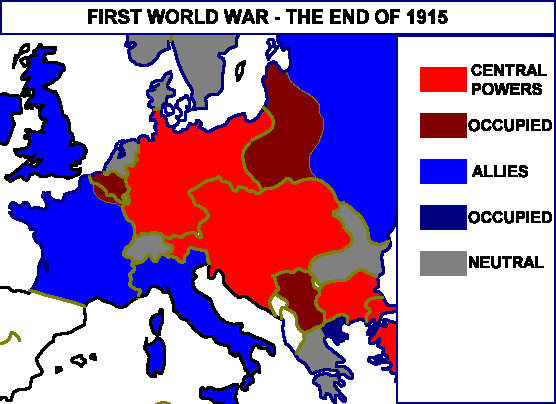

All through September and October, Korzybski remained in purgatory in Petrograd while the Russian retreat continued. By the end of September, the Germans had reached Riga, Pinsk, and Baranovichi, the former headquarters of the Russian General Staff. But the Germans had major problems too. They had reached the end of their supply lines. Along with the general destruction of battle, both the Germans and the retreating Russian forces had stripped much of the Polish infrastructure. As Korzybski had unhappily predicted, the German juggernaut could not depend on an undevastated Poland. By October, the Germans and Austrians—stuck in the White Russian and Ukrainian mud—dug into trenches facing the Russian side. Their advance had stopped.

http://www.historyofwar.org/Maps/maps_ww1_f.html

Notes 
You may download a pdf of all of the book's reference notes (including a note on primary source material and abbreviations used) from the link labeled Notes on the Contents page. The pdf of the Bibliography, linked on the Contents page contains full information on referenced books and articles. 
4. The microfilmed copy of Korzybski's 1915 pocket calendar makes it possible to specify the times for his presence there.“Kalendarz”. AKDA 2.27-2.37.

5. Korzybski 1947, pp. 148, 216. 

6. AK to V. Molodoy, Unsent letter, 12/16/1924. AKDA 15.733. 

7. Korzybski 1947, p. 148.

< Part 1      Part 3 >


Saturday, July 19, 2014

Chapter 9 - At The Disposal Of The Minister Of War: Part 1 - Introduction

Korzybski: A Biography (Free Online Edition)
Copyright © 2014 (2011) by Bruce I. Kodish 
All rights reserved. Copyright material may be quoted verbatim without need for permission from or payment to the copyright holder, provided that attribution is clearly given and that the material quoted is reasonably brief in extent.

In the winter of 1914–1915, Russian forces had some apparent success. They seemed about to capture Kracow and had reached the mountain passes of the Carpathians, which led down into the Austrian heartland. But the Austrians, with help from the Germans, pushed them back. By April, Warsaw was under threat. In addition to their losses, the shortages of shells, ammunition, rifles, clothing, and food further demoralized Russian troops.

From April to September of 1915, the Germans and Austrians relentlessly pushed forward. In the initial stages of the German-Austrian advance, Korzybski seemed to accelerate his efforts, traveling from one front to another gathering intelligence, not just for Stavka and the Second Army, but for the other Russian armies as well. But by the end of June it become clear that Russian forces would have to retreat from most, if not all, of Poland in order to just survive. The war was changing from one of mobility to one of positions and entrenchment. There would be no more need for Terechoff’s highly mobile cavalry intelligence group. It was disbanded on June 20. Korzybski helped organize the breakup of the office in Warsaw, including the disposal of equipment and the dispersal of men to other units. Where would he go?
Eastern Battle Front - 1915 
He had been thinking about an invention—a bomb. To work on it, he was sent to the Artillery Department Laboratory of the Headquarters of the Second Army. Korzybski’s invention, an incendiary device, seemed extremely simple but nasty. He manufactured some samples for a demonstration at General Staff Headquarters. His bomb consisted of a 12 by 4 inch wooden box that could easily break apart when dropped from a plane. The box was stuffed with tar and kerosene-soaked rags wrapped around a center portion containing smokeless powder. The powder in turn surrounded a thin metal capsule holding some phosphorous in a liquid solution. Since phosphorous burns when exposed to air, the bomb was set off by first breaking the capsule with an icepick. The surrounding fluid would evaporate, the phosphorous would start to burn, ignite the powder and then, in 5 to 10 minutes, the rags and then the box would begin to burn as well. At this point, the box could be dropped to do its work on a field or a roof of straw or wood.

After one successful demonstration in front of the General Staff, Korzybski was asked to do another one before Grand Duke Nicholas, who had missed it. The Grand Duke wanted to see an actual aerial demonstration, with Korzybski dropping his incendiary-box bombs from a plane onto a target field. Alfred did not relish going up in an airplane. He had not enjoyed his last plane ride—to say the least.


"Nieuport 10" (colorized) - French 2-Seater Airplane Used By Russian Imperial Forces

On the front, he had become friendly with a French flyer glad to have someone to speak with in his native language. One day the flying ace invited him to come along for a flight over the German trenches. Alfred described the ride:
I was not tied up. I had no safety belt. Not tied up and he wanted to give me the thrill which he assumed would be the thrill of my life, he began to make the loop over the German trenches and of course, the Germans did not appreciate the joke and they riddled us with machine guns. Well, I had very little to say about that because that son of a gun was doing the driving. We were in the meantime riddled with bullets on one side and on the other side, retaliating to the Germans, out of the window I was vomiting like hell on them. It was one of my first rides. How much I got to them I don't know. Their bullets got to us all right. The rest of my reaction was probably lost in the winds. But anyway I did it. Naturally when we came back home, [so to] speak home, naturally I gave him  ‘a piece of my mind’, so to say in quotation marks, no more airplanes for me. Well I did not calculate properly. Grand Duke Nicholas wanted to see....(1) 
The Grand Duke insisted and Alfred considered it his duty not to refuse:
I took my incendiary bombs with me and then we began to fly....What was I doing putting the ice pick into the phosphorus—oh, I don’t want to make a monkey out of myself...and I don’t know I dropped a half dozen of them, or a dozen, it doesn’t matter because they were small things and the question was just to make fire for five, ten minutes. They were timed deliberately for a short exposure, so to say, for air. They all collapse and they start burning, and in the meantime, I nearly, somehow, I nearly burned down the airplane by mistake and the pilot got nervous and so when we were landing he nearly smashed  the airplane. So, of course, we have an interchange of opinions about his capacity as a  pilot and my capacity as a bombadier. Just an exchange of opinions, that’s all...In the  meantime in front of Grand Duke Nicholas both of us had to keep our opinions in rather polite language. And there were two of my airplane rides. And since then [Alfred was telling this story in 1947], no more airplane rides, thank you. (2) 

Although in later life he realized commercial airline travel had become “not so unpleasant”(3), it seems he never did fly again. As for his incendiary bomb, although the demonstrations impressed the Russian and French officers watching them, his bomb was not used, since, with the diminishing front and the relatively short range of their planes, the Russians were worried about burning up parts of their own territory. The French later used their own version of an incendiary bomb using glass bottles which, in Korzybski’s opinion, didn’t work nearly as well.


Notes 
You may download a pdf of all of the book's reference notes (including a note on primary source material and abbreviations used) from the link labeled Notes on the Contents page. The pdf of the Bibliography, linked on the Contents page contains full information on referenced books and articles. 
1. Korzybski 1947, p. 304. 

2. Ibid., pp. 304-305. 

3. Korzybski 1947, p. 304. 

Part 2 >


Thursday, July 17, 2014

Chapter 8 - Battle And Retreat: Part 4 - Used To Be A Horseman

Korzybski: A Biography (Free Online Edition)
Copyright © 2014 (2011) by Bruce I. Kodish 
All rights reserved. Copyright material may be quoted verbatim without need for permission from or payment to the copyright holder, provided that attribution is clearly given and that the material quoted is reasonably brief in extent.

Since the start of the war only four months before, Korzybski had remained pretty much in constant motion. Shifting from place to place, locations blurred. Time distorted, days passing like hours and hours like days. August 1914 already seemed like the distant past. In the field, though not for the most part directly involved in combat, he usually worked under artillery bombardment. And he had seen up-close the results of artillery, rifle, and machine gun fire. Once while walking in a forest, he had stepped through a pile of leaves and onto something soft—parts of a decaying, unburied human body that he then had to scrape off his boots. For long periods of time he had to get by with very little sleep. He often had no food since, when traveling as a representative of his special headquarters unit, he was not attached to a regular army kitchen. Once while getting chauffeured in a dilapidated car to a new location, he and his driver saw a big piece of black bread, probably dropped from a field kitchen wagon, lying on the road in a muddy hole: "We stopped the car, retrieved that muddy loaf of bread, and began to eat it.”(9)

Somewhere on the Eastern Front, probably early 1915

After the fall of Lodz, Alfred’s nearby family estate came under German control. His mother by this time had moved to her place in Warsaw. So she was safe. But he didn’t know when he would see Rudnik again. Probably not long afterwards (he later had trouble remembering the exact time or location of the incident), Alfred found himself in the middle of a pitched battle. His horse, a beloved white Arabian bred at Rudnik, got shot during a barrage of gunfire. The Arabian fell on Alfred, crushing his pelvis and severely dislocating his left hip. The horse died and Alfred somehow managed to pull himself from underneath and crawl away. (10) Instead of reporting to a hospital, he stayed at the front working, managing to walk—although doubled up in pain—by using his sword as a crutch. A couple of days later, he happened to meet a general, a physician from the medical corps. The general took one look at the hobbling, bent-over Alfred and asked him, “What is wrong with you?” Korzybski replied, “Your Excellency, there is nothing wrong with me.” General: “Go to the hospital.” Korzybski: “I’m sorry, your Excellency, but I cannot do that. I have work to do.” General: “Go to the hospital. Those are orders.” Korzybski: “Yes, sir.” So Alfred got himself to the hospital. (11)

His memory of what happened there remained cloudy. He wasn’t even sure where the hospital was located. He remembered getting tied down to a surgical table and then being put under with chloroform or ether. He was later told that some screws were put into his leg and pelvis. He was put into a cast from his leg to his chest. It all seemed like a daze, except for the pain:
The only thing I [clearly] remember in the hospital [is] that once the pain was so acute—I am not a suicidal type at all—but the pain was [so] extremely acute that I decided to suicide, to kill myself. Couldn’t stand it any longer. I preferred to die than to suffer so much. The point was that I didn’t have the strength to get up to get at the gun. So the result was that I didn’t shoot myself, but just endured the pain. (12)

After he left the hospital (perhaps a month or two later), he found that he had a more or less permanent stiffness in his joints. For the rest of his life he tended to limp and within a few years regularly used a cane as well as a shoe lift extension on the left side. (That leg became shortened after the hip injury.) In later life he preferred sitting on a high, firm chair. His sciatic nerve had also somehow gotten injured and he had a predisposition towards sciatica for the remainder of his life.

Immediately after leaving the hospital, he became most aware of one fact: he could no longer jump onto a horse. He had to be lifted. This didn’t impede his military duties since by this time (the spring of 1915) his work required little time on horseback. The fact remained: Alfred could no longer get onto a horse or ride one with any ease. He had ridden and trained horses since childhood. He loved those animals. Over the course of the next year, he came to a poignant realization: his life as a horseman was over. Years later, in 1948, on a biographical form he filled out for the 8th Edition of American Men of Science, he wrote under Hobbies (along with “Electric, Mechanical Tools”): “Horse Training”, years: “1890–1916”. For “Degree of Skill” he marked an “x” under “Excellent” and wrote in the box, “Used to be”.(13)


Notes 
You may download a pdf of all of the book's reference notes (including a note on primary source material and abbreviations used) from the link labeled Notes on the Contents page. The pdf of the Bibliography, linked on the Contents page contains full information on referenced books and articles. 
9. Korzybski 1947, p. 125. 

10. Ibid., p. 125; “Artist and war hero wedded in Washington”. The Philadelphia Record, Feb. 8, 1919. IGS Archives. 

11. Korzybski 1947, pp. 125-126.

12. Ibid., p. 127. 

13. AK - 1948 Biographical Form for the 8th Edition of American Men of Science. IGS Archives.


Wednesday, July 16, 2014

Chapter 8 - Battle And Retreat: Part 3 - Retreat from Lodz

Korzybski: A Biography (Free Online Edition)
Copyright © 2014 (2011) by Bruce I. Kodish 
All rights reserved. Copyright material may be quoted verbatim without need for permission from or payment to the copyright holder, provided that attribution is clearly given and that the material quoted is reasonably brief in extent.

Possibly this crossed German phone transmission by Korzybski, finally alerted the Russian Northern Command and Stavka to the nature and extent of the German invasion. To the north, the Russian First Army under Rennenkampf, which had defended Plock, retreated and took up defensive positions in the direction of Warsaw. The capital of Russian Poland seemed safe for now but Lodz became the main target of the German Ninth Army’s southwest advance. The Russians did manage to keep Lodz from falling at once. In a masterful defensive move, the Russian Second and Fifth Armies—positioned miles west and southwest of the city as the main force for a planned invasion of Germany—beat the Germans to the city. By November 17, 1914—within two days of the order to fall back—the Russian forces had formed a defensive ring around the western, northern and eastern borders of Lodz. The Germans could no longer just march in, but Lodz was now under siege.
By Department of Military Art and Engineering, at the U.S. Military Academy (West Point) [Public domain], via Wikimedia Commons http://upload.wikimedia.org/wikipedia/commons/5/54/EasternFront1914b.jpg
Eastern Front, 1914 - The Battle of Lodz
Korzybski—his unit having set up temporary headquarters there—had arrived a few days earlier. To the west and north, the main forces of the German Ninth Army commanded by General Mackensen stood outside the Russian defensive ring. And to the east, that ring protected the city from an isolated German force under General Scheffer (including a reserve corp, a cavalry division, and a guard division) that had managed to slip through a gap in the Russian line during the retreat from the north. Scheffer’s forces presented a problem. They were postioned to block the escape route towards Warsaw if the Russians decided to abandon the city. It seemed like the Russians were surrounded.

By November 21, the Germans were shelling the city. The Russians were returning the fire and hoping Rennenkampf's First Army would come down to take care of Scheffer's eastern divisions. Perhaps the Russians might have even been able to defeat the Germans if the First Army had arrived en masse to reinforce the besieged Russian armies. Instead, Rennenkampf sent down a much smaller relief force, which was only able to convince Scheffer to retreat to the northwest, where he eventually joined the rest of the German Ninth Army. Scheffer did lose half of his men in the process but he also captured 16,000 Russian soldiers and 64 artillery pieces. Nonetheless, the Russians now had a more or less unobstructed path of retreat out of Lodz.

By December 6, Russian forces had lost 100,000 men. City hospitals overflowed with casualties. Winter had set in and some Russian soldiers had no boots. They were running short of rifles, ammunition, and artillery shells as well. The Germans had already begun to enter the city. The time for retreat had come. Korzybski managed to find a rickety, straw-filled horse-cart with a flimsy harness and a worn-out rope, along with a few broken-down horses to pull it. With Zurowski, and a duty sergeant—who technically outranked Korzybski but to whom Korzybski gave orders—Korzybski loaded bundles of intelligence documents onto the cart. On the straw, along with these papers, he had placed a five-gallon glass bottle of gasoline which he planned to shatter with his sword and put a match to, if there was any threat of getting captured. The valuable information about Terechoff’s intelligence operations could not be allowed to fall into German hands.

Colonel Terechoff, who had gone to say goodbye to a girlfriend, put Korzybski in charge. However, he deliberately didn’t tell Alfred exactly where they were headed. This turned out to show a certain wisdom on Terechoff’s part. While Alfred and Zorowski stood guard by the wagon waiting for the Colonel, a man in the uniform of a Russian Siberian infantry captain came from across the street. He walked up to Korzybski, who saluted him. The friendly Siberian captain told him not to bother with the military formalities. “I lost my regiment and as you are of the General Staff, please tell me where is your staff going?” Korzybski replied, “I’m sorry, sir, I don’t know. I am waiting orders.” The captain said, “I’m sorry”, saluted, and returned to the other side of the street. Zorowski went up to Alfred and told him he'd been talking with a German spy. In a flash, Korzybski realized this was probably right. The captain didn’t wear his uniform quite correctly. His Russian sounded somehow foreign. He hadn’t stayed with the Russians but walked back in the direction from where the Germans were entering the city. Alfred immediately called for the military police, who arrested the ‘Siberian captain’. (4)

When Terechoff returned, he, Korzybski, and his other men made their way along with the other Russian forces leaving Lodz. The retreating troops headed northeast, towards Warsaw, with some artillery and infantry staying behind to cover their withdrawal. Meanwhile German artillery did its best to impede their progress. Members of Korzybski’s unit either rode on horseback or rode along on the horse-drawn wagon filled with intelligence documents. 

Traffic soon became a major problem. Many officers seemed to have disappeared. None of the officers on the road, including his Colonel, were—in Alfred's opinion—taking command as needed to direct traffic, e.g., "Keep  that traffic clear, move that wagon to the side, wait for that cavalry group to pass the intersection, etc.” In fact, Korzybski’s Colonel seemed to lose his head. As Alfred described it later:
…he was here dumb Dora, doing nothing. And the mess was going on, blocking the traffic. So I poked him in the ribs quite hard with my sword, with the handle of my sword because he wouldn't listen otherwise. I said, "Order that, so, so, etc." He looked at me with enormous surprise but he obeyed and he barked orders. (5)

After they started to move again, Terechoff rode ahead leaving Alfred in charge of getting to their new headquarters. And now traffic management became a life-threatening issue. Melting snow and the trampling of men, horses, and wagons on the dirt roads leading out of Lodz had turned the retreat into a muddy mess. German artillery provided the 'musical' accompaniment of a loud and deadly percussion. The traffic had stopped again and Korzybski went up ahead to investigate the source of the tie-up. An artillery shell had landed on the road, making a large, impassable hole. There were no officers to be found. Korzybski—sword in one hand, pistol in the other—took command and began yelling orders at the unfamiliar men around him, telling them to fill the hole with anything they could find, e.g., pieces of wood from broken wagons, sacks of food, boxes of ammunition, etc. Some of the men looked at him and asked “Who are you?” He replied, “Never mind—obey. Never mind who am I." The hole got filled and they once more began to move. (6)

Soon enough they reached another impasse. A three-inch field artillery piece had gotten stuck in the half-frozen mud in the middle of the narrow road. The line of traffic once again came to a stop. With marshes on either side, they couldn’t go around. The three-inch gun, though one of the smallest and lightest of artillery pieces, was normally pulled by a team of horses. The men trying to move it somehow couldn’t get the horses attached and lined up properly to dislodge it. Then a group of six men, including Korzybski, attempted to lift it out of the mud enough to shift it from the road and into the marsh. Working at odds with one another, they couldn't coordinate themselves sufficiently to budge it. With all their straining and sweating, nothing useful was happening. Out of desperation, Korzybski motioned the men aside. With an enormous effort, he dislodged the gun from the mud by himself and tipped it into the marsh. In the process, he felt his “inside[s] got busted.” Indeed, he had severely herniated himself—an injury he never fully recovered from. But he had done what needed to get done at the time. The column of men, horses and wagons once more flowed. Korzybski rested by the side of the road and waited for his men and their cart of precious documents to come by.(7)


WWI Footage of Men lifting w/ pole & pushing artillery stuck in mud, 
horses pull up road, men run after
(go to 4:30 minute mark on video)

Korzybski now had to join up with Terechoff at the new General Staff headquarters. He had learned the destination and decided to switch to side roads, some even worse than the main one they had already traversed. Sometimes they passed close to German troops. Alfred decided it might be safer to go through some villages where the Germans had already passed. But these had been set afire by the Germans and he worried about sparks igniting his document-laden cart with its straw and gasoline. He and his dozen-or-so men took more side roads. They ended up in a forest with a deep, sandy path. The tired horses had more and more trouble pulling and then could pull no more.

As luck would have it, they saw ahead of them a large brewery wagon pulled by a team of big, strong-looking horses. They decided to requisition it—which they did with as much official flourish as they could muster—giving the brewery driver their broken-down wagon and tired horses in exchange. After they transferred their documents and before they drove away, Korzybski handed the driver a hastily-written note to the German General Mackensen, kindly requesting that he pay the bill for the hijacked beer-wagon. They proceeded with no further problems. Korzybski described their reception at Russian headquarters:

...finally we arrived at headquarters, I would say, in state, with that big, big beer wagon; big, big, heavy, well-fed horses—beautiful harnesses and what not; and my documents intact. So when I reported [to Colonel Terechoff]…that everything is safely back, he accepted my report and said, “Well, you were pretty long coming.” He didn’t thank me. I didn’t have a chance to tell him what hell I went through before I arrived, and I just made [an] ordinary report…[Colonel Terechoff] just cocked his head, looked at me and said, “Korzybski, next time you poke me in the ribs with your sword, please don’t do it so hard.” I smiled and I [said], “Yes, sir.” (8)

Notes 
You may download a pdf of all of the book's reference notes (including a note on primary source material and abbreviations used) from the link labeled Notes on the Contents page. The pdf of the Bibliography, linked on the Contents page contains full information on referenced books and articles. 
4. Korzybski 1947, pp. 100-102. 

5. Ibid. p. 115.

6. Ibid., p. 111. 

7. Ibid. pp. 111–112. 

8. Ibid., p. 115. See Norman Stone’s book The Eastern Front: 1914–1917 for the history of the WWI Eastern Front battles and, in particular, for important details about the battles of Plock and Lodz which Korzybski participated in.


< Part 2      Part 4 >      

Tuesday, July 15, 2014

Quote of the Day, Month, Year, Decade, Century...Etc.?- "The Unrecognized Power of Words"

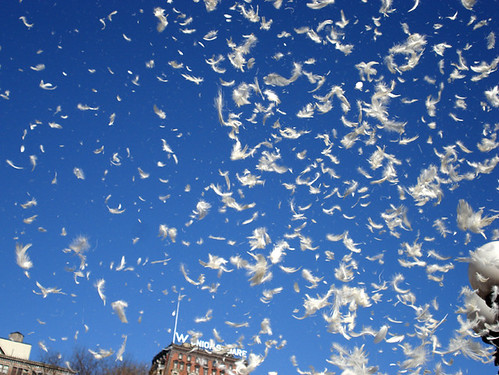
"In a small Eastern European town, a man went through the community slandering the rabbi. One day feeling suddenly remorseful, he begged the rabbi for forgiveness and offered to undergo any penance to make amends. The rabbi told him to take a feather pillow from his home, cut it open, scatter the feathers to the wind, then return to see him. The man did as he was told, then came to the rabbi and asked, "Am I forgiven." 


Photo by Mysuspira https://www.flickr.com/photos/mysuspira/

     "Almost," came the response. "You just have to do one more thing. Go and gather all the feathers."
     "But that's impossible," the man protested. "The wind has already scattered them."
     "Precisely," the rabbi answered. "And although you truly wish to correct the evil you have done, it is as impossible to repair the damage done by your words as it is to recover the feathers."

From Words That Hurt, Words That Heal: How To Choose Words Wisely And Well by Rabbi Joseph Telushkin

Monday, July 14, 2014

Chapter 8 - Battle And Retreat: Part 2 - 10,000 German Corpses

Korzybski: A Biography (Free Online Edition)
Copyright © 2014 (2011) by Bruce I. Kodish 
All rights reserved. Copyright material may be quoted verbatim without need for permission from or payment to the copyright holder, provided that attribution is clearly given and that the material quoted is reasonably brief in extent.

As the last Russian army men out of Plock, Korzybski and Zorowski almost got shot by their own men as they straggled back across the Russian line. They rode to meet Captain Wolkoff, from their intelligence unit, who was staying at the home of a landowner whom Korzybski knew. Korzybski usually took orders directly from Colonel Terechoff, but in Terechoff’s absence he had to take orders from Wolkoff, his superior. After the two men briefed the Captain, whose fine dinner they had disturbed by their arrival, he presented them with some news that confirmed Korzybski's judgement of him as incompetent. Wolkoff had forgotten to give important orders to some people working for the unit in Plock. Korzybski and Zorowski would have to return there to give the orders. Since the Germans probably now had control of the city, this mission seemed suicidal to Alfred. But he could only say “Yes, sir” and proceed to ride off again with Zorowski, who borrowed another horse from the landowner, since his own animal had injured a leg.

The two approached the town with trepidation, their rifles ready, but reached the center of town without finding any evidence of a German presence. After carrying out Wolkoff's orders, they found their favorite restaurant, had a nice dinner, and went back to the hotel where they had stayed before and got a good night’s sleep. They got up early—still no sign of the Germans. As they started their ride out, they looked across the Vistula and saw a squadron of Death’s Head Hussars, an elite Prussian bodyguard cavalry unit noted for its ruthlessness. Alfred and Zorowski couldn’t resist. They hid their horses behind a house and commenced
firing across the river at the Hussars. They dropped about ten of the Hussars but the whole squadron fired back, lightly wounding both of them. Alfred got struck in the knee; "nothing serious", he recalled. As they escaped, Alfred realized the stupidity of their 'heroism' since the Germans could easily have blamed the civilian inhabitants of Plock for their actions.
Officers and Men of the Kaiser's Famous Death's-Head Hussars
Prussian Death's Head Hussar Busby Hat (Pelzmutze)

On the way back to their own side, Zorowski’s horse took an unexpected detour and came to a stop in front of a country house. The horse would not budge and Zurowski and Korzybski had to pull the horse by the bridle and whip it from behind to get it going again. Afterwards, they again had to get through the line of Russian sentries who had bayonets raised and rifles aimed—"Are you German spies?", etc. When they finally reached Captain Wolkoff, they reported. Then Korzybski asked the landowner, “What in the hell is wrong with your horse?” The man replied that a girlfriend of his lived at the house where the horse had stopped. The horse had gotten used to staying there for hours waiting for its owner inside. (2)

After the Russian retreat from Plock, a furious battle ensued as the Germans advanced and the Russians engaged in rearguard action. The Germans paid dearly for every mile they advanced. Korzybski did his part to make them pay. Gathering information where he could, he went to a cellar where another intelligence officer had set up an office with a field telephone. Alfred went to say hello to the man who—with his ear to an earphone—put his finger up to his mouth to indicate to Alfred to shut up. He motioned for Alfred to come over, gave him another earphone, and pushed a pad and pencil towards him. The officer gestured for Alfred to listen and write. As Korzybski described it:

Somehow the telephone lines on ground—a shell probably did it—the telephone lines of the Russian General Staff with the German General Staff got crossed. And what the officer was listening to was the orders of the General Staff of Germany directing the battle. Priceless stuff...So I was listening to the orders of German headquarters and writing them down on a pad, and listening, writing down, using my hand to call orderlies, send to headquarters immediate news… It was a very bloody battle, very bloody…We were in the midst of it. And because we knew…the orders of the General Staff of Germany how they directed the battle, we counteracted immediately. The result—10,000 [German] corpses. (3)

Notes 
You may download a pdf of all of the book's reference notes (including a note on primary source material and abbreviations used) from the link labeled Notes on the Contents page. The pdf of the Bibliography, linked on the Contents page contains full information on referenced books and articles. 
2. Korzybski 1947, pp. 120–123. 

3. Ibid., pp. 109–110.


< Part 1      Part 3 >  


Sunday, July 13, 2014

Chapter 8 - Battle And Retreat: Part 1 - Introduction

Korzybski: A Biography (Free Online Edition)
Copyright © 2014 (2011) by Bruce I. Kodish 
All rights reserved. Copyright material may be quoted verbatim without need for permission from or payment to the copyright holder, provided that attribution is clearly given and that the material quoted is reasonably brief in extent.

As October 1914 ended, the Russian Army’s Northern Command—which included the Second Army and Terechoff’s irregular cavalry intelligence group—faced the Germans across the frontier of East Prussia and across central Poland towards Germany. Meanwhile, the armies of the Russian Southern Command were keeping up pressure on the Austrians and moving deeper into Galicia (Austrian Poland). Despite large numbers of Russian casualties and Russian prisoners taken, Russia still remained a threat. And despite their tactical successes in East Prussia and elsewhere, the Germans had taken tremendous losses themselves. As did the Austrians, who could not claim much tactical success against the Russians so far. Such were the circumstances on the Eastern Front as Stavka (the Russian Army General Staff) and its Northern Command, prepared for an invasion of Germany which would include the Second Army. They planned to start with the capture of Silesia, the southwestern section of partitioned Poland that Prussia had annexed more than a century before.
"EasternFront1914a" by Department of Military Art and Engineering, at the U.S. Military Academy (West Point) - West Point web site at:http://www.dean.usma.edu/history/web03/atlases/great%20war/great%20war%20%20pages/great%20war%20map%2028.htm. Licensed under Public domain via Викисклада - http://commons.wikimedia.org/wiki/File:EasternFront1914a.jpg#mediaviewer/%D0%A4%D0%B0%D0%B9%D0%BB:EasternFront1914a.jpg.
Eastern Front, Poland 1914 by September 26
Whatever successes Korzybski and his unit may have had, their activities constituted only a small part of the Russian intelligence and counter-intelligence effort, which remained on the whole quite pathetic. Via poorly-coded, intercepted Russian radio transmissions, the Germans had gotten vital information on Russian invasion plans. In the beginning of November, they began shifting by rail a quarter million men of their Ninth Army from Silesia—where they kept a remnant of defenders—to Thorn in West Prussia. From Thorn, the Ninth army looked southeast into Russian Poland toward Lodz, Plock and Warsaw. Hoping to catch the outer right flank of the advancing Russian armies, they prepared their own invasion, which began on November 11 and took Russian forces by surprise. Within a week they had driven back Russian positions at least 100 miles, all the way to the outskirts of Lodz, though Warsaw still felt no immediate threat.

As it happened, Korzybski and Zorowski had been in Plock—located on a high cliff overlooking the Vistula, about 60 miles west-northwest of Warsaw and 70 miles north of Lodz—for at least a week before it fell to the Germans. Terechoff had sent them there to meet some of their agents and to try to get some agents across the Vistula. There were already German patrols around, and Korzybski couldn’t get anyone across. The Germans had not yet appeared in the city but were expected to occupy it in a day or two. The Russian army and civil administration were making an orderly retreat.

By Rommullus (Own work) [CC-BY-SA-3.0 (http://creativecommons.org/licenses/by-sa/3.0) or GFDL (http://www.gnu.org/copyleft/fdl.html)], via Wikimedia Commons
Płock - the Tumskie Hill over the Vistula River (25 April, 2009) 
"Płock, Tumskie Hill" by Rommullus - Own work.
Licensed under Creative Commons Attribution-Share Alike 3.0 via Wikimedia Commons 

http://commons.wikimedia.org/wiki/File:P%C5%82ock,_Tumskie_Hill.jpg

In the meantime, Korzybski and Zurowski were organizing Poles in the town to provide help and information to their intelligence unit after the retreat. They got up to leave their nice hotel while it was still dark. Russian troops had completely cleared out and the two of them, as far as they knew, were the last remaining representatives of the Russian army. They expected the Germans to be coming in at any time. They should have gone too, but had heard that some German deserters nearby wanted to surrender. So, like fools, they rode out onto the German side, searching for the deserters whom they wanted to take as prisoners.

They ended up in a forest, stumbling around on their horses in the dark—falling into holes and getting bruised and scratched for their efforts. Finally, at daybreak they got to a small clearing and came upon a German cavalry reconnaissance patrol of a half dozen men. They stopped a few hundred yards away. Should they attack? The Germans stopped too, looking across at the two Poles. After a pause, the German lieutenant saluted them. Korzybski and Zorowski saluted back, turned their horses around (as did the Germans) and rode out of Plock and onto Russian territory as fast as they could go. (1)

Notes 
You may download a pdf of all of the book's reference notes (including a note on primary source material and abbreviations used) from the link labeled Notes on the Contents page. The pdf of the Bibliography, linked on the Contents page contains full information on referenced books and articles. 
1. Korzybski 1947, p. 116–120.


Thursday, July 10, 2014

Lance Strate's Blog Time Passing: Korzybski and I

Shout out to my friend Lance Strate for this nice little reminder:

Lance Strate's Blog Time Passing: Korzybski and I: Some of you may note the allusion in the title of this post, Korzybski and I, to the play and movie, the King and I. The similarity extends...


Lance Strate 

Chapter 7 - On The Eastern Front: Part 3 - Safe-Crackers, Spies, and Secret Police

Korzybski: A Biography (Free Online Edition)
Copyright © 2014 (2011) by Bruce I. Kodish 
All rights reserved. Copyright material may be quoted verbatim without need for permission from or payment to the copyright holder, provided that attribution is clearly given and that the material quoted is reasonably brief in extent.

Unlike what one might gather from some histories of the time, Russian military intelligence was not completely primitive nor utterly incompetent. Indeed, Korzybski often scored successes in his work for Colonel Terechoff’s unit which, among other things, involved the training and running of Russian spies and the catching of German ones.

In one of these jobs, he taught a class of thieves. Terechoff, wanting to rob the safes of the German General Staff, got a half-dozen or so safe-crackers released from Warsaw jails. Korzybski gave a series of lectures to the thieves. Not on how to crack safes—which they knew quite well how to do—but rather on details about German military organization, what documents to look for, the best ways to escape from German areas, etc. Korzybski measured his success by the fact that most of his men returned safely from their missions. (5)

Some of the agents with whom Korzybski dealt, worked for the Russians strictly for money. Korzybski considered these people the lowest of the low and didn’t even like to shake their hands after briefing them. For a time, Korzybski was put in charge of dealing with double agents. The double agents were people spying for the Russians who also spied for the Germans but represented themselves to the Russians as ‘really’ working for them, not the Germans. It could get confusing. Korzybski often didn't know with any confidence where the loyalty of such people lay. In such cases he would often provide a double agent with true but useless information, such as the location of a Second Army Division about to be moved somewhere else. In this way, he might at least mislead German battle planners. (6)

With other double agents, Korzybski could more definitely 'smell a rat'.  One such case involved a German officer who had come over to the Russian side. He was placed in Korzybski’s charge, to be put up in Korzybski’s Warsaw apartment. The man claimed to have information on German positions, etc., and managed to convince Terechoff of his sincerity. But Korzybski didn’t trust him. Terechoff brought the officer to the Grand Duke's 
headquarters, along with Korzybski. The man sat with Korzybski at one end of the room telling him in German about German positions southwest of Warsaw (so this incident must have occurred sometime early in 1915 after the Germans had already captured Lodz and the surrounding area). The man didn’t realize he was telling Korzybski details about Korzybski’s property at Rudnik and its adjacent territory. Since Korzybski was familiar with almost every stone for twenty miles around the estate, discrepancies in the man’s story indicated the man was fibbing. Korzybski kept a poker face and took notes, then excused himself as he got up to talk to Terechoff and the Grand Duke at the other side of the room. Saluting both men he reported, “That man is not an honest spy. Every word he said is just nothing but a damn lie.”(7) The German officer may have heard this or may have guessed in some other  way that his ruse had failed. He jumped up and ran to the window. Alfred pulled out his gun and yelled for the sentries, who grabbed the man and took him away.

Korzybski avoided involving himself in the disposal of rogue Russian agents. The Russian side would somehow let the Germans know that such-and-such a person worked for the Russians. This provided a way for the Russians to get rid of those they considered unreliable—the Germans could shoot or hang them. Korzybski considered this a dirty business and wanted nothing to do with it.

He himself soon became a target for German spying efforts. He often carried documents with him that could include information of great value to the enemy, e.g., lists of agents, where they had been sent, etc. Coming home to Warsaw from the front for several days, he met a beautiful young woman who immediately fell in love with him. This made him suspicious. He wondered if she was a spy sent—as others had been—to sleep with him and steal his papers. Colonel Terechoff had an opposite on the German side named Colonel Mueller. Korzybski guessed Mueller would have been the one most likely to send such a spy. So Korzybski wrote a letter to him with the address of the town where German Army Intelligence Headquarters was located:

Dear Colonel Mueller, I am deeply grateful to you for sending to me such beautiful young girl spies. In the meantime in the future when you do so, I would appreciate it but I would just advise you to brief the girls better not to be so obvious. Yours very truly,...(8)
Several days later, Korzybski was preparing to leave home and the young lady came to his apartment to say goodbye. He had gotten several soldiers to wait outside his apartment building and instructed them to arrest the woman leaving his apartment if he waved his handkerchief outside the window. Korzybski handed her the open letter and told her to read it since it was written to her friend the Colonel. At this point he hadn’t yet determined if she was a spy or not. He watched her turn pale when she saw the address and become faint when she read the letter. Her reaction confirmed his suspicions, he asked her to go, and she left. Alfred signaled with his handkerchief and the soldiers arrested her. He never learned what happened to her. His attitude here may seem harsh, but he did not take his duties lightly. He knew a good spy could cost the lives of many men.

As Terechoff’s unit captured German spies and people suspected of being spies, new problems arose. Even in Tsarist Russia and under severe wartime conditions, those suspected of spying could not just be shot. Rather, such prisoners, were sent for confinement to an old fortress about 30 miles from Warsaw manned by the Russian state-security police, known as the “gendarmes”, who later inspired the Nazi German Gestapo. As a Pole, Alfred especially loathed the gendarmes, since over the years many of his acquaintances, friends, and relatives had been harassed, imprisoned, or murdered by them. Indeed he himself had only just escaped getting sent by them to Siberia. It was already bad enough that many people in the regular army confused Korzybski’s army intelligence unit with them. To have to work with them seemed especially galling. Even worse, the gendarmes had begun to release the prisoners that Terechoff’s unit had already sent to them. This was not really surprising given that most of the gendarmes, Baltics of German descent, had strong pro-German sympathies. Neither Terechoff (nor Korzybski) would stand for the possibility that active spies might go free to continue their activities against Russia. Terechoff sent Korzybski to deal with the problem.

Korzybski arrived at the gendarmes’ fortress in a broken-down, 
chauffeur-driven, German-made automobile. Even with credentials from Terechoff, he had difficulty getting through the front gate. What business could this Private Korzybski have with the Colonel of the secret police? Finally, accompanied by a guard, he was allowed through and escorted into the commandant's office. Carrying his cavalry sword under his arm, Korzybski entered,  clicked his spurs and saluted. After being invited to do so, he removed his hat, sat down, and handed his credentials to the Colonel, who asked, “What is the problem?”

Korzybski very politely and diplomatically explained: "The officers, your men, you harm the General Staff by releasing suspect spies which, if spies, go on being spies…I was sent by Colonel Terechoff of the Intelligence Department simply to report to you.” The Colonel seemed very sympathetic, promised that no more prisoners would be released without consulting Terechoff's office, and asked Korzybski to give his report to the fortress's staff of captains.
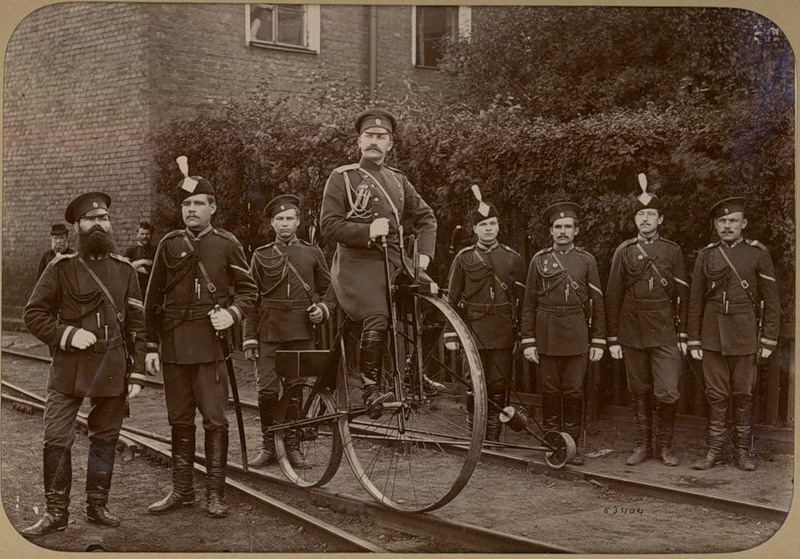
A Unit of Russian Gendarmes - 1890
They gathered in the assembly room, an old vault in the fortress with a floor of flat, uncemented stone. The Colonel sat at one end of a huge, long table. Korzybski stood at the other end with his sword under his arm. Along each side of the table sat the gendarme captains—ten in all. Korzybski was invited to sit and give his report. He did so. Then the various secret police captains began to question him aggressively and with increasing hostility. How is your unit organized? How does it operate? What activities is it currently involved with? Et cetera, et cetera. Korzybski was not about to reveal any information about his unit to this group of likely German sympathizers and possible traitors. The atmosphere of the room got more and more intimidating and Korzybski felt more and more enraged. Finally, he stood up, unsheathed his saber, and struck it against the floor with an enormous blow. The stone cracked. For grabbing the attention of a room full of secret police, there is nothing like breaking the floor with your sword.

Korzybski addressed the shocked and silent assembly. “Gentlemen, we are at war. For whom are you working? For the German or for the Russian?” The atmosphere immediately changed. The captains, suddenly solicitous, agreed to do everything they could to cooperate with Colonel Terechoff’s intelligence unit. As they left the assembly room all smiles, Korzybski refused to shake hands with any of them. He did shake hands with the Colonel, who gave him a letter promising the gendarmes’ full cooperation. (9)


Notes 
You may download a pdf of all of the book's reference notes (including a note on primary source material and abbreviations used) from the link labeled Notes on the Contents page. The pdf of the Bibliography, linked on the Contents page contains full information on referenced books and articles. 
5. Korzybski 1947, pp. 88–89.

6. Ibid., p. 86.

7. Ibid., p. 104.

8. Ibid., p. 98.

9. Ibid., 91–96.